Hardwood Flooring Grades Chart: Cost & Waste Calculator Guide
Use our hardwood flooring grades chart to estimate costs, calculate waste factors by grade, and budget accurately for Clear, Select, and Common oak.
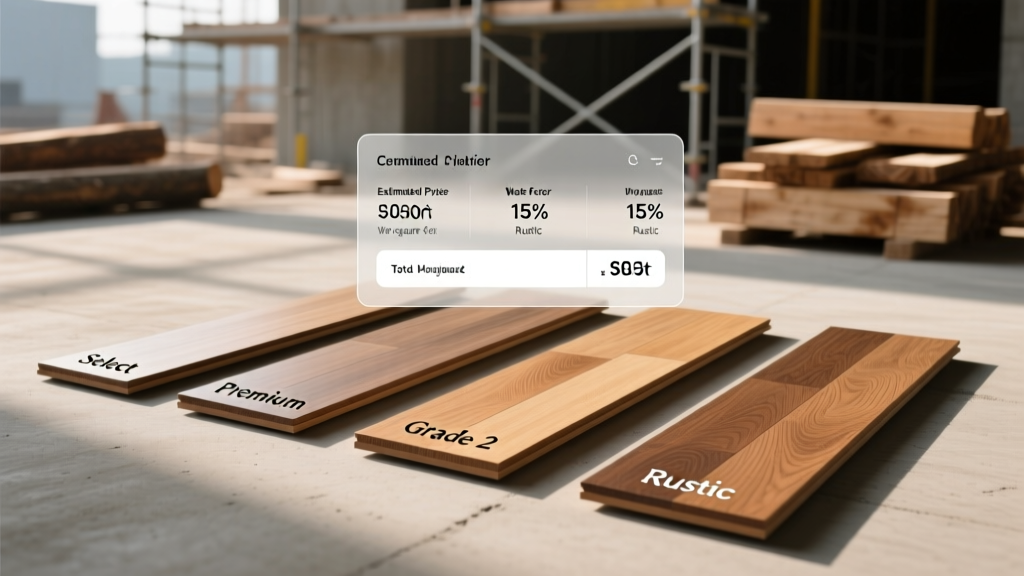
The 2026 NOFMA Hardwood Flooring Grades Chart & Pricing Matrix
Hardwood flooring grades dictate far more than visual aesthetics; they fundamentally alter your material yield, installation labor hours, and finishing costs. The National Oak Flooring Manufacturers Association (NOFMA) grading rules, now integrated into the NWFA grading standards, classify unfinished solid hardwood into four primary tiers. Understanding this hardwood flooring grades chart is the mandatory first step in building an accurate project estimator.
| NOFMA Grade | Visual Profile & Allowable Defects | Min. Clear Cutting | 2026 White Oak Cost (Unfinished) | Required Waste Overage |
|---|---|---|---|---|
| Clear | Uniform color, no sapwood, virtually no knots or character marks. Highly formal. | 16 inches | $12.50 – $18.00 / sq ft | 5% – 7% |
| Select | Mostly heartwood, minimal sapwood, small tight pin knots allowed. Clean, traditional look. | 12 inches | $8.50 – $12.00 / sq ft | 7% – 10% |
| #1 Common | Prominent color variations, both heartwood and sapwood, tight knots, and mineral streaks. | 6 inches | $5.50 – $8.00 / sq ft | 10% – 15% |
| #2 Common | Rustic character, large sound knots, heavy sapwood, open checks, and significant color contrast. | 3 inches | $3.50 – $5.50 / sq ft | 15% – 20%+ |
The "True Cost" Formula: Why Cheaper Grades Often Cost More
A common estimation error is multiplying the room's square footage by the base material price of #2 Common hardwood, assuming it is the most budget-friendly option. In reality, lower grades introduce compounding hidden costs through cull waste, racking labor, and extended finishing times. To estimate accurately, use the True Cost Formula:
Step-by-Step Waste & Yield Calculation
When calculating material quantities, you must account for both standard cutting waste (ends of rows) and grade-specific cull waste (discarding boards with unacceptable defects). Follow this sequence for your quantity calculator:
- Calculate Net Area: Measure the room's exact square footage (e.g., 1,000 sq ft).
- Apply the Grade Multiplier: Multiply the net area by the waste factor from the chart above. For #1 Common (15% max waste), multiply 1,000 × 1.15 = 1,150 sq ft.
- Factor in Mill Bundles: Hardwood is sold in random-length bundles. If your calculation yields 1,150 sq ft, and the mill bundles average 3.5 sq ft per bundle, divide 1,150 by 3.5 and round up to the nearest whole bundle (329 bundles).
- Add the "Installer Buffer": Always purchase an additional 2% to 3% beyond your calculated waste factor to account for future repairs, as lower grades cannot be easily matched years later.
1,000 Sq. Ft. Project Cost Matrix: Clear vs. #2 Common
To illustrate how the hardwood flooring grades chart impacts final budgets, below is a comparative cost matrix for a 1,000 square foot nail-down installation using unfinished White Oak, based on 2026 national averages compiled by Fixr's hardwood installation cost data and regional lumber indices.
| Cost Category | Clear Grade | Select Grade | #1 Common Grade | #2 Common Grade |
|---|---|---|---|---|
| Material Purchased | 1,070 sq ft | 1,100 sq ft | 1,150 sq ft | 1,200 sq ft |
| Total Material Cost | $15,515 (avg $14.50) | $11,000 (avg $10.00) | $7,762 (avg $6.75) | $5,400 (avg $4.50) |
| Installation Labor | $4,500 ($4.50/sq ft) | $4,800 ($4.80/sq ft) | $5,500 ($5.50/sq ft) | $6,500 ($6.50/sq ft) |
| Sanding & Finishing | $3,500 ($3.50/sq ft) | $3,800 ($3.80/sq ft) | $4,500 ($4.50/sq ft) | $5,500 ($5.50/sq ft) |
| ESTIMATED TOTAL | $23,515 | $19,600 | $17,762 | $17,400 |
Analysis: While #2 Common saves roughly $10,000 on raw materials compared to Clear, the final project cost is only $6,000 less. The savings are heavily offset by the 20% waste factor, the extra 200 sq ft of material that must be hauled and discarded, and the premium labor rates charged for racking and filling rustic boards.
Hidden Labor & Finishing Variables by Grade
When inputting data into your hardwood cost estimator, you must adjust the labor and finishing variables based on the specific grade selected. The National Wood Flooring Association (NWFA) Technical Guidelines highlight several grade-specific installation nuances that impact the bottom line.
Racking and Layout Premiums
Clear and Select grades feature long, uniform boards that installers can pull blindly from the stack. #1 and #2 Common grades require "racking"—the process of laying out boards in advance to distribute short pieces, color variations, and knots evenly across the floor. Expect to pay an additional $0.50 to $1.00 per square foot in labor for racking lower grades.
Wood Filler and Sanding Adjustments
#2 Common hardwood contains open checks, knot holes, and nail holes that must be filled before finishing.
- Filler Material: Standard latex wood filler shrinks and cracks in large rustic knots. You must budget for two-part tinted epoxy fillers (like Timbermate or Bona Kemi), which cost $80 to $120 per gallon compared to $30 for standard latex.
- Sanding Grit Progression: Because lower grades have mixed grain densities (sapwood is softer than heartwood), aggressive sanding can cause dishing. Installers must start with a finer grit (e.g., 40 or 50 grit instead of 36 grit) and perform an extra intermediate sanding pass to ensure a flat surface. This adds $0.50 to $0.75 per square foot to the finishing cost.
Expert Decision Framework: Which Grade Should You Buy?
Use this decision matrix to select the optimal grade for your specific project parameters, balancing budget constraints with aesthetic goals.
Scenario A: The High-End Custom Build
Recommended Grade: Clear or Select
Why: If the architectural design calls for a minimalist, formal, or highly uniform space, the visual noise of #1 or #2 Common will clash. The higher material cost is justified by the elimination of racking labor and the predictability of the finishing process. Use Select if you want a slight, natural warmth without prominent knots.
Scenario B: The Modern Farmhouse or Rustic Cabin
Recommended Grade: #1 Common
Why: #1 Common provides the ideal "sweet spot" for character floors. It offers beautiful color variation and tight, sound knots without the structural liabilities of open checks found in #2 Common. It accepts penetrating oils and hardwax finishes exceptionally well, which highlight the mineral streaks and grain contrast.
Scenario C: The Strict Budget or DIY Installation
Recommended Grade: #2 Common (With Caveats)
Why: If raw material cost is the absolute primary constraint and you are installing the floor yourself (eliminating the racking labor premium), #2 Common is viable. Warning: Do not choose #2 Common if you plan to use a pre-finished UV-cured factory finish, as the mill will reject boards with excessive defects, drastically increasing your waste factor to 25% or more. Buy unfinished and finish on-site.
Acclimation and Moisture Content Edge Cases
A frequently overlooked variable in hardwood estimation is acclimation time. Lower grades (#1 and #2 Common) contain a higher ratio of sapwood to heartwood, and often include boards cut from different parts of the log. Sapwood absorbs and releases moisture at a different rate than heartwood. According to NWFA standards, while standard 3/4" solid oak requires 7 to 14 days of acclimation in the installation environment, mixed-grade rustic bundles may require up to 21 days to reach equilibrium moisture content (EMC). Failing to factor this extended timeline into your project schedule can result in delayed finishing phases and increased HVAC running costs to maintain the required 35-55% relative humidity in the space.