Best Fake Wood Deck Material: 2026 Selection Framework
Discover the best fake wood deck material for your 2026 project. Compare capped composite, PVC, and mineral options with real pricing and climate guides.
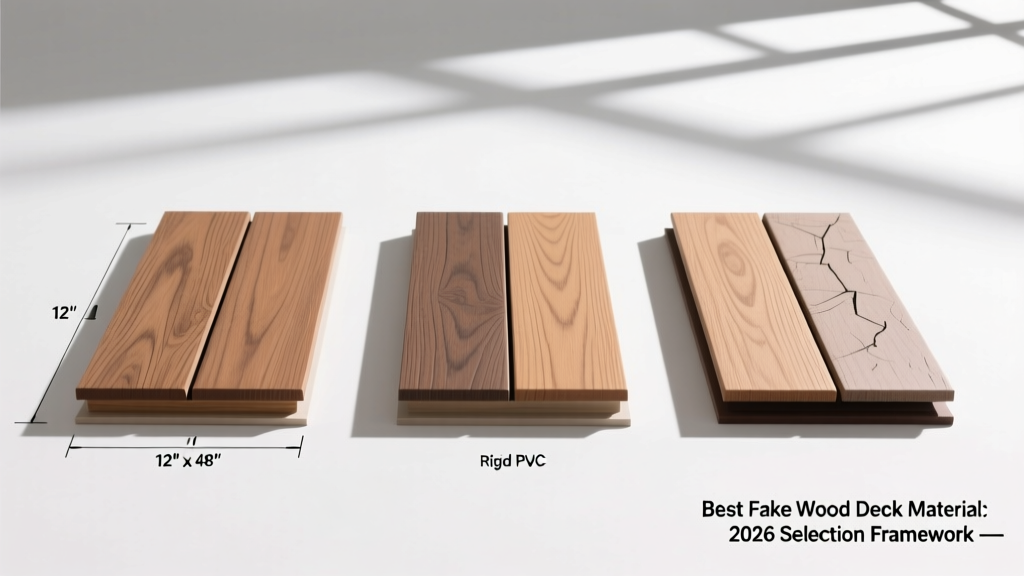
Decoding "Fake Wood": The 2026 Material Landscape
The term "fake wood deck material" encompasses a rapidly evolving category of synthetic and semi-synthetic building products designed to replicate the aesthetic of natural timber while eliminating its inherent vulnerabilities to rot, insects, and moisture. As of 2026, the market has definitively moved past first-generation uncapped composites, which were notorious for staining and structural degradation. Today's selection framework requires a nuanced understanding of polymer chemistry, core density, and thermal dynamics. Choosing the right synthetic decking is no longer just about color; it is about matching the material's physical properties to your specific microclimate, substructure, and maintenance tolerance.
The Big Three: Material Science & Performance Profiles
To make an informed selection, you must understand the structural differences between the three dominant categories of synthetic decking available on the market.
1. Capped Wood-Plastic Composite (WPC)
Capped WPC consists of a core made from wood flour (sawdust) blended with high-density polyethylene (HDPE) or polypropylene, entirely encased in a protective polymer shell. The shell prevents moisture from reaching the organic wood fibers inside. According to Trex sustainability initiatives, modern WPC cores heavily utilize recycled plastics and reclaimed wood fibers, making them an environmentally dense choice.
- Top 2026 Product Lines: Trex Transcend Lineage, MoistureShield Vision.
- Pros: Excellent rigidity, highly realistic wood-grain embossing, lower cost than PVC, heavy and solid underfoot.
- Cons: Retains more heat than PVC in direct sunlight, slight thermal expansion, core can absorb moisture if the cut ends are not properly sealed.
2. Cellular PVC (Polyvinyl Chloride)
Cellular PVC contains zero wood flour. It is a 100% synthetic, foamed plastic board. Because there are no organic materials in the core, it is entirely impervious to water absorption, mold, and mildew. Advanced manufacturing techniques now allow PVC boards to feature multi-color streaking and micro-textures that closely mimic tropical hardwoods like Ipe and Mahogany.
- Top 2026 Product Lines: TimberTech Advanced PVC (AZEK Landmark Series), Wolf Serenity.
- Pros: Zero water absorption, stays significantly cooler in direct sun, lightweight, impervious to mold.
- Cons: Highest material cost, can produce a hollow "clicking" sound when walked on with hard-soled shoes, wider expansion/contraction gaps required.
3. Mineral-Based Composite (MBC)
MBC is the newest disruptive technology in the synthetic space. It replaces a significant portion of the wood flour and plastic with advanced minerals. This creates a board with unparalleled dimensional stability, meaning it barely expands or contracts with temperature fluctuations.
- Top 2026 Product Lines: Deckorators MBC (Vault and Vista lines).
- Pros: Lowest thermal expansion rate in the industry, excellent traction, highly resistant to scratching.
- Cons: Limited color palettes compared to WPC and PVC, slightly heavier than cellular PVC.
When cutting capped WPC boards, the exposed core is vulnerable to moisture intrusion. In 2026, manufacturer warranties strictly require the application of a specialized end-sealant (like MoistureShield's End Seal) to any cut edge that will be exposed to the elements. Failure to seal cut ends will void the stain and fade warranty.
Climate & Usage Decision Matrix
Use this framework to align your environmental conditions with the optimal fake wood deck material.
| Environmental Profile | Recommended Material | Why This Works |
|---|---|---|
| High Humidity / Coastal / Heavy Shade | Cellular PVC | Zero organic content prevents mold and mildew growth in perpetually damp, shaded environments. |
| Extreme Temperature Swings (Desert/Mountain) | Mineral-Based Composite | Near-zero thermal expansion prevents fastener shear and board buckling during 50°F+ daily swings. |
| Moderate Climate / High Foot Traffic | Capped WPC | Dense core provides a solid, wood-like feel underfoot while resisting standard wear and tear. |
| Direct Southern Exposure / Pool Surround | Light-Colored PVC | Cellular foam core dissipates heat better than dense WPC; light colors reflect UV radiation. |
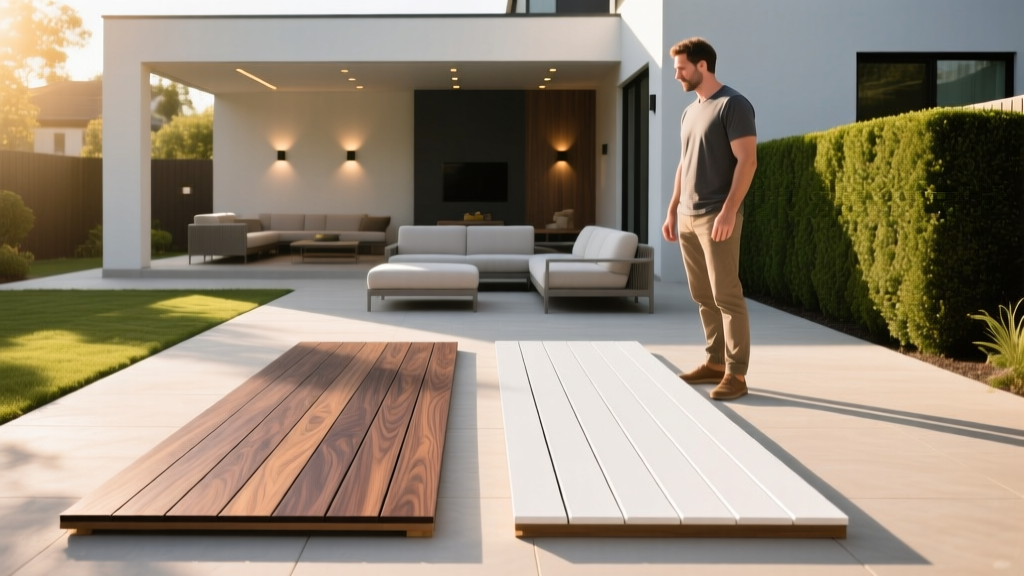
2026 Cost Realities: Material vs. Total System
A common mistake is budgeting only for the deck boards. Synthetic decking requires a specialized substructure and fastening system. Below is the realistic material-only cost breakdown per square foot for 2026.
| Cost Category | Capped WPC | Cellular PVC | Mineral-Based (MBC) |
|---|---|---|---|
| Deck Boards (per sq. ft.) | $8.50 - $12.00 | $11.50 - $17.00 | $10.00 - $14.50 |
| Hidden Fastener System | $1.20 / sq. ft. | $1.50 / sq. ft. | $1.30 / sq. ft. |
| Butyl Joist Tape (Crucial) | $0.85 / lin. ft. | $0.85 / lin. ft. | $0.85 / lin. ft. |
| Total Material Cost | $10.55 - $14.05 | $13.85 - $19.35 | $12.15 - $16.65 |
Note: Labor costs for installing synthetic decking typically range from $15 to $25 per square foot, depending on site accessibility and substructure complexity.
Critical Installation Gotchas & Failure Modes
Even the most expensive fake wood deck material will fail prematurely if installed using outdated natural-wood methodologies. Research and field data from the USDA Forest Products Laboratory consistently highlight that substructure degradation, not the decking itself, is the primary failure point in modern deck construction.
1. The Joist Rot Epidemic and the Butyl Solution
Synthetic boards do not rot, but the pressure-treated pine joists underneath them do. Because composite and PVC boards trap moisture against the top of the joist, the wood substructure rots at an accelerated rate. Actionable fix: You must apply a continuous strip of butyl-based flashing tape (such as Trex Protect or DeckWise WiseTape) to the top of every joist before laying the boards. Avoid cheap bitumen-based (asphalt) tapes; they dry out, crack, and lose adhesion within three to five years. Butyl tape remains pliable and watertight for decades.
2. Thermal Expansion and Fastener Shear
Cellular PVC expands and contracts at a rate of approximately 1/16 inch per 10 feet for every 10°F change in temperature. If you install PVC boards tightly together on a cold morning in November, they will buckle and pop fasteners when the temperature hits 90°F in July. Actionable fix: Always follow the manufacturer's specific gapping chart based on the exact ambient temperature at the moment of installation. Use hidden clip fasteners (like TimberTech CONCEALoc) that are engineered to slide slightly within the board groove, accommodating lateral movement without shearing the fastener shaft.
3. Static Discharge in Arid Climates
Homeowners in dry, low-humidity regions (such as the American Southwest) frequently report painful static shocks when walking on synthetic decking, particularly PVC, and touching metal railings. This occurs because the synthetic surface acts as an insulator, building up an electrostatic charge from shoe friction. Actionable fix: If building in an arid climate, prioritize Mineral-Based Composite (MBC) or WPC over PVC, as the organic/mineral content slightly alters the surface resistivity. Alternatively, integrate anti-static grounding wires into the metal railing posts, tying them to a dedicated grounding rod.
Always design your deck with a "picture frame" border. This involves running a perimeter board around the outside edge of the deck to hide the exposed end-cuts of the field boards. Not only does this create a premium, finished aesthetic, but it also eliminates the need to apply end-sealant to the highly visible cut edges of your WPC boards, keeping the installation cleaner and more visually cohesive.
Final Selection Directives
Selecting the best fake wood deck material requires abandoning the idea that one product fits all scenarios. If your primary concern is absolute moisture immunity and you are building near an ocean or in deep shade, invest the premium in Cellular PVC. If you are dealing with extreme desert temperature swings and need dimensional stability to prevent board buckling, Mineral-Based Composite is your only logical choice. For the vast majority of residential applications in temperate climates where a balance of cost, rigidity, and natural aesthetics is desired, a high-quality Capped WPC with a thick polymer shell remains the undisputed standard. Whichever material you choose, pair it with a butyl-taped substructure and hidden fastening system to ensure the deck outlasts its 25-year warranty.
Written by
Elena RodriguezElena Rodriguez is a civil engineer and technical writer specializing in concrete technology, masonry systems, and ASTM/ACI compliance. She earned her B.S. in Civil Engineering from Texas A&M University and spent a decade at a materials testing laboratory, performing over 2,000 concrete compressive strength tests and masonry prism evaluations. Elena is an ACI-certified Field Testing Technician (Grade I) and a member of ASTM Committee C12 on Natural Building Stone. She currently consults on forensic engineering cases involving concrete failures and moisture intrusion. Based in San Antonio, TX, Elena is a proud member of the Society of Women Engineers (SWE) and coaches her daughter's FIRST Robotics team.
More from Elena Rodriguez
View all
Walls & Panels
Cost Analysis: Light Gauge Steel Framing Advantages and Disadvantages
Evaluate light gauge steel framing advantages and disadvantages through a strict cost analysis lens, comparing material, labor, and lifecycle expenses.
Aug 4, 2026

Walls & Panels
Gypsum Board Types: Exact Specifications, Thickness & Dimensions
Compare standard, Type X, and moisture-resistant gypsum board types. Get exact specifications, thicknesses, dimensions, and ASTM standards for your project.
Aug 4, 2026

Fire Resistance
Best Fire-Resistant Outdoor Decking Materials: 2026 Buyer Guide
Discover the best fire-resistant outdoor decking materials for 2026. Compare Class A PVC, aluminum, and hardwood options for WUI compliance and safety.
Aug 4, 2026