Types of Wood Splitters: 2026 Cost & Value Analysis
Compare the true cost and value of different types of wood splitters. Our 2026 analysis breaks down TCO, cycle times, and ROI for every model.

The Economics of Firewood Processing: Beyond the Sticker Price
Procuring firewood is a capital-intensive endeavor. In 2026, purchasing a pre-split cord of seasoned hardwood averages between $350 and $550 depending on regional supply chains. For households burning three to five cords annually, outsourcing the splitting process results in a recurring annual expense of up to $2,750. Investing in a mechanical wood splitter shifts this cost structure from an operational expense to a capital amortization model. However, the upfront purchase price of a splitter is only a fraction of its true financial impact. To determine the actual return on investment, one must evaluate the Total Cost of Ownership (TCO), which encompasses fuel consumption, hydraulic maintenance, cycle-time efficiency, and mechanical longevity.
According to the EPA's BurnWise program, properly split and seasoned wood burns significantly more efficiently, reducing particulate emissions and maximizing BTU output. This makes the mechanical splitting process not just a matter of physical labor savings, but a critical component of thermal efficiency. Below, we break down the five primary types of wood splitters, analyzing their cost structures, operational value, and ideal use cases.
Comparative Matrix: The 5 Main Types of Wood Splitters
| Splitter Type | Avg. Upfront Cost (2026) | Cycle Time | Power Source | Best Application |
|---|---|---|---|---|
| Manual / Lever | $50 - $150 | 8 - 12 seconds | Human Kinetic | Kindling, softwoods, < 0.5 cords/yr |
| Electric Hydraulic | $350 - $700 | 12 - 18 seconds | 120V / 240V AC | Indoor/garage use, 1-2 cords/yr |
| Gas Hydraulic | $900 - $1,800 | 10 - 15 seconds | Gasoline (OHV Engine) | Heavy hardwoods, 3-6 cords/yr |
| Kinetic (Flywheel) | $1,100 - $1,600 | 2 - 3 seconds | Gasoline | High volume, stringy/elm wood |
| PTO (Tractor) | $1,200 - $2,200 | 6 - 12 seconds | Tractor PTO Shaft | Farm/ranch use, 10+ cords/yr |
Deep Dive: Cost & Value by Splitter Category
1. Electric Hydraulic Splitters (120V & 240V)
Electric splitters, such as the popular Boss Industrial 7-Ton or the WEN 56200 10-Ton models, dominate the entry-level market. Their primary value proposition is zero-emission operation, allowing them to be used inside a garage or basement during winter months. A standard 120V, 7-ton model draws roughly 15 amps (1.8 kW). At the 2026 national average electricity rate of $0.17 per kWh, splitting a full cord of wood (which takes approximately 3 hours of continuous run time) costs just $0.92 in electricity.
The Catch: Most 120V units are limited to 7 to 10 tons of splitting force. While sufficient for straight-grained pine, cedar, or seasoned oak, they will stall on knotty elm or frozen hickory. Upgrading to a 240V, 15-ton unit requires installing a dedicated NEMA 6-20R outlet, adding $150 to $300 in electrical contractor fees to the TCO.
2. Gas-Powered Hydraulic Splitters
Gas hydraulic splitters remain the industry standard for residential and semi-commercial processing. A 25-ton to 30-ton model, like the Champion Power Equipment 100249 (powered by a 224cc clone engine) or premium units featuring genuine Honda GC160 engines, provides the force necessary to fracture dense, green hardwoods.
Operational costs are higher than electric. A 25-ton splitter typically consumes about 0.4 gallons of gasoline per hour. Assuming $3.60 per gallon, fuel costs roughly $1.44 per hour of splitting. Maintenance adds to the TCO: annual oil changes, spark plug replacements, air filter cleanings, and the replacement of AW32 hydraulic fluid (which requires roughly 3 to 5 gallons per unit, costing about $25 to $45 per change).
Never use standard motor oil in a log splitter. Hydraulic systems require AW32 (anti-wear, ISO grade 32) fluid. Using the wrong fluid in sub-freezing temperatures will cause pump cavitation, leading to catastrophic pump failure that often exceeds the cost of a new entry-level splitter.
3. Kinetic (Flywheel) Splitters
Kinetic splitters represent a massive leap in cycle-time efficiency. Instead of using a hydraulic pump and cylinder, they use a gas engine to spin heavy steel flywheels. When the operator engages the rack and pinion, the stored kinetic energy is instantly transferred to the ram. Cycle times drop from 15 seconds to under 3 seconds. Models like the Power King Fast Split 12-Ton or the Champion 11-Ton Kinetic are ideal for processing massive volumes of wood quickly.
Value Analysis: While the upfront cost is 20% to 30% higher than a comparable gas-hydraulic unit, the labor savings are immense. For a commercial firewood vendor processing 50+ cords a year, the time saved translates directly to increased revenue. However, kinetic splitters lack the "holding power" of hydraulics; if a log binds on the wedge, you cannot simply hold the valve open to push through it. You must manually pry the log loose.
4. PTO (Power Take-Off) Splitters
If you already own a utility tractor with a PTO shaft, a PTO splitter (e.g., Dirty Hand Tools 35-Ton PTO) eliminates the need for a dedicated engine, hydraulic pump, and associated maintenance. The tractor's hydraulic system powers the cylinder. The upfront cost of the splitter attachment is lower, but this is a false economy if you do not already own the tractor. Factoring in a $15,000+ tractor purchase makes this the most expensive option for residential users, but the most cost-effective for existing agricultural operations.
Wood Species and Required Tonnage Framework
Purchasing a splitter with inadequate tonnage for your local wood species is the most common financial mistake buyers make. Under-powered machines result in stalled rams, blown hydraulic seals, and burned-out electric motors. Penn State Extension notes that wood density and grain structure drastically alter the force required for mechanical fracture.
| Wood Species | Grain Structure | Minimum Required Tonnage | Recommended Splitter Type |
|---|---|---|---|
| White Pine / Cedar | Straight, soft | 4 - 7 Tons | Electric (120V) or Manual |
| Red Oak / Maple | Straight to interlocked, hard | 15 - 20 Tons | Gas Hydraulic (25-Ton) |
| Hickory / Locust | Extremely dense, tough | 25 - 30 Tons | Gas Hydraulic (30-Ton+) |
| Elm / Sycamore | Stringy, interlocking | 20+ Tons (High Speed) | Kinetic Flywheel (to tear fibers) |
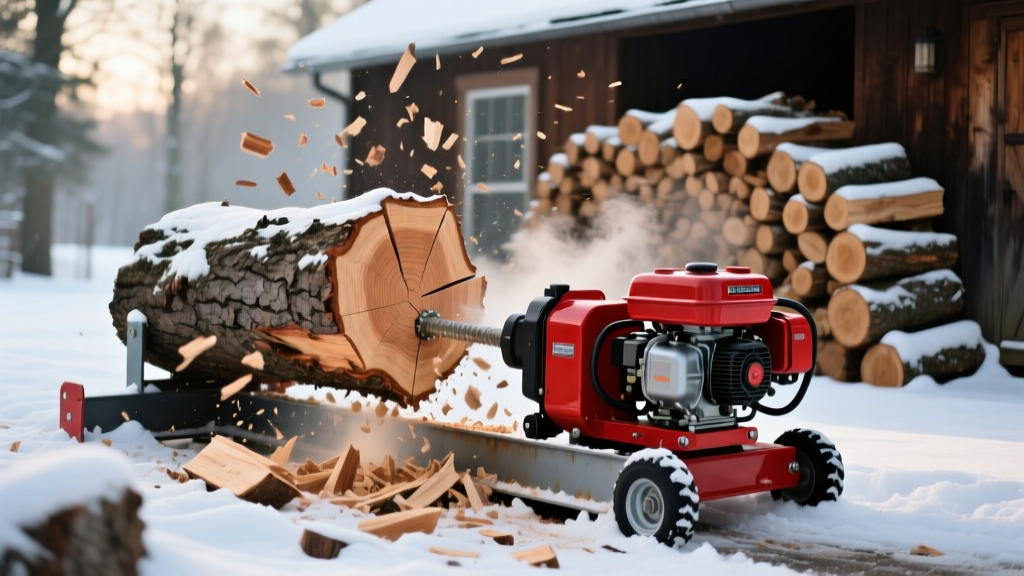
5-Year Total Cost of Ownership (TCO) Projection
The following model projects the 5-year cost of processing 4 cords of mixed hardwood annually. It assumes the equipment is stored in a dry environment and receives baseline annual maintenance.
- 7-Ton Electric (120V): $450 (Unit) + $15 (Electricity) + $0 (Fluid/Maintenance) = $465 Total
- 25-Ton Gas Hydraulic: $1,100 (Unit) + $120 (Gas) + $150 (AW32 fluid, filters, plugs) = $1,370 Total
- 12-Ton Kinetic Gas: $1,300 (Unit) + $90 (Gas) + $80 (Belt/grease maintenance) = $1,470 Total
While the electric splitter boasts the lowest TCO, its inability to process unseasoned hickory or stringy elm severely limits its utility for serious wood burners. The gas hydraulic unit offers the highest value-to-capability ratio for the average homesteader.
Hidden Costs and Edge Cases to Avoid
When budgeting for a wood splitter, buyers frequently overlook the peripheral costs required to make the machine operational and safe.
A 25-ton gas splitter weighs between 450 and 600 lbs. You cannot transport this in the trunk of a sedan. You must factor in the cost of a heavy-duty utility trailer ($400+), a loading ramp, heavy-duty ratchet straps, and potentially a hitch receiver installation for your vehicle. If you lack a truck or trailer, rental fees ($60/day) will rapidly erode the ROI of owning the machine versus renting a commercial splitter from a local equipment yard.
The 4-Way Wedge Illusion
Many manufacturers offer a 4-way splitting wedge as an accessory, claiming it quadruples productivity. In practice, a 4-way wedge increases the surface area resistance by a factor of three. If your 20-ton splitter struggles with a 24-inch diameter oak round using the standard wedge, attaching the 4-way wedge will stall the machine entirely. Only use 4-way wedges on 30-ton+ machines or when processing small-diameter (under 10 inches), straight-grained softwoods.
Decision Framework: Selecting Your Machine
Use this diagnostic flow to finalize your purchase decision:
- Volume Check: Do you split less than 1 cord a year? Buy a manual kindling splitter (e.g., Kindling Cracker King) and a high-quality Fiskars maul. Total cost: $180.
- Environment Check: Do you split primarily indoors or in an attached garage during winter? Buy a 7-ton 120V electric splitter. Ensure you have a dedicated 15-amp or 20-amp circuit to prevent breaker trips.
- Species Check: Are you splitting green elm, sycamore, or massive oak rounds over 20 inches in diameter? Bypass standard hydraulics and invest in a kinetic flywheel splitter, or a minimum 30-ton gas hydraulic unit with a stroke time under 12 seconds.
- Infrastructure Check: Do you own a sub-compact tractor with a Category 1 hitch and live PTO? Purchase a PTO splitter attachment to leverage your existing capital equipment.
For further reading on optimizing your firewood processing for maximum thermal efficiency and safety, consult the resources provided by the Wood Heat Organization. Properly sizing your splitter to your specific wood species and annual volume ensures that your capital investment yields dividends in both labor savings and winter heating security.
Written by
Marcus ChenMarcus Chen is a licensed structural engineer (PE) and building materials analyst with over 12 years of experience across residential, commercial, and industrial construction. He holds a Master of Science in Civil Engineering from UC Berkeley and spent six years at Thornton Tomasetti before transitioning to independent consulting and technical writing. Marcus specializes in material selection for seismic-prone regions, concrete reinforcement strategies, and lifecycle cost analysis. His work has been cited by the American Concrete Institute (ACI) and the Structural Engineers Association of California (SEAOC). When he is not on a job site or at his desk, you will find him hiking the Sierra Nevada or restoring a 1920s craftsman bungalow in Oakland, CA.
More from Marcus Chen
View all
Construction Cost
How Much Did the Eiffel Tower Cost to Build?
How much did the Eiffel Tower cost to build in 1889? We adjust for inflation and compare its budget to modern skyscraper construction.
Aug 4, 2026

Fire Resistance
What Is a Fire Resistant Material? Testing & Certification Guide
Discover what is a fire resistant material through ASTM and UL testing. Learn how fire ratings, certifications, and assemblies work in construction.
Aug 4, 2026

Construction Cost
How Much Did the Burj Khalifa Cost to Build?
How much did the Burj Khalifa cost to build? We break down the $1.5B project and extract 5 money-saving strategies for your next build.
Jul 30, 2026