Which Type of Wood Flooring Delivers the Highest ROI in 2026?
Compare the cost, lifespan, and resale value of every major type of wood flooring. Find out which species and format yield the highest ROI in 2026.

The Real Cost of Wood Flooring: Beyond the Price Tag
Selecting the right type of wood flooring is fundamentally a capital allocation decision. While aesthetic preferences drive initial selections, the long-term financial viability of a wood floor depends on material longevity, maintenance cycles, and eventual resale recovery. In 2026, the gap between premium material costs and actual appraised value has widened, making it critical to differentiate between flooring that merely looks expensive and flooring that actually appraises at a premium.
The baseline cost for hardwood flooring installation in 2026 ranges from $9 to $22 per square foot, fully installed. However, this figure obscures the hidden cost multipliers that routinely blow budgets. According to the National Wood Flooring Association (NWFA), improper subfloor preparation and moisture mismanagement account for over 75% of premature wood floor failures.
- Moisture Testing: A calcium chloride test or relative humidity (RH) probe test costs $150-$300 but prevents catastrophic cupping. Skipping this voids most manufacturer warranties.
- Subfloor Leveling: Modern wide-plank floors (7+ inches) require subfloors flat to within 1/8 inch over 10 feet. Self-leveling compound application adds $2.50 to $4.00 per square foot.
- Acclimation: Solid wood requires 5-14 days of climate-controlled acclimation. Engineered wood requires 48-72 hours. Delays in construction timelines can incur carrying costs.
Solid vs. Engineered: A Financial Breakdown
The debate between solid and engineered hardwood is no longer just about stability; it is about lifecycle costing. Engineered wood has captured over 60% of the premium market share in 2026 due to its compatibility with radiant heating systems and concrete subfloors, but not all engineered products hold their value equally.
| Metric | Solid Hardwood (3/4 inch) | Premium Engineered (5/8 inch, 4mm+ wear layer) | Budget Engineered (1/2 inch, <2mm wear layer) |
|---|---|---|---|
| Material Cost (per sq. ft.) | $6.00 - $11.00 | $8.50 - $16.00 | $4.00 - $7.00 |
| Installation Cost | $4.00 - $6.00 (Nail/Staple) | $5.00 - $8.00 (Glue-down/Float) | $3.00 - $5.00 (Click-lock Float) |
| Refinishing Cycles | 5 to 7 times | 2 to 4 times | 0 (Cannot be sanded) |
| Expected Lifespan | 80+ years | 40-60 years | 15-20 years |
| Appraisal Impact | Maximum (Classified as permanent) | High (If glue-down/thick wear layer) | Low (Often classified as floating/laminate) |
For maximum return on investment, specify engineered wood with a minimum 4mm sawn veneer wear layer over a multi-ply birch or eucalyptus core. Avoid MDF or HDF core engineered products in moisture-prone areas, as a single plumbing leak will cause the core to swell and delaminate, requiring a total tear-out.
Wood Species ROI: Which Type of Wood Flooring Pays Off?
The species of wood you select dictates both the upfront material cost and the eventual resale recovery. The National Association of Realtors (NAR) Remodeling Impact Report consistently ranks hardwood floor installation and refinishing among the top interior projects for cost recovery, often yielding a 100% to 106% return at resale. However, this aggregate data masks severe penalties for choosing the wrong species.
Tier 1: High-Volume, High-ROI (White Oak, Hard Maple, Hickory)
Domestic species with neutral undertones dominate the 2026 market. White Oak (Janka hardness rating: 1360) is the undisputed leader in ROI. Its open grain structure accepts a wide variety of stains, and its natural tan/brown undertones resist turning yellow or orange over time, unlike Red Oak. Hard Maple (Janka: 1450) offers superior dent resistance but features a closed grain that can result in blotchy staining if not properly conditioned. Hickory (Janka: 1820) provides extreme durability for high-traffic zones but features high color variation that limits broad buyer appeal.
Tier 2: The Luxury Trap (Brazilian Cherry, Teak, Mahogany)
Exotic species command premium prices ($12 to $22+ per square foot for materials) but frequently trigger a resale penalty. According to the National Association of Home Builders (NAHB), modern buyers overwhelmingly prefer light-to-medium, low-sheen floors. Exotic woods like Brazilian Cherry (Janka: 2350) darken significantly over time when exposed to UV light, resulting in deep reds and purples that clash with contemporary interior design palettes. Appraisers rarely assign a premium for exotic species over high-grade domestic White Oak, meaning the initial $8,000+ premium paid for exotics is rarely recovered at sale.
Do not conflate Janka hardness with scratch resistance. Janka measures dent resistance (the force required to embed a steel ball into the wood). A high-Janka wood like Hickory will resist heel dents, but its factory finish will scratch just as easily as a lower-Janka wood like Walnut. If scratch resistance is your primary concern, invest in a commercial-grade UV-cured aluminum oxide finish rather than a harder wood species.
Installation Methods and Their Impact on Long-Term Value
How the wood is fastened to the subfloor directly impacts acoustic performance, structural integrity, and appraisal classifications. Floating floors, while cheaper to install, introduce a hollow acoustic profile and a distinct 'click' underfoot that savvy buyers and appraisers immediately identify as a lower-tier installation.
- Nail/Staple-Down (Solid & Thick Engineered): Requires a plywood subfloor. Provides a solid, traditional feel. Cost: $4-$6/sq. ft. Best for upper-level joist construction.
- Full-Spread Glue-Down (Engineered): Bonds the floor directly to concrete or plywood using urethane adhesives. Eliminates hollow sounds and provides superior moisture blocking. Cost: $6-$9/sq. ft. (includes adhesive). Mandatory for below-grade or radiant heat installations.
- Click-Lock Floating (Budget Engineered): Planks lock together and rest on a foam underlayment. Fastest installation ($3-$5/sq. ft.), but susceptible to edge-fraying, separation at the seams during humidity drops, and acoustic degradation over time.
Finish Technologies: Site-Finished vs. Factory-Finished
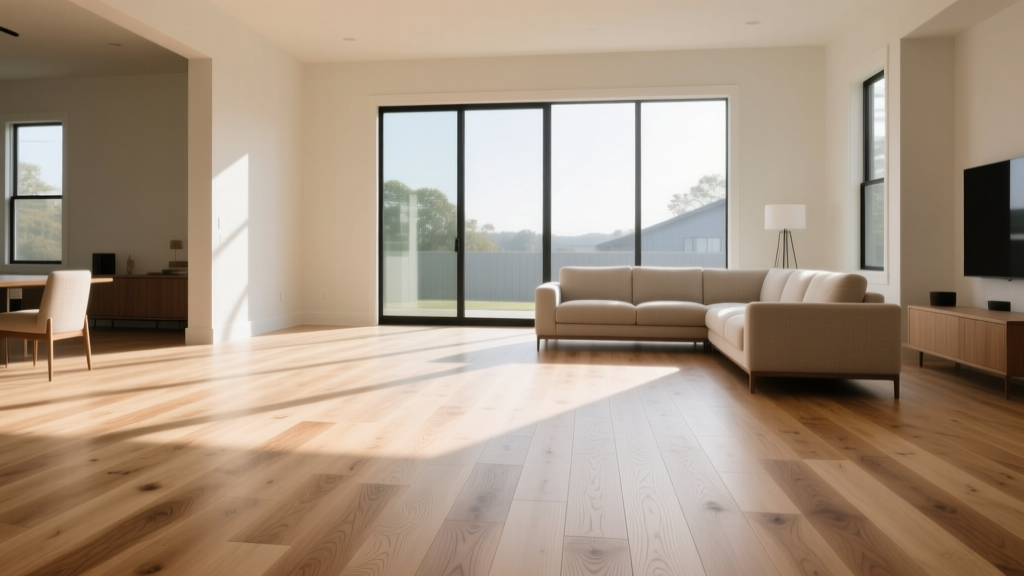
The finish layer is the actual wear surface of your floor. In 2026, factory-finished floors utilizing UV-cured aluminum oxide or ceramic bead technologies offer 15 to 25-year wear warranties that site-finished polyurethane cannot match. Site-finished floors (sanded and coated on-site) cost an additional $3.50 to $5.50 per square foot in labor and materials, and require 5-7 days of curing time before furniture can be moved in. However, site-finished floors offer a seamless look with no micro-bevels between planks, which is highly prized in luxury architectural builds. For pure financial ROI, factory-finished wide-plank White Oak with a matte or satin sheen provides the optimal balance of low maintenance, high durability, and maximum market appeal.
Final Verdict: Maximizing Your Flooring Investment
If your objective is to maximize the financial return on your flooring investment, the data points to a specific configuration: 5-inch to 7-inch wide-plank, engineered White Oak with a 4mm sawn wear layer, installed via full-spread urethane glue-down over a properly leveled and moisture-tested subfloor. This specific type of wood flooring satisfies the 2026 aesthetic demand for wide, matte-finished planks while providing the dimensional stability required for modern HVAC environments and the structural permanence required by real estate appraisers. Avoid exotic species, high-gloss finishes, and floating click-lock systems if your primary metric is long-term equity retention.
Written by
James ThorntonJames Thornton is a construction industry veteran with 25 years of hands-on experience in wood framing, lumber grading, and residential building codes. He started as a framing carpenter in rural Oregon, earned his ICC Residential Building Inspector certification, and eventually became a senior plan reviewer for the City of Portland Bureau of Development Services. James holds a B.S. in Wood Science & Technology from Oregon State University and is a certified lumber grader through the West Coast Lumber Inspection Bureau (WCLIB). He has inspected over 3,000 residential construction sites and authored the city's internal guide on advanced framing techniques (2x6 at 24" O.C.). James lives in Bend, OR, where he builds custom timber-frame cabins and competes in lumberjack sports.
More from James Thornton
View all
Insulation
Best Home Insulation Materials: Complete 2026 Guide
Compare top home insulation materials for 2026. Find R-values, installed costs per square foot, and best uses for fiberglass, spray foam, and mineral wool.
Aug 4, 2026

Sustainable Building
Certify Your Green Building Material for LEED and WELL
Step-by-step guide to certifying a green building material for LEED v5 and WELL v2. Master EPDs, HPDs, and VOC limits for 2026 project specifications.
Aug 4, 2026

Stone & Masonry
Veneer Stacked Stone Panels: Interior Design & Style Showcase
Discover how veneer stacked stone panels transform interiors. Explore modern design profiles, material pairings, and technical installation specs.
Aug 4, 2026