Hardwood Flooring Installation: Performance Specs & Subfloor Tolerances
Master hardwood flooring installation with precise performance specs, Janka ratings, moisture tolerances, and NOFMA subfloor flatness requirements.
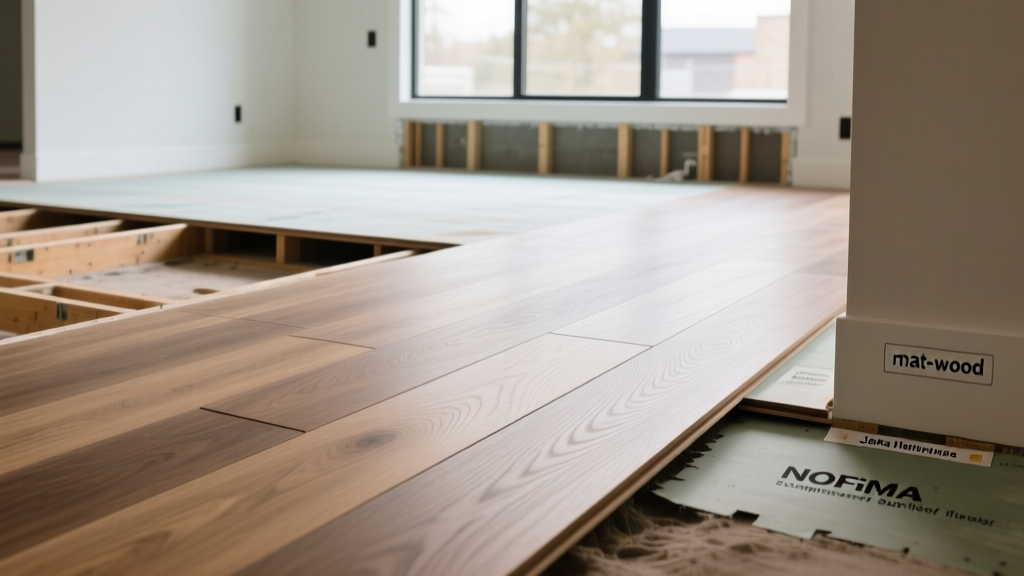
The Engineering of Hardwood Flooring Installation
Successful hardwood flooring installation is an exercise in applied building science, not merely a cosmetic finish. Wood is a hygroscopic, anisotropic material that continuously exchanges moisture with its environment. When installers ignore precise performance specifications regarding moisture differentials, subfloor flatness, and fastener holding power, the result is predictable: cupping, gapping, structural squeaks, and catastrophic finish failure. This guide details the exact technical tolerances required for a high-performance solid and engineered hardwood installation.
Do not acclimate hardwood based on a calendar timeline (e.g., 'leave it in the room for 72 hours'). Acclimation is strictly a moisture equilibrium process. The installation must only proceed when the moisture content (MC) of the wood and the subfloor meet the exact differential specifications outlined below, regardless of how many days the material has been on-site.
Moisture Content (MC) Differentials & Subfloor Tolerances
Moisture imbalance is the primary cause of hardwood flooring failure. The National Wood Flooring Association (NWFA) mandates strict MC differentials between the flooring material and the subfloor prior to installation.
Solid Hardwood MC Differentials
| Board Width Category | Maximum MC Differential (Wood vs. Subfloor) | Subfloor Maximum MC Limit |
|---|---|---|
| Strip Flooring (Under 3 inches) | 4.0% | 12.0% |
| Wide-Plank Flooring (3 inches and wider) | 2.0% | 12.0% |
Concrete Subfloor Specifications (ASTM F2170)
When installing engineered hardwood over concrete using adhesives or moisture barriers, pin-type moisture meters are invalid. You must perform in-situ relative humidity (RH) testing using reusable probes embedded at 40% of the slab depth, per ASTM F2170 standards. Most premium urethane adhesives require the concrete RH to be below 75% to 85%, and the pH level must fall between 7 and 9. Always cross-reference the adhesive manufacturer's specific technical data sheet (TDS).
Subfloor Flatness & Structural Deflection Limits
Vertical deflection and uneven subfloors cause fastener withdrawal and board-to-board friction, resulting in squeaks and broken tongues. The National Oak Flooring Manufacturers Association (NOFMA) and NWFA enforce rigid flatness tolerances for all nail-down and glue-down installations.
- Standard Tolerance: The subfloor must be flat to within 3/16 of an inch over a 10-foot radius.
- Secondary Tolerance: The subfloor must be flat to within 1/8 of an inch over a 6-foot radius.
- Structural Deflection: Joist systems must meet L/360 deflection limits under live loads to prevent the floor system from flexing and snapping fasteners.
Remediation Protocol: For wood subfloors, sand down high spots and build up low spots using layered asphalt shingles or 15-lb roofing felt (never use drywall shims, which compress over time). For concrete subfloors, use Portland cement-based self-leveling underlayments (SLU). Avoid gypsum-based levelers under nail-down solid hardwood, as they retain moisture and accelerate fastener corrosion.
Species Performance Matrix: Janka Hardness & Dimensional Stability
Not all hardwoods react to environmental shifts equally. The USDA Forest Products Laboratory (FPL) tracks the tangential and radial shrinkage of wood species. A lower Tangential-to-Radial (T/R) ratio indicates greater dimensional stability, meaning the wood is less prone to cupping and warping during humidity fluctuations.
| Wood Species | Janka Hardness (lbf) | T/R Ratio (Stability) | Installation Note |
|---|---|---|---|
| Brazilian Walnut (Ipe) | 3,680 | 1.4 (Excellent) | Requires pre-drilling; glue-down preferred. |
| Hickory | 1,820 | 1.5 (Good) | Use 16-ga cleats to prevent tongue splitting. |
| Hard Maple | 1,450 | 1.5 (Good) | High density; ensure sharp fastener blades. |
| White Oak | 1,360 | 1.9 (Moderate) | Quartersawn cuts recommended for wide planks. |
| Red Oak | 1,290 | 1.8 (Moderate) | Industry baseline; highly forgiving to install. |
| Black Walnut | 1,010 | 1.3 (Excellent) | Softer wood; use wider staple crowns. |
Fastener Specifications & Pneumatic Holding Power
The mechanical connection between the hardwood and the subfloor dictates the floor's acoustic performance and longevity. Choosing the wrong fastener gauge or type for a specific Janka hardness rating is a common failure point.
Cleats vs. Staples: A Technical Breakdown
While 15.5-gauge staples offer higher initial sheer strength and are faster to drive, they act as wedges. When driven into ultra-dense species like Hickory or Hard Maple, staples frequently cause micro-fractures in the tongue. Over time, seasonal expansion and contraction widen these fractures, leading to a loss of holding power and resulting in squeaks.
Expert Specification: For any wood species with a Janka hardness rating above 1,300 lbf, use 16-gauge or 18-gauge L-cleats. Cleats slice cleanly through dense wood fibers rather than wedging them apart, preserving the structural integrity of the tongue-and-groove milling.
Pneumatic Pressure and Placement Protocols
- PSI Settings: Calibrate pneumatic flooring nailers to operate between 70 and 90 PSI. Pressures exceeding 100 PSI will over-drive the fastener, crushing the wood fibers of the tongue and compromising the interlocking joint.
- Fastener Spacing: Drive fasteners every 8 to 10 inches along the length of the board. For wide-plank flooring (5 inches or wider), reduce spacing to every 6 to 8 inches.
- End-Distance Rule: Never place a fastener closer than 1 to 3 inches from the end of a board. End-grain lacks lateral shear strength, and fasteners placed too close to the ends will inevitably split the wood.
Environmental Controls Post-Installation
The installation is not complete until the environment is stabilized. Hardwood flooring warranties are universally voided if the interior climate is not controlled. The HVAC system must be fully operational before, during, and after installation. Maintain the interior temperature between 60°F and 80°F, and keep the relative humidity (RH) strictly between 30% and 50% (or 35% to 55% in humid climates, per the specific manufacturer's warranty). Installing permanent hygrometers in the living space is highly recommended to monitor these metrics continuously and prevent seasonal gapping or cupping.