Types of Wood Hand Saws for Structural Timber Framing
Discover the best types of wood hand saws for structural framing. Compare TPI, blade gauges, and kerf widths for heavy timber and rough carpentry cuts.

The Role of Hand Saws in Modern Structural Framing
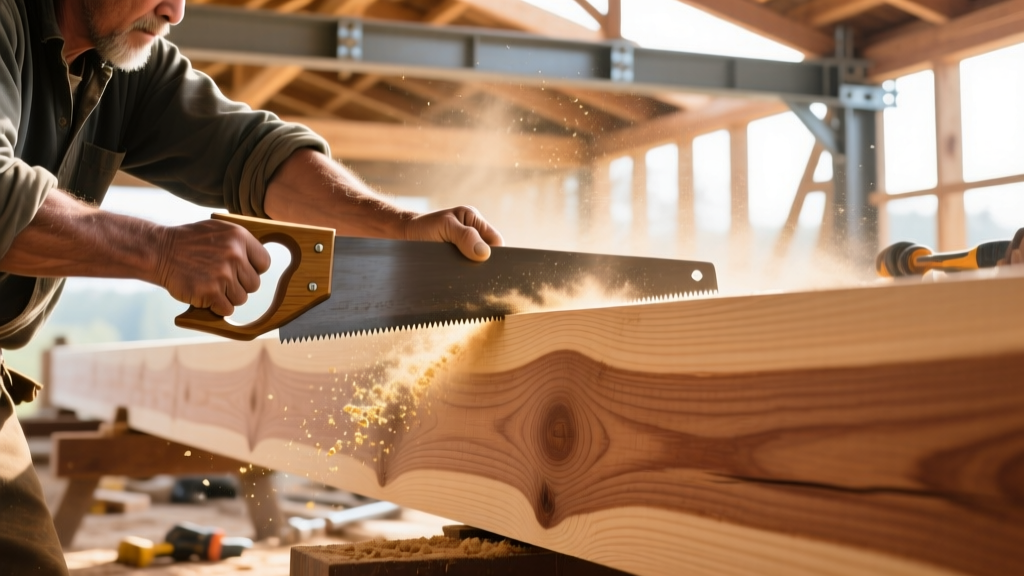
On a structural framing site, hand saws are not mere backups for dead circular saw batteries. They are precision instruments essential for cutting engineered lumber, trimming complex timber frame joinery, and executing silent cuts in occupied retrofit spaces. When working with dense structural timber like Douglas Fir, Southern Yellow Pine, or abrasive engineered products like LVL (Laminated Veneer Lumber) and Glulam, selecting the correct tool dictates both the speed of the cut and the structural integrity of the joint. The Timber Framers Guild emphasizes that hand-cut joints in heavy timber rely on exact kerf widths and blade stiffness to ensure flush, load-bearing connections without relying entirely on hidden steel fasteners.
Decoding Saw Anatomy for Heavy-Duty Cuts
Before evaluating specific models, structural carpenters must understand the physics of the blade. A hand saw designed for fine trim work will buckle, bind, and overheat when ripping a 2x12 SPF (Spruce-Pine-Fir) board or crosscutting a wet 6x6 oak timber.
TPI (Teeth Per Inch) and Kerf Width
Teeth Per Inch (TPI) determines the aggressiveness and finish of the cut. For structural framing, you are generally prioritizing speed and chip clearance over a glass-smooth finish.
- Rip Cuts (Parallel to Grain): 4 to 7 TPI. Rip teeth act like chisels, scooping out material. Lower TPI provides larger gullets to clear the long, stringy fibers found in structural softwoods.
- Crosscuts (Perpendicular to Grain): 7 to 11 TPI. Crosscut teeth act like knives, severing fibers. Higher TPI prevents tear-out on the exit side of structural beams, which is critical for preventing stress fractures at joint intersections.
Kerf and Set: The 'set' is the alternating outward bend of the teeth, creating a kerf wider than the blade itself. Wet, green structural timber shrinks as it dries and will aggressively bind a narrow-kerf saw. For green timber framing, a heavy set (creating a kerf of 0.050' or wider) is mandatory to prevent the blade from trapping.
Blade Gauge and Metallurgy
Blade thickness (gauge) prevents buckling under the heavy downward pressure required to cut dense structural members. Western push saws typically require a thicker blade (0.035' to 0.045') to resist compression buckling. Japanese pull saws, which cut on the tension stroke, can utilize ultra-thin blades (0.020') without buckling, resulting in less physical exertion and less material removal.
According to the USDA Forest Products Laboratory Wood Handbook, understanding the moisture content and density of the specific wood species being framed is paramount to selecting the right tool tolerance, as high-moisture timber demands wider kerfs to accommodate swelling during the friction of the cut.
Primary Types of Wood Hand Saws for Structural Work
The market offers distinct categories of hand saws, each engineered for specific structural applications. Below is a breakdown of the essential types of wood hand saws utilized in heavy carpentry and timber framing.
1. Western Carpentry and Panel Saws
The traditional Western push saw remains a staple for rough crosscutting of dimensional lumber (2x4, 2x6, 2x12). Modern iterations feature impulse-hardened teeth that stay sharp significantly longer when cutting through the abrasive glues found in LVLs and OSB.
- Top Application: Sizing dimensional SPF headers, trimming rafter tails, and cutting blocking.
- Limitation: Impulse-hardened teeth cannot be resharpened with a standard file; once dull, the blade must be replaced. The thick blade also removes more material, wasting expensive engineered lumber.
- Industry Standard: Stanley FatMax 15-inch Crosscut Saw (11 TPI) or Vaughan 26-inch Rip Saw (7 TPI).
2. Japanese Pull Saws (Kataba and Ryoba)
Japanese saws cut on the pull stroke, allowing for thinner, harder steel. The Kataba (single-edged) and Ryoba (double-edged, featuring rip on one side and crosscut on the other) are revolutionizing structural timber framing due to their precision and low kerf waste.
- Top Application: Cutting precise tenons in 6x6 and 8x8 timbers, flush-cutting structural wooden pegs (trunnels), and fine-tuning Glulam beam seats.
- Limitation: The thin blades are susceptible to bending if the operator twists their wrist mid-stroke, and the delicate teeth can chip if they strike hidden masonry nails in retrofit work.
- Industry Standard: Gyokucho Razorsaw series or Silky Katanaboy for heavy timber.
3. Bow Saws and Frame Saws
For deep rip cuts that exceed the depth capacity of standard panel saws (such as ripping a 12x12 timber to create a scarf joint), the traditional frame saw or bow saw is irreplaceable. The narrow blade is held in tension by a wooden or tubular steel frame, allowing it to cut infinitely deep as long as the frame clears the wood.
- Top Application: Deep rip cuts in heavy timber framing, resawing structural blocks, and cutting large wooden wedges for structural shimming.
- Limitation: Bulky to carry on a standard framing belt; requires significant physical space to swing the frame.
4. Heavy-Duty Curved Pruning Saws
While technically categorized for arborists, heavy-duty curved pull saws have been adopted by structural framers for rough demolition, clearing rot from existing beams, and cutting green, unmilled logs for rustic structural posts.
- Top Application: Rough-sizing green timber, demolition of load-bearing walls, and cutting structural logs.
- Industry Standard: Silky Zubat 300 (6.5 TPI, curved blade). The curved profile naturally pulls the saw into the wood, reducing the downward force required by the framer.
Application Decision Matrix: Which Saw for Which Joint?
Selecting the wrong saw for a specific structural joint leads to blown-out grain, binding, and compromised load transfer. Use this matrix to match the tool to the structural task.
| Structural Task | Recommended Saw Type | Ideal TPI / Kerf | Why This Tool Works |
|---|---|---|---|
| Crosscutting LVL Headers | Western Impulse-Hardened Panel Saw | 11 TPI / 0.045' kerf | Hardened teeth resist abrasive phenolic resins; stiff blade prevents binding in dense laminates. |
| Cutting Timber Frame Tenons | Japanese Ryoba (Pull Saw) | 17 TPI (Cross) / 0.020' kerf | Ultra-thin kerf allows for micro-adjustments; pull stroke ensures absolute straightness for flush joint seating. |
| Ripping Green 6x6 Oak Posts | Western Rip Saw or Frame Saw | 5 TPI / Heavy Set (0.050'+) | Large gullets clear wet, stringy fibers; heavy set prevents the shrinking green wood from pinching the blade. |
| Flush-Cutting Structural Dowels | Japanese Kataba or Flush-Cut Saw | 20+ TPI / No Set | Zero set and flexible blade allow the saw to lay perfectly flat against the timber, cutting the dowel flush without scoring the beam. |
Maintenance and Pitch Removal for Structural Lumber
Structural softwoods, particularly Southern Yellow Pine and Douglas Fir, are heavily saturated with pitch and resin. When friction heats the saw blade during a cut, this pitch melts, adheres to the teeth, and cools into a hardened glaze. This glaze increases friction, causes binding, and ultimately leads to blade buckling.
Step-by-Step Pitch Removal Protocol:
- Apply Solvent: Spray the blade liberally with a dedicated pitch remover (such as CMT 2050 or Simple Green) immediately after cutting resinous structural timber.
- Dwell Time: Allow the solvent to sit for 3 to 5 minutes to break down the polymerized resin.
- Scrub: Use a stiff nylon brush or a brass-bristle brush to gently scrub the gullets. Always brush away from the cutting edge to avoid lacerations.
- Dry and Protect: Wipe the blade completely dry with a microfiber cloth. Apply a micro-thin layer of Camellia oil or a dry PTFE lubricant to prevent flash rusting, which is highly prevalent on high-carbon SK5 steel blades used in Japanese saws.
Sourcing and Pricing in 2026
Investing in structural hand saws requires balancing upfront cost against blade longevity, especially when cutting engineered lumber. As of 2026, pricing for professional-grade structural hand saws reflects the increased cost of high-carbon steel and specialized impulse-hardening processes.
- Western Panel Saws: Expect to pay between $25 and $45. These are generally treated as consumable items on high-volume framing crews due to the inability to resharpen impulse-hardened teeth.
- Japanese Pull Saws: Professional timber framing models (like the Gyokucho or Silky Katanaboy) range from $50 to $120. Replacement blades typically cost 60% of the initial tool price.
- Timber Frame Bow Saws: Custom or high-end production frame saws range from $150 to over $300, but the blades can be endlessly resharpened, making them a lifetime investment for dedicated timber framers.
Ultimately, mastering the various types of wood hand saws elevates a structural carpenter from a mere assembler of pre-cut parts to a true craftsman capable of executing complex, load-bearing joinery with millimeter precision. By matching the TPI, kerf, and metallurgy to the specific structural material—whether it is wet SPF, dense Oak, or abrasive LVL—builders ensure that every joint performs exactly as the structural engineer intended.
Written by
Elena RodriguezElena Rodriguez is a civil engineer and technical writer specializing in concrete technology, masonry systems, and ASTM/ACI compliance. She earned her B.S. in Civil Engineering from Texas A&M University and spent a decade at a materials testing laboratory, performing over 2,000 concrete compressive strength tests and masonry prism evaluations. Elena is an ACI-certified Field Testing Technician (Grade I) and a member of ASTM Committee C12 on Natural Building Stone. She currently consults on forensic engineering cases involving concrete failures and moisture intrusion. Based in San Antonio, TX, Elena is a proud member of the Society of Women Engineers (SWE) and coaches her daughter's FIRST Robotics team.
More from Elena Rodriguez
View all
Walls & Panels
Cost Analysis: Light Gauge Steel Framing Advantages and Disadvantages
Evaluate light gauge steel framing advantages and disadvantages through a strict cost analysis lens, comparing material, labor, and lifecycle expenses.
Aug 4, 2026

Walls & Panels
Gypsum Board Types: Exact Specifications, Thickness & Dimensions
Compare standard, Type X, and moisture-resistant gypsum board types. Get exact specifications, thicknesses, dimensions, and ASTM standards for your project.
Aug 4, 2026

Fire Resistance
Best Fire-Resistant Outdoor Decking Materials: 2026 Buyer Guide
Discover the best fire-resistant outdoor decking materials for 2026. Compare Class A PVC, aluminum, and hardwood options for WUI compliance and safety.
Aug 4, 2026