How Much Does It Cost to Build a Wood Fence in 2026?
Discover how much it costs to build a wood fence in 2026. Breakdown of prices by lumber grade, wood species, and quality factors for lasting durability.

The True Cost of Wood Fencing: Beyond the Price Per Foot
When calculating how much it costs to build a wood fence, most homeowners and contractors fixate on the price per linear foot. However, the final invoice and the fence's ultimate lifespan are dictated by a factor rarely discussed in consumer guides: lumber grading and treatment classifications. In 2026, the national average to install a 150-linear-foot wood fence ranges from $2,400 to $8,500. This massive $6,100 variance is not just about labor rates; it is directly tied to the species selected and the specific quality grade stamped on the end grain of the boards.
This guide decodes the Western Wood Products Association (WWPA) grading rules and American Wood Protection Association (AWPA) treatment standards to show you exactly where your money goes—and where you can safely cut costs without sacrificing structural integrity.
Lumber Grades Decoded: How Quality Dictates Your Budget
Wood fencing does not require the same structural load-bearing capacity as floor joists or roof rafters. Therefore, paying for 'Select Structural' grades is a waste of capital. Fencing relies on 'Appearance' and 'Common' grades. Here is how the grading hierarchy impacts your 2026 material costs:
Clear / Select Grade (The Premium Tier)
Clear grade lumber is free of knots, wane (bark edges), and pitch pockets. It is milled from the center of old-growth or high-quality second-growth logs. For Western Red Cedar, Clear grade offers a uniform, flawless face that takes stain perfectly. Cost Impact: Expect to pay a 120% to 150% premium over standard grades. This is strictly an aesthetic choice; it offers no additional rot resistance compared to lower grades of the same species.
#1 Common (Construction / Select Common)
This is the sweet spot for high-end residential fencing. #1 Common allows for small, tight knots (typically under 1.5 inches in diameter) and minor wane on one edge. The boards are structurally sound, resist warping better than lower grades due to tighter grain patterns, and provide a premium look from the street side. Cost Impact: The industry standard for custom cedar and redwood fences. Balances aesthetic appeal with reasonable material waste (under 5% cull rate during installation).
#2 Common (Standard / Utility Grade)
#2 Common permits larger knots, occasional knot holes, and more pronounced wane. In pressure-treated Southern Yellow Pine (SYP), this is the most widely available grade at big-box retailers. The primary drawback is the higher rate of 'crook' and 'bow' (warping) as the wood dries, which can lead to a wavy fence line if not properly fastened with ring-shank nails. Cost Impact: The most budget-friendly option, heavily utilized in production homebuilding and agricultural fencing.
2026 Species vs. Grade Pricing Matrix
The table below breaks down the material-only cost per linear foot for a standard 6-foot-tall privacy fence (using 1x6 pickets and 2x4 rails) based on current 2026 wholesale and pro-desk pricing.
| Wood Species | Lumber Grade | Material Cost / Linear Ft. | Expected Lifespan (Unsealed) | Best Application |
|---|---|---|---|---|
| Pressure-Treated SYP | #2 Common | $6.50 - $9.00 | 15 - 20 Years | Budget privacy, agricultural, HOA standard |
| Western Red Cedar | #1 Common | $14.50 - $19.00 | 20 - 25 Years | Custom residential, high-wind areas |
| Western Red Cedar | Clear (Select) | $29.00 - $42.00 | 25 - 30 Years | Luxury estates, horizontal slat designs |
| Redwood | Construction Common | $18.00 - $24.00 | 20 - 25 Years | California/West Coast regional builds |
| Redwood | Clear All Heart | $48.00 - $68.00 | 30+ Years | Ground-contact without concrete, premium showpieces |
| Spruce / Whitewood | #2 Common | $4.50 - $6.50 | 7 - 10 Years | Temporary fencing, extreme budget constraints |
Note: Add $14.00 to $28.00 per linear foot for professional installation labor, depending on regional rates, soil conditions (e.g., clay vs. sand), and terrain slope.
Hidden Cost Drivers: Treatments, Dimensions, and Hardware
Selecting the right grade is only half the battle. The Southern Pine Inspection Bureau (SPIB) and AWPA outline specific treatment standards that drastically alter both cost and longevity.
The Post Treatment Failure Point (UC4A vs. UC4B)
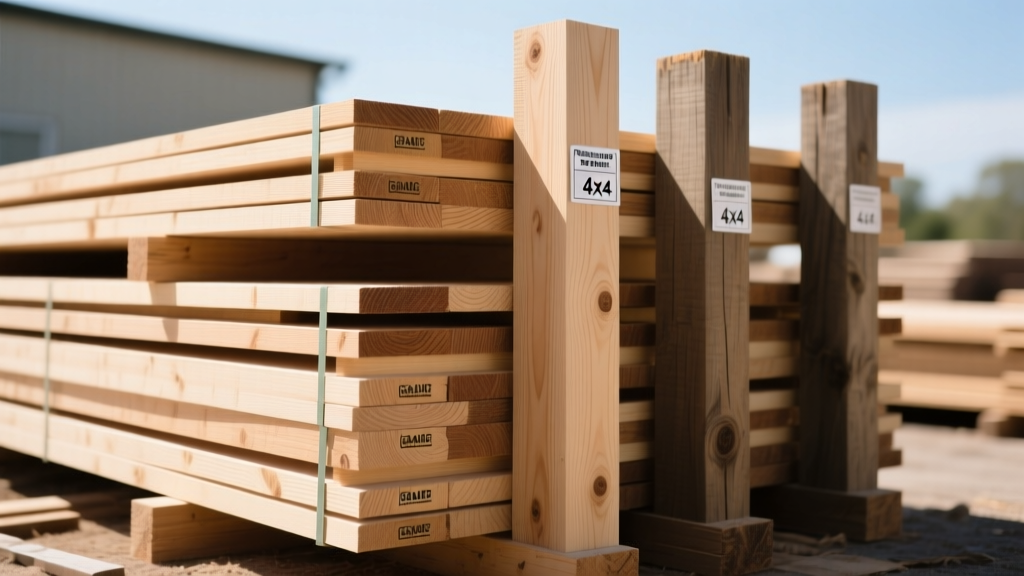
The most common reason a wood fence fails prematurely is post rot at the concrete collar. Retailers often stock UC4A (Above Ground) treated lumber because it is cheaper and lighter. Actionable Rule: You must inspect the end tag on every 4x4 post. If it says UC4A, reject it for ground contact. You must purchase UC4B (Ground Contact) or UC4C (Heavy Duty Ground Contact) posts. UC4B contains a higher retention level of copper azole or micronized copper, preventing fungal decay in damp soil. UC4B posts cost roughly 15% more than UC4A, but they prevent a $4,000 fence from leaning in year five.
Dimensional Upgrades: 4x4 vs. 6x6 Posts
While a nominal 4x4 post (actual 3.5" x 3.5") is the industry minimum for a 6-foot fence, upgrading to 6x6 posts (actual 5.5" x 5.5") for the main structural corners and gate posts adds roughly $18 to $25 per post in material costs. This upgrade provides a massive return on investment by eliminating the torsional twisting that causes gates to sag and latch misalignments over time.
Fastener Corrosion and ASTM Standards
Modern pressure-treated wood utilizes copper-based preservatives that act as a galvanic battery when exposed to standard zinc or electroplated nails, eating through the fastener in 3 to 5 years. Hardware Specification: Only use Hot-Dipped Galvanized (HDG) fasteners meeting ASTM A153 standards, or Type 304/316 Stainless Steel for coastal zones. A box of 316 stainless steel ring-shank nails costs 4x more than standard zinc, but it is a non-negotiable requirement for ACQ and CA-C treated lumbers.
Lifecycle Cost Analysis: Cheap Wood vs. Premium Grade
To understand the true cost of a wood fence, evaluate the 20-year lifecycle. A cheaper initial material cost often results in higher maintenance and early replacement expenses.
| Metric | #2 Common PT Pine (Budget) | #1 Common Cedar (Mid-Tier) | Clear Redwood (Premium) |
|---|---|---|---|
| Initial Material Cost (150 ft) | $1,162 | $2,512 | $8,700 |
| Sealing/Staining (Every 3 Yrs) | $1,800 (Requires heavy prep) | $1,500 (Takes stain easily) | $900 (Often left natural) |
| Board Replacement (Warping/Rot) | $450 (15% failure rate) | $150 (5% failure rate) | $50 (Negligible failure) |
| 20-Year Total Cost of Ownership | $3,412 | $4,162 | $9,650 |
While Clear Redwood remains a luxury investment, the data shows that #1 Common Cedar offers the best long-term value. The initial material premium over pine is offset by significantly lower maintenance costs, less warping, and natural tannins that resist insect damage without chemical treatments.
Final Procurement Checklist for 2026
- Verify the Stamp: Ensure every board has a visible grade stamp (e.g., 'WWPA #1 C' or 'SPIB #2'). Unstamped 'economy' bins often contain cull lumber with excessive bowing.
- Check Post Tags: Confirm UC4B or UC4C for all posts destined for concrete footings.
- Measure Moisture: If buying kiln-dried after treatment (KDAT) pine, expect to pay a 10% premium, but you will eliminate the massive shrinkage gaps that occur when standard wet PT pine dries in the sun.
- Hardware Match: Pair cedar and redwood with stainless steel or polymer-coated screws to prevent black iron-stain streaking on the wood face.
Written by
James ThorntonJames Thornton is a construction industry veteran with 25 years of hands-on experience in wood framing, lumber grading, and residential building codes. He started as a framing carpenter in rural Oregon, earned his ICC Residential Building Inspector certification, and eventually became a senior plan reviewer for the City of Portland Bureau of Development Services. James holds a B.S. in Wood Science & Technology from Oregon State University and is a certified lumber grader through the West Coast Lumber Inspection Bureau (WCLIB). He has inspected over 3,000 residential construction sites and authored the city's internal guide on advanced framing techniques (2x6 at 24" O.C.). James lives in Bend, OR, where he builds custom timber-frame cabins and competes in lumberjack sports.
More from James Thornton
View all
Insulation
Best Home Insulation Materials: Complete 2026 Guide
Compare top home insulation materials for 2026. Find R-values, installed costs per square foot, and best uses for fiberglass, spray foam, and mineral wool.
Aug 4, 2026

Sustainable Building
Certify Your Green Building Material for LEED and WELL
Step-by-step guide to certifying a green building material for LEED v5 and WELL v2. Master EPDs, HPDs, and VOC limits for 2026 project specifications.
Aug 4, 2026

Stone & Masonry
Veneer Stacked Stone Panels: Interior Design & Style Showcase
Discover how veneer stacked stone panels transform interiors. Explore modern design profiles, material pairings, and technical installation specs.
Aug 4, 2026