How to Tell the Different Types of Wood: A Complete Species Guide
Learn how to tell the different types of wood using end-grain analysis, sensory tests, and density metrics. A complete species guide for builders.

The Three Pillars of Wood Identification
Accurately identifying wood species is a critical skill for contractors, architects, and millworkers. Misidentifying a structural timber can lead to catastrophic load-bearing failures, while confusing hardwood species can result in finish adhesion issues or premature wear. Professional wood identification relies on three primary pillars: macroscopic visual analysis, end-grain anatomy, and sensory or chemical testing. While face-grain patterns and color can provide initial clues, they are highly unreliable due to variations in soil chemistry, climate, and artificial staining. True identification requires a systematic approach grounded in cellular structure and physical density metrics.
End-Grain Analysis: The Definitive Test
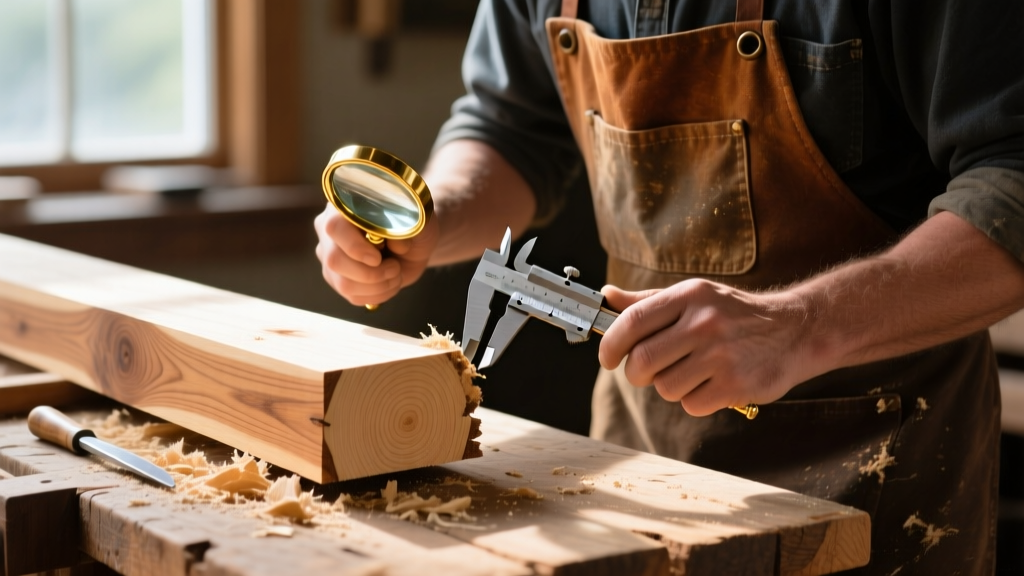
The most reliable method to determine wood species without laboratory DNA testing is examining the end grain under 10x to 15x magnification. The end grain reveals the cellular structure of the xylem, which differs distinctly between species. According to the anatomical frameworks established by the Wood Database, angiosperms (hardwoods) and gymnosperms (softwoods) exhibit fundamentally different water-transport systems.
Sawing the end grain with a standard circular saw crushes the cells, obscuring anatomical features. For accurate identification, slice the end grain with a razor-sharp chisel or use a microtome to create a clean, 90-degree cross-section. Lightly sanding with 320-grit paper and applying a drop of mineral oil will increase contrast and reveal the pore structure.
Hardwood Pore Structures
- Ring-Porous: Earlywood pores are significantly larger than latewood pores, forming distinct rings. Common in White Oak (Quercus alba), Ash (Fraxinus), and Hickory (Carya). This structure often correlates with high bending strength but can cause splitting if pre-drilling is skipped during fastening.
- Diffuse-Porous: Pores are uniformly sized and evenly distributed across the growth ring. Typical of Hard Maple (Acer saccharum), Cherry (Prunus serotina), and Poplar (Liriodendron tulipifera). These woods generally offer superior machining properties and a smoother finished surface.
- Semi-Ring-Porous: A transitional category where earlywood pores are slightly larger, seen in Black Walnut (Juglans nigra) and Persimmon.
Softwood Tracheid Patterns
Softwoods lack true pores. Instead, they rely on tracheids for water transport. Identification hinges on the presence and arrangement of resin canals. Pines (Pinus) and Spruces (Picea) feature prominent, often visible resin canals that appear as tiny white or dark dots on the end grain. Firs (Abies) and Cedars (Cedrus) lack normal resin canals, which is a key diagnostic differentiator when distinguishing Douglas Fir from True Firs or Cedars.
Hardwood vs. Softwood: Field Comparison Matrix
The botanical distinction between hardwoods (deciduous, seed-producing angiosperms) and softwoods (coniferous, needle-bearing gymnosperms) does not always align with physical hardness. Balsa is a hardwood, while Yew is a softwood harder than many oak species. The USDA Forest Products Laboratory emphasizes using Janka hardness and specific gravity rather than botanical classification for structural assumptions.
| Species (Common) | Category | Janka Hardness (lbf) | Density (lbs/ft³) | Primary Construction Use |
|---|---|---|---|---|
| Southern Yellow Pine | Softwood | 870 | 3.6 | Structural framing, joists |
| Douglas Fir | Softwood | 660 | 3.2 | Beams, headers, glulam |
| White Oak | Hardwood | 1,360 | 4.7 | Exterior trim, heavy flooring |
| Hard Maple | Hardwood | 1,450 | 4.0 | High-traffic flooring, butcher blocks |
| Western Red Cedar | Softwood | 350 | 2.3 | Siding, decking, exterior trim |
Identifying Common Construction Species by Visual Cues
When end-grain analysis is impossible—such as when evaluating installed siding or pre-finished flooring—builders must rely on macroscopic face-grain characteristics, color oxidation, and ray fleck patterns.
Softwood Field Identification
- Douglas Fir vs. Hem-Fir: Douglas Fir exhibits a distinct reddish-brown heartwood with tight, straight grain and prominent, dark brown knots. Hem-Fir (Hemlock and True Fir) is significantly lighter, often pale yellow to almost white, with less pronounced latewood bands and a lack of resinous odor when cut.
- Southern Yellow Pine (SYP): SYP is characterized by an extreme contrast between its pale yellow earlywood and dark, dense reddish-brown latewood. This creates a very bold, striped appearance on the face grain that is absent in softer Ponderosa or White Pines.
- Western Red Cedar: Features a straight grain with a uniform, coarse texture. The color ranges from pale yellow sapwood to a rich, reddish-brown heartwood that weathers to a silvery-gray if left untreated. It lacks the visible resin canals found in Pine.
Hardwood Field Identification
- Red Oak vs. White Oak: While both have prominent ray fleck patterns on quartersawn faces, White Oak has a tighter grain, slightly olive/brown undertones, and closed cellular tyloses (making it waterproof). Red Oak has a pinkish hue, more open pores, and wider ray flecks. Water testing the end grain will reveal Red Oak's open pores as it absorbs moisture rapidly, while White Oak repels it.
- Hard Maple vs. Soft Maple: Visually similar, but Hard Maple (Sugar Maple) is noticeably heavier and features a tighter, more uniform diffuse-porous grain. Soft Maple often exhibits mineral streaks (green/brown discolorations) and a slightly grayer hue in the heartwood.
Sensory and Chemical Identification Methods
When visual and anatomical traits overlap, sensory and chemical tests provide definitive confirmation. These methods are particularly useful when dealing with weathered or reclaimed lumber where the original color has been compromised by UV exposure or oxidation.
"The olfactory signature of freshly machined wood is one of the most underutilized identification tools in the field. The volatile organic compounds (VOCs) released during cutting are highly species-specific." — Advanced Timber Framing Guidelines
- Olfactory Testing: Western Red Cedar emits a sharp, camphor-like scent due to plicatic acid, which provides its natural rot resistance. Black Walnut smells distinctly of dark chocolate and tobacco when milled. Brazilian Rosewood smells like bubblegum or sweet vanilla.
- UV Fluorescence: Black Locust (Robinia pseudoacacia) and Osage Orange exhibit a brilliant yellow-green fluorescence under blacklight (UV-A), making them easy to distinguish from visually similar species like Honeylocust or Mulberry.
- Water Extract Fluorescence: If UV testing is inconclusive, soaking wood shavings in water can reveal extractives. White Oak heartwood will fluoresce a pale greenish-yellow in water, while Red Oak will not.
Decision Framework: Matching Species to Structural Requirements
Identifying the wood is only the first step; applying that knowledge to structural engineering and building codes is where expertise matters. The Virginia Tech Dendrology Database and the American Wood Council's National Design Specification (NDS) provide the baseline for matching species to load requirements.
High Load-Bearing (Beams & Headers)
Target Species: Douglas Fir, Southern Yellow Pine, Larch.
Why: High Modulus of Elasticity (E) and extreme fiber bending strength (Fb). Douglas Fir-Larch is the industry standard for manufactured glulam and LVL due to its predictable stress-grading characteristics.
Moisture-Exposed Exterior
Target Species: Western Red Cedar, Redwood, White Oak, Black Locust.
Why: High concentrations of natural extractives (tannins, thujaplicins) inhibit fungal decay and insect infiltration. White Oak's tyloses block capillary water absorption, making it ideal for marine and ground-contact applications without chemical treatment.
High-Impact Flooring
Target Species: Hickory, Hard Maple, White Oak.
Why: Janka hardness ratings exceeding 1,300 lbf ensure resistance to denting from dropped objects and high-heel traffic. Hickory (1,820 lbf) is the hardest domestic commercial species, though its high shrinkage rate requires strict acclimation protocols before installation.
Frequently Asked Questions
Can I accurately identify wood if it has been stained or painted?
Surface stains obscure color and face-grain contrast, making visual identification nearly impossible. You must expose raw wood by sanding through the finish in an inconspicuous area, or rely on end-grain analysis, weight calculations (specific gravity), and olfactory testing on hidden cut-offs or the back of the board.
How do I tell the difference between solid hardwood and engineered wood veneers?
Examine the edge profile and end grain. Solid hardwood will show continuous growth rings wrapping from the face to the edge. Engineered wood features a thin top veneer (usually 2mm to 6mm) glued to a plywood or HDF core, visible as a distinct horizontal lamination line on the edge. Additionally, engineered flooring will not show continuous end-grain cellular structures on the board ends.
Written by
Sarah WhitfieldSarah Whitfield is a chartered quantity surveyor (MRICS) and construction cost analyst with 15 years of experience in material pricing, procurement strategy, and project budgeting. She earned her degree in Construction Management from the University of Reading (UK) and has worked on projects ranging from $2M custom homes to $180M mixed-use developments across North America and Europe. Sarah currently leads cost estimating for BuildMat Insight, maintaining a proprietary database of 4,000+ material price points updated quarterly. She is a frequent contributor to RSMeans cost data panels and has presented at the International Cost Engineering Council (ICEC) congress. Based in Denver, CO, Sarah is an avid trail runner and volunteer mentor for Women in Construction.
More from Sarah Whitfield
View all
Wood & Lumber
What Are the Different Types of Wood? A Builder's Guide
Compare structural softwoods, finish hardwoods, and engineered lumber. Analyze Janka ratings, MOE values, and 2026 pricing for construction.
Aug 4, 2026

Walls & Panels
Steel Framing vs Wood Framing: Corrosion and Moisture Defense
Compare steel framing vs wood framing for moisture resistance. Learn about galvanized coatings, condensation risks, and corrosion protection strategies.
Jul 21, 2026

Stone & Masonry
How to Cut Stone Veneer: Wet Saw vs Grinder Comparison
Compare the best tools for cutting stone veneer. We review wet saws, angle grinders, and chop saws to help you achieve clean, chip-free cuts.
Jul 21, 2026