Types of Wooden Flutes: Wood Species Selection Framework for Makers
A material selection framework for crafting types of wooden flutes, detailing lumber density, acoustic properties, and sourcing guidelines.
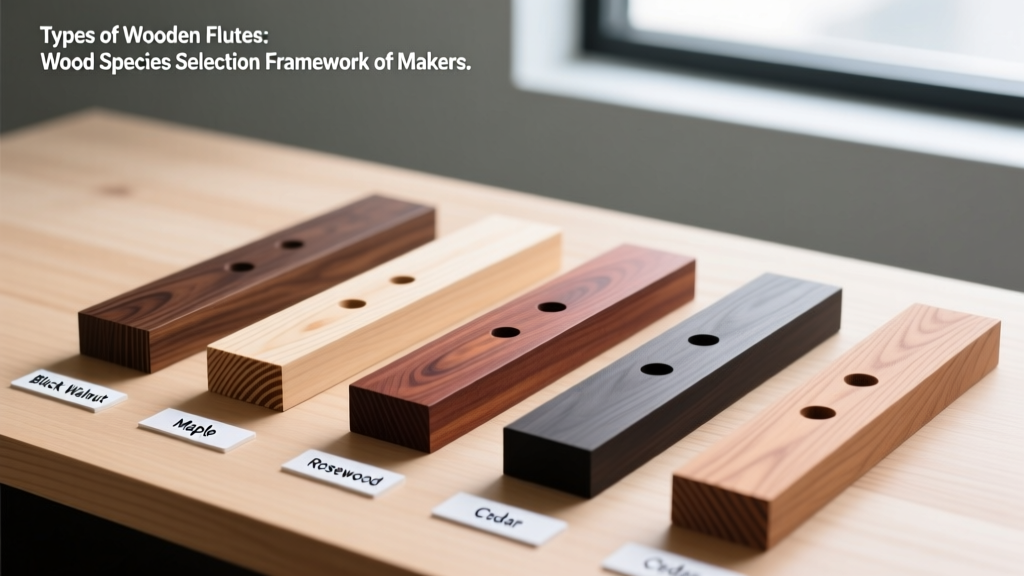
The Acoustic Mechanics of Wood Selection
The tonal character, projection, and structural longevity of woodwind instruments are dictated by the cellular structure of the lumber used. When evaluating the material requirements for various types of wooden flutes, makers must prioritize characteristic acoustic impedance ($Z$), which is the product of wood density ($\rho$) and the speed of sound ($c$) through the material. High-impedance woods reflect more acoustic energy back into the air column, yielding a brighter, more focused tone with greater projection. Conversely, lower-impedance woods absorb more vibrational energy, producing a warmer, more complex harmonic spectrum.
Beyond acoustics, the lumber must possess extreme dimensional stability. The internal bore of a flute is subjected to rapid, localized spikes in relative humidity (RH) from the player's breath, while the exterior remains in the ambient environment. This differential moisture exposure creates severe tangential and radial shear stresses. Selecting the wrong species, or improperly seasoned blanks, guarantees catastrophic bore cracking.
Primary Wood Species for Flute Making
The selection of tonewoods for flute making is constrained by density requirements, workability, and international trade regulations. Below are the primary species utilized in professional-grade instrument manufacturing.
Grenadilla (African Blackwood - Dalbergia melanoxylon)
Grenadilla is the modern standard for professional orchestral flutes and piccolos. With a specific gravity of 1.30 and a Janka hardness of 3,670 lbf, it is exceptionally dense. This density provides the high acoustic impedance required for a brilliant, penetrating tone that cuts through orchestral textures. According to The Wood Database, its natural oils offer high resistance to moisture ingress, though its extreme hardness requires specialized carbide or high-speed steel (HSS) tooling to prevent burning during bore reaming.
European Boxwood (Buxus sempervirens)
Historically the dominant material for Baroque and Classical period flutes, Boxwood has a specific gravity of 0.91 and a Janka hardness of 1,630 lbf. It yields a significantly warmer, more diffuse tone compared to Grenadilla. Because it is less dense, it is more prone to warping and requires meticulous, slow seasoning—often air-dried for up to a decade. Makers favor it for historical reproduction flutes where an authentic, mellow timbre is required.
Mopane (Colophospermum mopane)
Mopane has emerged as a premier alternative to Grenadilla, particularly given tightening CITES regulations on Dalbergia species. With a specific gravity of 1.08 and a Janka hardness of 1,780 lbf, Mopane offers a tonal profile that bridges the gap between the brilliance of Blackwood and the warmth of Boxwood. Its interlocked grain can cause tear-out during hand scraping, but it machines cleanly with sharp, low-angle cutting edges.
Tulipwood (Dalbergia decipularis)
Prized for its striking crimson and yellow striping, Tulipwood is occasionally used for bespoke, visually striking flutes. However, its specific gravity (0.96) is lower than Grenadilla, resulting in a softer attack. Due to severe export restrictions detailed in the CITES Appendices, sourcing legally harvested, kiln-dried Tulipwood blanks requires rigorous chain-of-custody documentation.
Wood Selection Matrix: Density vs. Workability
The following matrix provides actionable data for makers balancing acoustic goals with manufacturing constraints.
| Wood Species | Specific Gravity (Basic) | Janka Hardness (lbf) | Acoustic Profile | Tool Wear Factor |
|---|---|---|---|---|
| Grenadilla | 1.30 | 3,670 | Bright, focused, high projection | Extreme (Requires HSS/Carbide) |
| Mopane | 1.08 | 1,780 | Balanced, warm core with clear overtones | Moderate (Interlocked grain tear-out risk) |
| Boxwood | 0.91 | 1,630 | Warm, complex, diffuse projection | Low (Excellent hand-carving properties) |
| Tulipwood | 0.96 | 1,880 | Soft attack, rich midrange | Moderate (High natural oil content) |
| Cocobolo | 1.10 | 2,960 | Bright, highly resonant | High (Severe allergenic dust risks) |
Moisture Content and Dimensional Stability
The leading cause of failure in wooden flutes is differential shrinkage. Wood shrinks and swells primarily in the tangential and radial directions, with negligible movement along the longitudinal grain. When a player blows warm, moist air into a dry bore, the interior cells expand rapidly while the exterior remains static, generating hoop stress that exceeds the wood's tensile strength perpendicular to the grain.
To mitigate shear stress, makers must understand the radial-to-tangential shrinkage ratio (T/R ratio). A T/R ratio close to 1.0 indicates uniform shrinkage and high stability. Grenadilla boasts a highly favorable T/R ratio, which is a primary reason it dominates professional manufacturing despite its extreme hardness. For comprehensive data on calculating dimensional stability and shrinkage percentages across varying species, refer to the dimensional stability guides provided by wood science databases.
Sourcing and Grading Lumber for Instrument Making
Standard FAS (First and Second) lumber grading rules used in cabinetry do not apply to instrument making. Flute makers require specialized, highly figured, or perfectly quartersawn blanks.
The Quartersawing Requirement
Flute blanks must be cut strictly quartersawn (end grain rings intersecting the face at 60 to 90 degrees). Quartersawn lumber exposes the radial face, which exhibits significantly less dimensional movement than the tangential face. It also exposes the medullary rays, which act as natural structural reinforcement against radial cracking. When ordering from specialty tonewood suppliers, explicitly specify "strictly quartersawn, zero run-out" blanks.
Blank Dimensions and End-Sealing
Standard transverse flute blanks are typically milled to 1.5" x 1.5" x 16". Because moisture escapes from the end grain up to 50 times faster than from the lateral faces, all blanks must be heavily sealed with an anchor seal or paraffin wax immediately after milling. Unsealed blanks stored in environments with fluctuating RH will develop end-checks that propagate inward, ruining the structural integrity of the bore.
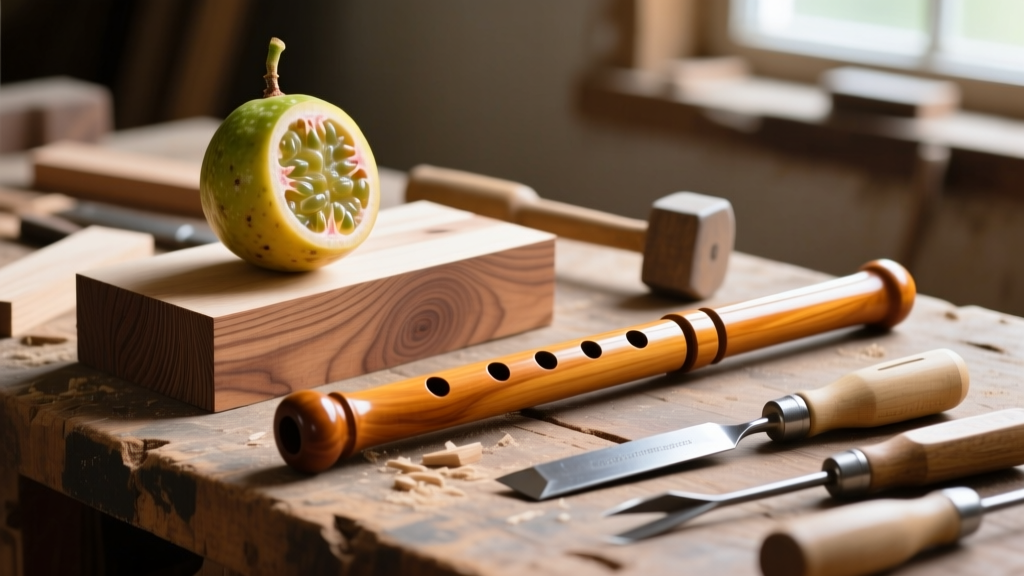
Decision Flowchart: Matching Wood to Flute Type
Use this framework to select the optimal lumber based on the specific instrument being crafted and the target end-user.
- Identify the Target Repertoire and Acoustic Goal:
- If Orchestral/Modern Classical: Require high projection and sharp attack. Proceed to Step 2A.
- If Baroque/Early Music/Historical Reproduction: Require warm, blended, complex harmonics. Proceed to Step 2B.
- If Folk/Traditional/Outdoor Playing: Require durability and moisture resistance. Proceed to Step 2C.
- Select the Species Category:
- Step 2A (Modern): Select Grenadilla or Mopane. Factor in CITES permitting if exporting the finished instrument internationally.
- Step 2B (Historical): Select European Boxwood or fruitwoods (e.g., Plum, Pear). Prepare for extended hand-scraping and burnishing workflows.
- Step 2C (Folk/Outdoor): Select Mopane or heavily resinous softwoods like Cedar (for larger, lower-pitched flutes) treated with bore oils.
- Verify Blank Integrity:
- Confirm strict quartersawn orientation.
- Verify core EMC is between 6% and 8%.
- Inspect for microscopic pith inclusion (the absolute center of the tree), which must be excluded from the blank to prevent radial splitting.
Final Machining Considerations
When boring high-density woods like Grenadilla, utilize peck-drilling techniques with specialized gun drills to ensure efficient chip ejection. Failure to clear chips in deep, narrow bores results in friction-burning, which alters the localized density of the wood and creates dead spots in the acoustic resonance. Always finish the bore with a micro-mesh progression up to 12,000 grit before applying a polymerized tung oil or specialized bore sealant to lock out moisture.
Written by
Elena RodriguezElena Rodriguez is a civil engineer and technical writer specializing in concrete technology, masonry systems, and ASTM/ACI compliance. She earned her B.S. in Civil Engineering from Texas A&M University and spent a decade at a materials testing laboratory, performing over 2,000 concrete compressive strength tests and masonry prism evaluations. Elena is an ACI-certified Field Testing Technician (Grade I) and a member of ASTM Committee C12 on Natural Building Stone. She currently consults on forensic engineering cases involving concrete failures and moisture intrusion. Based in San Antonio, TX, Elena is a proud member of the Society of Women Engineers (SWE) and coaches her daughter's FIRST Robotics team.
More from Elena Rodriguez
View all
Walls & Panels
Cost Analysis: Light Gauge Steel Framing Advantages and Disadvantages
Evaluate light gauge steel framing advantages and disadvantages through a strict cost analysis lens, comparing material, labor, and lifecycle expenses.
Aug 4, 2026

Walls & Panels
Gypsum Board Types: Exact Specifications, Thickness & Dimensions
Compare standard, Type X, and moisture-resistant gypsum board types. Get exact specifications, thicknesses, dimensions, and ASTM standards for your project.
Aug 4, 2026

Fire Resistance
Best Fire-Resistant Outdoor Decking Materials: 2026 Buyer Guide
Discover the best fire-resistant outdoor decking materials for 2026. Compare Class A PVC, aluminum, and hardwood options for WUI compliance and safety.
Aug 4, 2026