How to Tell Type of Wood by Grain, Weight, and End Grain Patterns
Learn how to tell type of wood using end grain analysis, Janka hardness, and visual grain patterns. Essential identification guide for builders.

Why Accurate Wood Identification Matters in Modern Construction
Misidentifying lumber on a job site or in a woodworking shop is a costly error that compromises structural integrity, finish quality, and building code compliance. Knowing how to tell type of wood goes far beyond superficial color matching or relying on the tag at the big-box store. With the rise of mass timber and Cross-Laminated Timber (CLT) systems in 2026 commercial construction, verifying the exact species and grade of structural members is critical for load-bearing calculations and fire-resistance ratings.
Superficial visual cues like color and general grain pattern are notoriously unreliable. Stains, age, UV exposure, and regional soil variations can drastically alter a board's appearance. A piece of weathered Southern Yellow Pine can easily be mistaken for Douglas Fir, while stained Poplar is frequently passed off as Cherry. To accurately identify wood species, builders and inspectors must rely on cellular anatomy, density metrics, and standardized grading marks.
The End Grain Test: Your Most Reliable Identification Tool
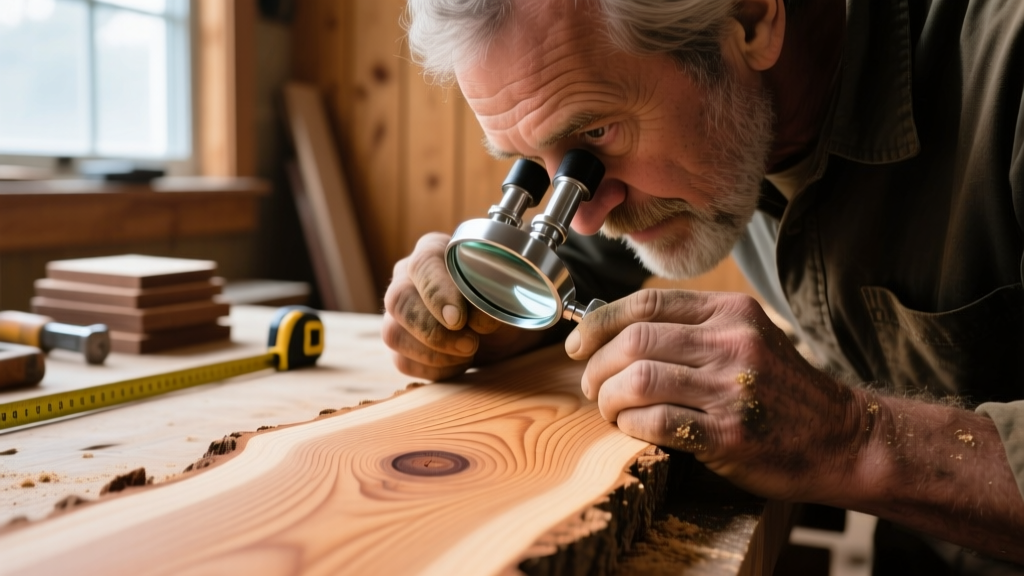
The most definitive way to identify solid wood is by examining its end grain under magnification. While face grain shows you the longitudinal cells, the end grain reveals the cross-sectional anatomy of the wood's vascular system. According to the USDA Forest Products Laboratory Wood Handbook, the arrangement, size, and presence of specific cellular structures are unique to individual species or tight genus groupings.
Step-by-Step End Grain Preparation
- Cut a Clean Cross-Section: Use a sharp block plane, a microtome, or a razor blade to slice a perfectly perpendicular, clean cross-section of the board. Avoid saws, as they tear the cellular walls and obscure the pores.
- Sand Progressively: Sand the end grain progressively through 120, 220, and finally 320 or 400 grit. This removes the torn fibers left by the blade and polishes the cell walls.
- Apply a Contrast Agent (Optional): Wiping the sanded end grain with a light oil (like mineral oil) or water can increase the contrast between the earlywood and latewood, making pores easier to see.
- Magnify: Use a 10x to 30x jeweler's loupe or a digital macro lens attached to a smartphone to inspect the cellular structure.
What to Look For Under Magnification
When analyzing the end grain, you are primarily looking for the presence and arrangement of pores (vessels). Hardwoods are broadly categorized by their pore arrangement, while softwoods lack pores entirely.
- Ring-Porous Hardwoods: Large earlywood pores form a distinct ring at the start of each growth ring, transitioning to tiny latewood pores. Examples include White Oak, Red Oak, Ash, and Elm.
- Diffuse-Porous Hardwoods: Pores are relatively uniform in size and evenly distributed throughout the growth ring. Examples include Maple, Birch, Poplar, and Basswood.
- Semi-Ring-Porous Hardwoods: A transitional category where earlywood pores are slightly larger but not strictly ring-aligned. Black Walnut and Cherry fall into this group.
- Softwoods (Non-Porous): Softwoods like Pine, Fir, and Spruce do not have vessels. Instead, they rely on tracheids for water transport. Under magnification, their end grain looks like a dense, uniform honeycomb. The presence of resin canals (visible as small, dark dots) is a key indicator of Pine and Spruce species.
Decoding Visual Grain Patterns and Color Shifts
While end grain is the gold standard, visual face-grain analysis provides vital secondary clues, especially when evaluating lumber for architectural millwork or flooring where aesthetics dictate the grade.
Heartwood vs. Sapwood Dynamics: The heartwood (the darker, inner core of the tree) contains extractives that provide natural rot resistance and deeper color. The sapwood (the lighter, outer rings) is highly permeable and susceptible to decay. In premium grades of Western Red Cedar or Black Locust, specifiers must verify the percentage of heartwood, as structural beams with excessive sapwood will fail prematurely in exterior applications.
Medullary Rays and Fleck Patterns
Medullary rays are ribbons of cells that extend radially from the pith to the bark. In most species, they are invisible on the face grain. However, in White Oak and Sycamore, these rays are exceptionally wide. When quartersawn, White Oak exhibits a dramatic 'ray fleck' pattern. This is a critical distinction for architectural woodworkers: Red Oak lacks these prominent rays, and substituting it in a marine or exterior application (where White Oak's tyloses-blocked pores provide waterproofing) will result in catastrophic rot.
Density, Weight, and the Janka Hardness Benchmark
Weight and density are excellent physical indicators of species, particularly when differentiating between visually similar softwoods. The Janka hardness test measures the force required to embed a 0.444-inch steel ball halfway into the wood. This metric directly correlates to the wood's specific gravity and its suitability for high-traffic flooring or heavy timber framing.
| Wood Species | Janka Hardness (lbf) | Specific Gravity (Oven-Dry) | Primary Construction / Architectural Use |
|---|---|---|---|
| Western Red Cedar | 350 | 0.32 | Exterior siding, decking, acoustic paneling |
| Douglas Fir | 660 | 0.50 | Structural framing, glulam beams, CLT cores |
| Southern Yellow Pine | 870 | 0.59 | Heavy timber joists, industrial flooring, scaffolding |
| White Oak | 1,350 | 0.68 | Premium flooring, marine construction, exterior timbers |
| Hard Maple | 1,450 | 0.63 | High-traffic commercial flooring, bowling alleys, butcher blocks |
| Hickory (Pecan) | 1,820 | 0.75 | Tool handles, high-impact residential flooring |
Data sourced from the Wood Database and USDA Forest Products Laboratory standard testing metrics.
Reading Lumber Grade Stamps and Mill Marks
In structural and commercial construction, you rarely need to rely solely on physical identification because the lumber is stamped by an accredited grading agency. Understanding how to read these ink stamps is a mandatory skill for site superintendents and framing inspectors.
Anatomy of an ALSC Grade Stamp
A standard American Lumber Standard Committee (ALSC) stamp contains four critical pieces of data:
- Species Mark: Identifies the wood type. S-SPF indicates Spruce-Pine-Fir (South), while DF-L indicates Douglas Fir-Larch. Note that SPF is a marketing group; the actual species could be White Spruce, Lodgepole Pine, or Balsam Fir, which have slightly different structural capacities.
- Grade Designation: Indicates structural integrity. Select Structural is the highest grade for framing, featuring tight knots and high load-bearing capacity. No. 2 is the standard utility grade for most residential wall framing.
- Condition of Seasoning: S-DRY means the moisture content was 19% or less at the time of surfacing. MC-15 indicates a maximum of 15% moisture content, crucial for interior finish carpentry to prevent shrinkage.
- Mill Number: A unique identifier for the manufacturing mill, essential for tracing material defects or recalls.
Advanced Field Techniques: Fluorescence and Odor
When visual and structural tests yield ambiguous results, advanced sensory and chemical tests can break the tie. These methods are particularly useful in forensic construction analysis or when verifying the authenticity of expensive, imported hardwoods.
Ultraviolet Fluorescence
Certain wood extractives react to ultraviolet (UV) light, emitting a specific color. This is a highly reliable, non-destructive field test.
- Black Locust: Glows a vibrant yellow-green under a standard 365nm UV flashlight, easily distinguishing it from visually similar Osage Orange or Honey Locust.
- Brazilian Rosewood: Exhibits a faint, chalky blue or green fluorescence, which helps inspectors differentiate it from restricted or lookalike species in the Dalbergia genus.
Olfactory Identification
While it sounds unscientific, the sense of smell is heavily relied upon by veteran millworkers. Sanding or planing the wood releases volatile organic compounds (VOCs) specific to the species.
- Eastern Red Cedar: Emits a sharp, distinct 'pencil shavings' scent due to the presence of thujopsene.
- Spanish Cedar: Smells distinctly like a humidor, rich and spicy, which is why it is the mandated material for premium cigar cabinetry.
- Camphorwood: Smells strongly of Vicks VapoRub or camphor, immediately identifiable upon cutting.
Common Field Misidentifications and How to Avoid Them
Even experienced builders fall victim to lookalikes. Here is a troubleshooting framework for the most common species mix-ups encountered on modern job sites:
Douglas Fir vs. Hem-Fir
The Problem: Both are used in structural framing and share a similar reddish-brown hue when freshly milled.
The Fix: Check the end grain for resin canals. Douglas Fir has distinct, visible resin canals, while Hemlock (the 'Hem' in Hem-Fir) lacks them entirely. Additionally, Douglas Fir latewood bands are sharply defined and hard, whereas Hemlock latewood transitions gradually and is much softer to the thumbnail.
Red Oak vs. White Oak
The Problem: Stained Red Oak is frequently sold or mistakenly installed as White Oak in flooring and exterior trim applications.
The Fix: Look at the end grain pores. White Oak pores are plugged with tyloses (foam-like cellular growths), making the wood impermeable to water. Red Oak pores are open and hollow. If you blow air through a short piece of Red Oak, it will pass through; White Oak will block the air entirely.
Final Verification for Engineered and Mass Timber
As the construction industry shifts heavily toward engineered wood products (EWP) like LVL (Laminated Veneer Lumber) and Glulam, visual species identification becomes secondary to verifying the manufacturer's stress grade and adhesive type. In CLT panels, the outer lamellae are typically a high-grade, high-density species like Douglas Fir or Southern Yellow Pine for impact and wear resistance, while the inner cross-laminated layers may use lower-grade SPF to reduce weight and cost. Always cross-reference the physical end-grain characteristics of the outer layers with the digital BIM (Building Information Modeling) specs and the mill's QR-coded certification tag to ensure the installed mass timber matches the structural engineer's load calculations.
Written by
James ThorntonJames Thornton is a construction industry veteran with 25 years of hands-on experience in wood framing, lumber grading, and residential building codes. He started as a framing carpenter in rural Oregon, earned his ICC Residential Building Inspector certification, and eventually became a senior plan reviewer for the City of Portland Bureau of Development Services. James holds a B.S. in Wood Science & Technology from Oregon State University and is a certified lumber grader through the West Coast Lumber Inspection Bureau (WCLIB). He has inspected over 3,000 residential construction sites and authored the city's internal guide on advanced framing techniques (2x6 at 24" O.C.). James lives in Bend, OR, where he builds custom timber-frame cabins and competes in lumberjack sports.
More from James Thornton
View all
Insulation
Best Home Insulation Materials: Complete 2026 Guide
Compare top home insulation materials for 2026. Find R-values, installed costs per square foot, and best uses for fiberglass, spray foam, and mineral wool.
Aug 4, 2026

Sustainable Building
Certify Your Green Building Material for LEED and WELL
Step-by-step guide to certifying a green building material for LEED v5 and WELL v2. Master EPDs, HPDs, and VOC limits for 2026 project specifications.
Aug 4, 2026

Stone & Masonry
Veneer Stacked Stone Panels: Interior Design & Style Showcase
Discover how veneer stacked stone panels transform interiors. Explore modern design profiles, material pairings, and technical installation specs.
Aug 4, 2026