Best Types of Wood for Decks: Structural Framing & Span Guide
Compare the best types of wood for decks, focusing on structural framing, joist spans, beam sizing, and decay resistance for long-lasting builds.

The Structural Hierarchy of Deck Building
When evaluating the best types of wood for decks, builders and homeowners frequently make the mistake of focusing solely on the visible walking surface. However, a deck is a complex structural system that must support a minimum live load of 40 to 60 pounds per square foot (psf), resist lateral wind forces, and endure decades of moisture exposure. To specify lumber correctly, you must divide your material selection into two distinct categories: the structural skeleton (posts, beams, and joists) and the decking surface (walking boards and fascia).
The structural skeleton requires lumber with high bending strength (Fb) and stiffness (E), while the decking surface prioritizes decay resistance, dimensional stability, and surface hardness. This guide breaks down the exact species, preservative treatments, and span limitations required for a code-compliant, long-lasting deck build.
Framing Lumber: The Hidden Backbone
For 90% of residential decks in North America, the structural framing consists of softwood dimensional lumber. The two dominant species used for joists, beams, and posts are Southern Yellow Pine (SYP) and Douglas Fir-Larch. Both are typically sold as pressure-treated (PT) lumber to resist fungal decay and insect infestation.
Southern Yellow Pine (SYP) vs. Douglas Fir
Southern Yellow Pine is the industry standard for deck framing in the Eastern and Southern United States. It possesses a naturally high density and excellent preservative penetration characteristics. Douglas Fir-Larch is more common in the Western US and offers superior dimensional stability (less warping and twisting as it dries) but requires more rigorous incising to achieve the same preservative penetration as SYP.
| Structural Property | Southern Yellow Pine (#2 Grade) | Douglas Fir-Larch (#2 Grade) |
|---|---|---|
| Bending Strength (Fb) | 1,500 psi | 1,500 psi |
| Stiffness (E) | 1,900,000 psi | 1,900,000 psi |
| Horizontal Shear (Fv) | 90 psi | 180 psi |
| Preservative Penetration | Excellent (deep cellular absorption) | Moderate (requires mechanical incising) |
Not all pressure-treated wood is identical. The American Wood Protection Association (AWPA) classifies treated lumber by Use Categories. Standard above-ground framing is rated UC3B. However, any structural post embedded in concrete, or any joist less than 6 inches from the ground, must be rated UC4A (Ground Contact) or UC4B (Heavy-Duty Ground Contact). Using UC3B lumber in ground-contact applications will result in catastrophic structural rot within 5 to 7 years.
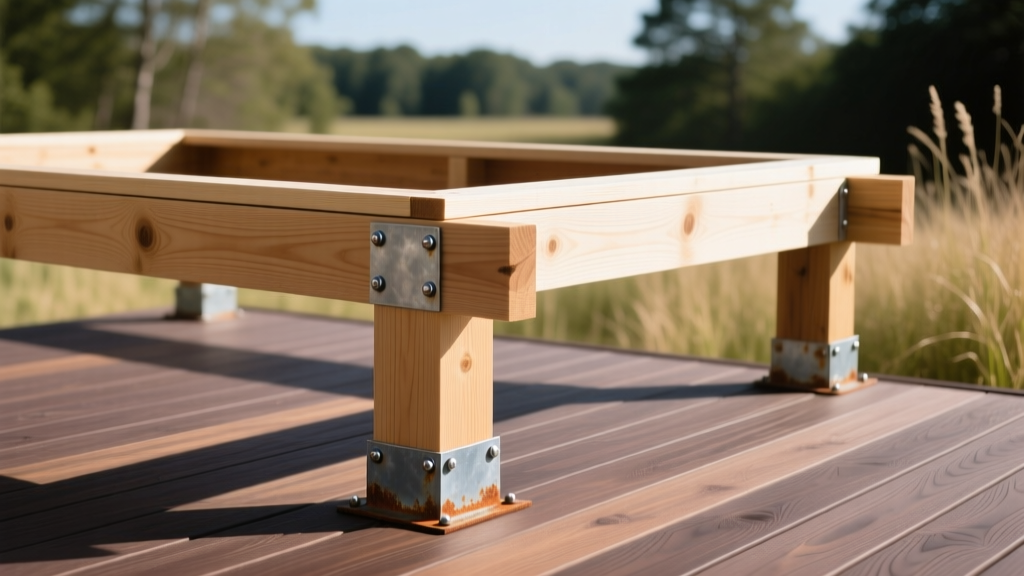
Decking Boards: Surface Types of Wood for Decks
The decking surface dictates the aesthetic, maintenance requirements, and foot-traffic durability of the structure. When selecting types of wood for decks, the Janka hardness scale—a measure of resistance to denting and wear—is a critical metric, especially for homes with large dogs or high outdoor entertaining traffic.
Material Comparison Matrix
| Wood Species | Janka Hardness | Natural Decay Resistance | Est. Cost per Linear Foot (2026) | Maintenance Profile |
|---|---|---|---|---|
| Pressure-Treated Pine (5/4x6) | 690 lbf | High (via chemical treatment) | $2.50 - $3.50 | Annual sealing required; prone to checking |
| Western Red Cedar | 350 lbf | Moderate (natural tannins) | $5.00 - $7.50 | Bi-annual oiling; soft surface dents easily |
| Coast Redwood | 420 lbf | High (heartwood only) | $8.00 - $12.00 | Bi-annual oiling; highly dimensionally stable |
| Ipe (Brazilian Walnut) | 3,680 lbf | Extreme (Class A fire rating) | $14.00 - $18.00 | Low; grays naturally or requires UV oil |
| Cumaru (Brazilian Teak) | 3,540 lbf | Extreme | $10.00 - $13.00 | Low; requires pre-drilling for all fasteners |
For structural longevity without chemical treatments, tropical hardwoods like Ipe and Cumaru are unmatched. According to the U.S. Forest Products Laboratory, the natural extractives in these dense hardwoods act as built-in fungicides, offering a service life of 40+ years even in direct ground contact. However, their extreme density requires specialized carbide-tipped saw blades and pre-drilled holes for fasteners to prevent shear failure of the screws.
Span Ratings and Load-Bearing Limits
The most frequent structural failure in DIY and poorly managed deck builds is exceeding the allowable span of the joists. Span limits are dictated by the species, the grade of the lumber, the spacing of the joists (typically 12', 16', or 24' on-center), and the local code requirements for live and dead loads.
The American Wood Council's Prescriptive Residential Deck Construction Guide (DCA-6) provides the definitive span tables used by building inspectors nationwide. Below are the maximum allowable spans for common framing lumber under a standard 40 psf live load and 10 psf dead load:
- 2x8 Southern Yellow Pine (#2 Grade): Max span of 13' 1" at 16" O.C. spacing.
- 2x8 Douglas Fir-Larch (#2 Grade): Max span of 12' 4" at 16" O.C. spacing.
- 2x10 Southern Yellow Pine (#2 Grade): Max span of 16' 2" at 16" O.C. spacing.
- 2x10 Douglas Fir-Larch (#2 Grade): Max span of 15' 1" at 16" O.C. spacing.
Dimensional lumber is rarely perfectly straight. When installing joists, look down the edge of the board to identify the 'crown' (the slight upward bow). Always install joists with the crown facing UP. As the deck bears weight and the wood ages, the load will push the crowned joist down into a flat, level position. Installing a joist crown-down will result in a permanent, visible sag in the decking surface.
Fastener Compatibility and Corrosion
A deck is only as strong as its connections. The alkaline copper quaternary (ACQ) and copper azole (CA-C) preservatives used in modern pressure-treated lumber are highly corrosive to standard metals. Using uncoated or electro-galvanized nails and joist hangers will result in severe galvanic corrosion, compromising the structural connections within a few seasons.
For all structural connections involving pressure-treated wood, you must specify:
- Hot-Dipped Galvanized (HDG) Fasteners: Must meet ASTM A153 Class D (for nails/screws) or ASTM A653 Class G185 (for joist hangers and connectors).
- Stainless Steel: Type 304 is sufficient for most environments, but Type 316 is mandatory for coastal builds within 10 miles of saltwater.
- Isolation Membranes: When attaching wood beams to steel posts or using specialized hidden fastener systems, use a polyethylene or rubber membrane to prevent direct wood-to-metal moisture trapping.
Decision Framework: Choosing Your Lumber Package
Selecting the right types of wood for decks requires balancing upfront budget, structural demands, and long-term maintenance. Use this framework to finalize your material list:
Scenario A: The Budget-Conscious Structural Build
Framing: #2 Grade Pressure-Treated SYP (UC3B for joists/beams, UC4A for posts).
Decking: 5/4x6 Pressure-Treated SYP.
Verdict: Lowest upfront cost. Requires annual power washing and sealing to prevent severe checking and splintering. Best for utilitarian spaces or future composite upgrades.
Scenario B: The Premium Natural Aesthetic
Framing: #2 Grade Pressure-Treated SYP or Douglas Fir.
Decking: 5/4x6 Western Red Cedar or Clear-Grade Coast Redwood.
Verdict: Moderate cost with high visual appeal. The natural tannins provide moderate rot resistance, but the soft Janka rating means furniture legs and pet claws will leave permanent indentations. Requires penetrating oil finishes every 2 years to prevent UV graying.
Scenario C: The Generational Fortress
Framing: #1 Grade Pressure-Treated SYP or structural steel framing.
Decking: 5/4x6 Ipe or Cumaru with hidden clip fasteners.
Verdict: Highest upfront material and labor cost (pre-drilling and specialized clips add 30% to labor time). Yields a Class-A fire-rated, rot-proof surface that will easily outlast the 40-year structural lifespan of the pressure-treated framing beneath it. End-grain sealing with anchor-seal wax is mandatory during installation to prevent micro-checking.
'The integration of proper lumber grading, accurate span calculations, and strict adherence to preservative Use Categories separates a 40-year structural asset from a 10-year liability.' — WoodWorks Design Solutions
By treating the structural framing and the surface decking as two separate engineering decisions, you ensure that the types of wood for decks you select will perform safely under load while delivering the exact aesthetic and maintenance profile your project requires.
Written by
Priya KapoorPriya Kapoor is a real estate market analyst and construction economics researcher with expertise in housing affordability, development feasibility, and infrastructure investment. She holds a Master of Regional Planning from Cornell University and previously worked as a senior analyst at CBRE's Investment Properties group, where she modeled returns for $4B in mixed-use development pipelines. Priya now runs an independent research practice advising developers, municipalities, and REITs on construction cost forecasting and market timing. She publishes the quarterly "BuildMat Market Pulse" report tracking material price indices across 12 commodity categories. Based in Austin, TX, Priya serves on the board of Habitat for Humanity Austin and is a marathon runner.
More from Priya Kapoor
View all
Construction Cost
Cost to Build a 1600 Sq Ft Home in 2026: Full Breakdown
Accurate 2026 cost to build a 1600 sq ft home—material, labor, and regional pricing breakdowns included. Plan your budget with real-time estimates.
Aug 11, 2026

Wood & Lumber
Name the Types of Wood for Pressure Treatment and Preservation
Learn how to name the types of wood best suited for pressure treatment. Compare species treatability, chemical retention levels, and 2026 preservation costs.
Aug 4, 2026

Stone & Masonry
Stone Veneer Suppliers Lindenhurst: 2026 Cost Analysis
Analyze 2026 stone veneer costs in Lindenhurst, NY. Compare local supplier pricing, delivery fees, and Suffolk County installation labor rates.
Aug 4, 2026