Types of Sandpaper for Wood: 2026 Cost & Value Analysis
Compare types of sandpaper for wood with our cost analysis. Discover the true ROI of ceramic, aluminum oxide, and garnet abrasives for every wood species.

The True Cost of Sanding: Upfront Price vs. Labor Value
When sourcing abrasives for a woodworking shop or a custom cabinetry project, the immediate instinct is to minimize material costs. A standard sheet of garnet sandpaper might cost $0.50, while a premium ceramic-backed sheet can exceed $4.00. However, evaluating the types of sandpaper for wood strictly on upfront price is a fundamental miscalculation that destroys project margins.
In 2026, the average custom woodworking shop rate hovers between $85 and $120 per hour. If a cheaper abrasive clogs after 45 seconds of sanding resinous pine, the operator must stop the random orbital sander, peel off the hook-and-loop disc, and apply a new one. If that workflow interruption takes 30 seconds, and the operator goes through 15 discs to finish a single cabinet run, you have just lost 7.5 minutes of billable labor—roughly $11.25 in shop time—saving perhaps $3.00 in abrasive material. The true cost of sandpaper is measured in cost per square foot of material removed, not cost per sheet.
True Cost = (Price per Disc + (Time to Change Disc × Hourly Shop Rate)) ÷ Square Feet Sanded Before Failure
Abrasive Material Breakdown & Cost Matrix
Different abrasive minerals fracture, dull, and interact with wood fibers in fundamentally different ways. According to Wood Magazine's comprehensive sandpaper guide, matching the mineral to the wood species is the single most effective way to prevent premature clogging and scratching.
| Abrasive Mineral | Avg. Cost (5-inch Disc) | Lifespan & Friability | Best Wood Application |
|---|---|---|---|
| Garnet (Natural) | $0.40 - $0.70 | Low. Dulls quickly but burnishes wood. | Final hand-sanding bare softwoods before shellac. |
| Aluminum Oxide | $0.65 - $1.30 | Medium. Friable (fractures to expose new sharp edges). | General hardwoods (Oak, Maple, Ash). |
| Silicon Carbide | $1.10 - $1.90 | High. Extremely hard, sharp, but brittle. | Wet-sanding finishes, resinous woods, MDF. |
| Ceramic (e.g., Cubitron) | $2.80 - $4.50 | Extreme. Self-sharpening micro-crystalline structure. | Heavy stock removal, exotic hardwoods, belt sanding. |
The Hidden Cost of Grit Grading Mismatches
A frequent and expensive error in professional finishing shops is mixing sandpaper grading standards. There are two primary grading systems for the types of sandpaper for wood available in North America: the older CAMI (Coated Abrasive Manufacturers Institute) standard and the European FEPA (Federation of European Producers of Abrasives) standard, which is denoted by a 'P' prefix (e.g., P220).
Why the 'P' Matters for Your Bottom Line
As detailed by the Federation of European Producers of Abrasives (FEPA), the FEPA standard allows for a tighter tolerance in particle size distribution. More importantly, at finer grits, FEPA and CAMI diverge drastically. A CAMI 220-grit paper has an average particle size of 68 microns, while a FEPA P220 has an average particle size of 68 microns, but a FEPA P180 is actually coarser than a CAMI 180. If an operator transitions from a CAMI 150 disc to a FEPA P180 disc, they are effectively making a massive jump in coarseness, leaving deep scratch patterns that require an additional 20 minutes of labor to erase. Always verify the grading system printed on the backing to ensure a seamless, cost-effective grit progression.
Wood-Specific Sandpaper Selection Framework
Wood is not a uniform substrate. The Janka hardness, pitch content, and natural oils of a species dictate which abrasive coating will yield the highest return on investment.
- Resinous Softwoods (Pine, Cedar, Fir): These species generate heat under power sanding, which melts natural pitch and instantly glues wood dust to the abrasive valleys (a failure mode known as 'corning'). Solution: Use stearated (no-load) aluminum oxide. The zinc stearate coating acts as a dry lubricant, preventing pitch adhesion. It costs 15% more than non-stearated paper but extends disc life by up to 400% on pine.
- Domestic Hardwoods (White Oak, Hard Maple, Hickory): High Janka hardness ratings (1300+ lbf) blunt standard abrasives quickly. Solution: Use open-coat aluminum oxide. The 'open coat' means the abrasive grains cover only 50% to 70% of the backing, providing channels for hardwood dust to evacuate without clogging the cutting surface.
- Oily Exotics (Teak, Rosewood, Cocobolo): Natural oils act as a binder for sawdust, rendering standard paper useless in minutes. Solution: Use silicon carbide or wipe the wood with naphtha immediately before sanding. According to Klingspor's wood application technical data, silicon carbide's sharp, glass-like fracture mechanism cuts through oily fibers without generating the friction-heat that draws more oil to the surface.
Never use stearated (no-load) sandpaper between coats of water-based polyurethane or lacquer. The zinc stearate residue left on the wood surface acts as a bond-breaker, causing the water-based topcoat to crawl, fisheye, or delaminate. Reserve stearated papers strictly for bare-wood preparation, and vacuum thoroughly with a HEPA filter before finishing.
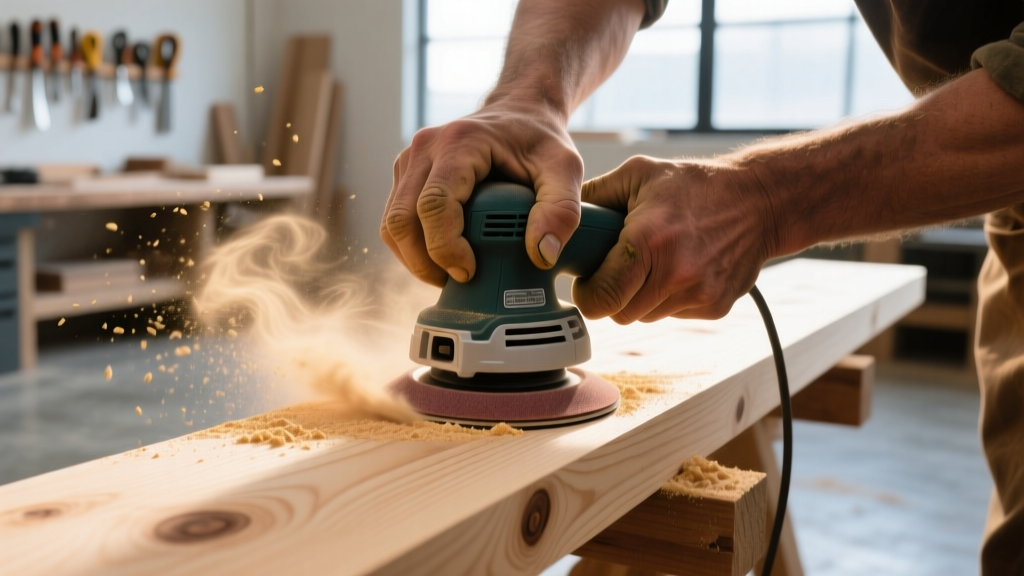
Power Sanding vs. Hand Sanding: Consumable Economics
The format of the sandpaper dictates its cost-efficiency profile. While 9x11 inch sheets are standard for hand-sanding blocks, random orbital sanders (ROS) and belt sanders require specialized formats.
Belt and Disc Economics
For heavy stock removal—such as flattening a glued-up slab dining table or leveling a butcher block—ceramic abrasive belts (like Norton Blaze or 3M Cubitron II) represent the highest value. A 3x21 inch ceramic belt may cost $14.00, compared to $4.00 for an aluminum oxide equivalent. However, the ceramic belt will remove 80% more material before the grains fracture and dull. When factoring in the time saved on belt changes and the reduced physical fatigue on the operator, ceramic belts offer a 3:1 ROI for material removal tasks exceeding 1/16th of an inch.
For final finishing on a random orbital sander, the cost dynamic shifts. Because the final grits (P180 to P220) are removing microscopic fibers rather than leveling joints, the extreme cutting power of ceramic is wasted. Standard stearated aluminum oxide hook-and-loop discs provide the optimal balance of cost and finish quality for the final 20% of the sanding workflow.
Pro Tips for Maximizing Sandpaper ROI
Even the most expensive abrasives will fail prematurely if shop protocols ignore dust extraction and maintenance. Implement these three practices to reduce your annual abrasive spend by up to 30%:
- Optimize Dust Extraction Velocity: A random orbital sander connected to a standard shop vacuum loses up to 40% of its suction power if the hose exceeds 10 feet in length or features sharp 90-degree bends. Trapped dust recirculates under the pad, grinding the abrasive grains down like sandpaper on sandpaper. Use short, wide-diameter anti-static hoses.
- Utilize Crepe Rubber Cleaning Blocks: For $8.00, a natural gum rubber block can clean clogged pitch and dust from the valleys of a partially worn belt or disc. Pressing the rubber block against the spinning abrasive pulls out embedded debris, often restoring 80% of the disc's cutting ability and doubling its usable lifespan.
- Store in Climate-Controlled Environments: The paper and cloth backings of sandpaper are hygroscopic. Storing boxes of abrasive sheets in an unheated, damp garage causes the backing to warp and the adhesive bonding the grain to the backing to degrade. When applied to a hook-and-loop pad, warped discs will vibrate, creating uneven 'pigtails' (swirl marks) in the wood that require costly rework to fix.
Ultimately, selecting the right types of sandpaper for wood is an exercise in process engineering. By aligning the abrasive mineral, the coating technology, and the grit grading system with the specific biological properties of your lumber, you shift sanding from a frustrating consumable expense to a highly predictable, cost-controlled variable in your production pipeline.
Written by
David NakamuraDavid Nakamura is a licensed architect (AIA) and construction technology writer focused on sustainable building methods, mass timber engineering, and high-performance building envelopes. He holds a Master of Architecture from the University of Washington and is a certified Passive House Consultant (CPHC). David spent eight years at the Seattle firm Mithun, where he led the design of three LEED Platinum projects, before founding his own practice specializing in net-zero residential design. He serves on the editorial advisory board of GreenBuilder Magazine and has authored peer-reviewed papers on cross-laminated timber (CLT) connections for the Journal of Structural Engineering. In his spare time, David teaches woodworking at Pratt Fine Arts Center and kayaks the Puget Sound.
More from David Nakamura
View all
Construction Cost
Labor Cost to Build a Deck Per Sq Ft: 2026 Installation Guide
Discover the exact labor cost to build a deck per sq ft in 2026. This installation guide breaks down contractor rates, complexity factors, and hidden fees.
Aug 4, 2026

Construction Cost
How Much Does It Cost to Build a 3 Bedroom House? Financing Guide
Learn exactly how much it costs to build a 3 bedroom house and explore 2026 financing options, construction loan types, and budget frameworks for your build.
Aug 4, 2026

Construction Cost
Cost to Build a Tennis Court: 2026 Guide
How much does it cost to build a tennis court in 2026? Breakdowns for asphalt, concrete, and synthetic surfaces plus fencing and lighting.
Jul 30, 2026