Matching Wood Species to Different Types of Wood Stoves
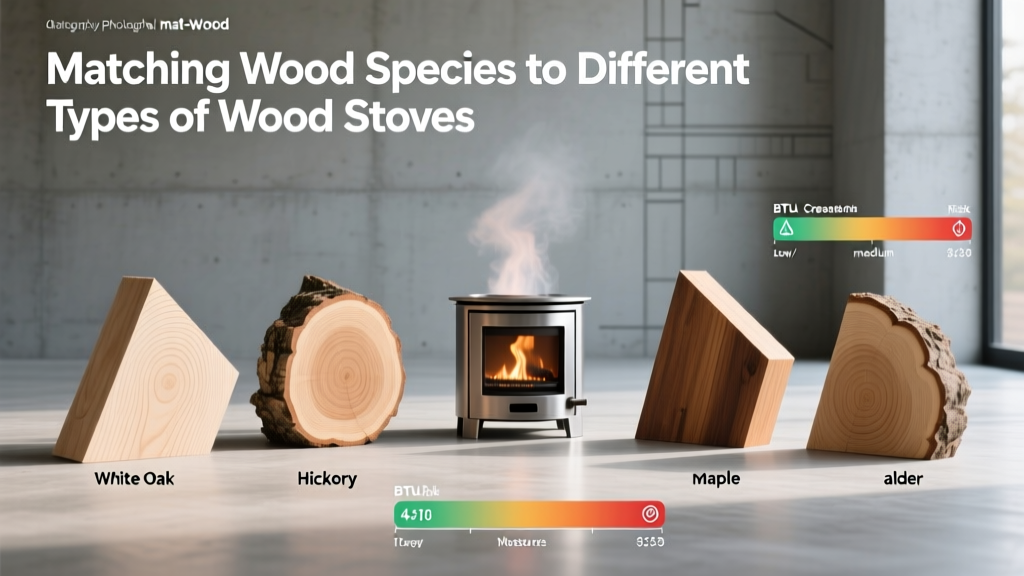
Match the right wood species to different types of wood stoves. Compare BTU, creosote risk, and moisture targets for catalytic and non-catalytic models.
The Intersection of Stove Technology and Timber Selection
The modern wood heating landscape is defined by stringent emission regulations. Under the Environmental Protection Agency (EPA) New Source Performance Standards (NSPS), cordwood stoves are limited to 2.0 grams of particulate matter per hour. Meeting this threshold requires advanced combustion engineering, which in turn dictates strict fuel parameters. When evaluating different types of wood stoves, understanding the thermodynamic and chemical properties of specific wood species is no longer optional—it is a mechanical necessity. Burning the wrong timber in a highly engineered firebox leads to catalyst poisoning, secondary air tube blockages, and severe creosote accumulation. This guide maps specific lumber species to their optimal stove architectures, ensuring maximum thermal efficiency and equipment longevity.
Catalytic vs. Non-Catalytic: Combustion Mechanics and Wood Density
The primary division in modern wood heating is between catalytic and non-catalytic combustion systems. Each relies on entirely different chemical pathways to achieve secondary combustion, requiring distinct wood species profiles.
Catalytic combustors operate by routing smoke through a ceramic or stainless steel honeycomb coated in platinum or palladium. If you introduce wood with a moisture content above 20%, the resulting steam causes rapid thermal shock, cracking the ceramic substrate. Furthermore, high-sap softwoods (like Pine or Spruce) vaporize unburned hydrocarbons that coat the precious metal washcoat, permanently deactivating the catalyst.
Species Profiles for Catalytic Combustors
Catalytic stoves thrive on dense, low-resin hardwoods that provide a steady, predictable burn rate and minimal volatile organic compound (VOC) off-gassing. The EPA BurnWise program emphasizes that clean fuel is critical for maintaining the sub-2.0 g/hr emission rates of catalytic units.
- White Oak (Quercus alba): Yields approximately 26.4 million BTUs per cord. Its tight cellular structure and low sap content make it the premier fuel for catalytic stoves, providing a long, stable coal bed that keeps the combustor in its optimal 500°F–1000°F operating window.
- Sugar Maple (Acer saccharum): Delivering 24.0 million BTUs per cord, Sugar Maple splits cleanly and seasons predictably. It produces minimal ash, preventing the clogging of the catalyst's micro-pores.
- Yellow Birch (Betula alleghaniensis): At 23.6 million BTUs per cord, Yellow Birch offers a high heat output with a moderate burn rate. However, the bark must be managed, as it can occasionally flake and obstruct primary air inlets.
Species Profiles for Non-Catalytic Secondary Burn
Non-catalytic stoves utilize firebox insulation, baffles, and secondary air tubes to ignite smoke above the fire. Because they lack a fragile catalyst, they can tolerate a wider variety of wood species, including moderate-resin softwoods for shoulder-season heating.
- Red Oak (Quercus rubra): Producing 24.6 million BTUs per cord, Red Oak burns slightly faster and hotter than White Oak. The aggressive secondary air injection in non-catalytic stoves perfectly handles Red Oak's heavier initial off-gassing phase.
- White Ash (Fraxinus americana): At 24.2 million BTUs per cord, Ash is unique for its naturally low moisture content even when green. It is ideal for non-catalytic stoves when rapid heat is required without a prolonged seasoning wait.
- Douglas Fir (Pseudotsuga menziesii): Yielding 20.7 million BTUs per cord, this softwood is excellent for autumn and spring 'shoulder season' fires in non-catalytic units. The secondary air tubes effectively combust the resins that would otherwise foul a catalyst.
Masonry Heaters: High-Mass Thermal Storage Requirements
Masonry heaters (often referred to as Finnish or Russian fireplaces) operate on a completely different paradigm. Rather than a slow, smoldering burn, they require a rapid, intensely hot fire to charge thousands of pounds of soapstone, brick, or tile. The thermal mass absorbs the heat and radiates it slowly over 12 to 24 hours.
For masonry heaters, slow-burning hardwoods are counterproductive. You need species with extreme energy density that burn rapidly and completely to flue gas temperatures exceeding 1,500°F.
- Osage Orange (Maclura pomifera): The undisputed king of firewood at 32.9 million BTUs per cord. It burns incredibly hot and fast, perfectly charging a masonry mass in a single 90-minute burn cycle.
- Hickory (Carya spp.): Delivering 28.5 million BTUs per cord, Hickory provides the intense, rapid thermal spike required to penetrate deep into the masonry flue channels without leaving excessive unburned carbon in the ash.
Wood Species BTU, Creosote, and Stove Match Matrix
The following matrix cross-references common North American timber species with their thermal output, creosote risk profile, and optimal stove pairing. Proper matching prevents chimney fires and ensures compliance with local air quality regulations, as monitored by organizations like the Chimney Safety Institute of America (CSIA).
| Wood Species | BTU per Cord (Millions) | Creosote Risk | Ideal Stove Type Match |
|---|---|---|---|
| Osage Orange | 32.9 | Very Low | Masonry Heaters |
| Hickory | 28.5 | Low | Masonry / Non-Catalytic |
| White Oak | 26.4 | Low | Catalytic / Non-Catalytic |
| Red Oak | 24.6 | Low-Moderate | Non-Catalytic |
| White Ash | 24.2 | Low | Non-Catalytic |
| Yellow Birch | 23.6 | Moderate | Catalytic (Bark Removed) |
| Douglas Fir | 20.7 | High | Non-Catalytic (Shoulder Season) |
| Ponderosa Pine | 15.2 | Very High | Outdoor Boiler / Avoid Indoors |
Pellet Stoves: The Engineered Wood Matrix
Pellet stoves represent a highly automated subset of wood heating, utilizing compressed sawdust and wood shavings. The fuel is standardized by the Pellet Fuels Institute (PFI), but understanding the underlying wood species used in the pellets is vital for ash management and clinker prevention.
Hardwood vs. Softwood Pellets
A common misconception is that hardwood pellets are universally superior because hardwood logs burn longer. In the context of pellet stoves, this is often false. Softwood pellets (derived from Pine, Spruce, or Fir) typically possess higher lignin content and lower ash percentages than hardwood pellets. When compressed into pellets, softwood yields a higher BTU output per pound and burns cleaner, provided the manufacturing process removes bark and impurities.
- Premium Softwood Pellets: Ash content < 1%. Ideal for high-efficiency pellet stoves with small ash pans (e.g., Harman P68). Requires cleaning every 3-4 days.
- Standard Hardwood Pellets: Ash content 1% - 3%. Suitable for utility-grade stoves or models with large ash extraction systems. Requires daily vacuuming to prevent auger jams.
Moisture Content and Seasoning Protocols by Stove Type
The species of wood is irrelevant if the moisture content (MC) falls outside the operational parameters of the stove. Using a pinless moisture meter (such as the Wagner Meters MMC220) is mandatory for modern wood heating.
- Catalytic Stoves (Target 15% - 18% MC): Split White Oak or Maple to a maximum diameter of 5 inches. Stack in a single row, off the ground on pressure-treated pallets, and cover only the top 18 inches with a tarp to allow lateral wind drying. Expect 18 to 24 months of seasoning time for dense hardwoods.
- Non-Catalytic Stoves (Target 18% - 20% MC): Red Oak and Ash can be split to 6-inch diameters. These species can reach target moisture levels in 12 to 15 months under optimal solar and wind exposure.
- Masonry Heaters (Target < 15% MC): Hickory and Osage Orange must be kiln-dried or seasoned for a minimum of 24 months. Any excess moisture will absorb the thermal energy needed to charge the masonry mass, resulting in a cold flue and heavy smoke.
2026 Sourcing and Cost Metrics
Procurement costs for firewood have stabilized following the supply chain disruptions of the early 2020s, but regional variances remain significant. As of 2026, a standard cord (128 cubic feet) of seasoned mixed hardwood averages between $350 and $550 in the Northeastern and Midwestern United States. Premium, kiln-dried White Oak or Hickory, packaged in shrink-wrapped fractions (1/8 cord or 1/4 cord), commands a premium, often equating to $700 to $900 per full cord equivalent. When purchasing, always verify the species composition and demand a moisture reading at the point of delivery. Mixing high-resin softwoods into a hardwood cord will immediately degrade the performance of a catalytic combustor, turning a $400 fuel investment into a $300 catalyst replacement liability.
Written by
Sarah WhitfieldSarah Whitfield is a chartered quantity surveyor (MRICS) and construction cost analyst with 15 years of experience in material pricing, procurement strategy, and project budgeting. She earned her degree in Construction Management from the University of Reading (UK) and has worked on projects ranging from $2M custom homes to $180M mixed-use developments across North America and Europe. Sarah currently leads cost estimating for BuildMat Insight, maintaining a proprietary database of 4,000+ material price points updated quarterly. She is a frequent contributor to RSMeans cost data panels and has presented at the International Cost Engineering Council (ICEC) congress. Based in Denver, CO, Sarah is an avid trail runner and volunteer mentor for Women in Construction.
More from Sarah Whitfield
View all
Wood & Lumber
What Are the Different Types of Wood? A Builder's Guide
Compare structural softwoods, finish hardwoods, and engineered lumber. Analyze Janka ratings, MOE values, and 2026 pricing for construction.
Aug 4, 2026

Walls & Panels
Steel Framing vs Wood Framing: Corrosion and Moisture Defense
Compare steel framing vs wood framing for moisture resistance. Learn about galvanized coatings, condensation risks, and corrosion protection strategies.
Jul 21, 2026

Stone & Masonry
How to Cut Stone Veneer: Wet Saw vs Grinder Comparison
Compare the best tools for cutting stone veneer. We review wet saws, angle grinders, and chop saws to help you achieve clean, chip-free cuts.
Jul 21, 2026