Types of Wooden Doors: Cost, ROI, and Value Analysis
Compare the types of wooden doors by cost, lifespan, and ROI. Analyze solid wood, solid core, and hollow core options to maximize your home's value.

The Financial Reality of Wooden Door Selection
Selecting the right wooden door is fundamentally a capital allocation decision. While aesthetics often drive the initial choice, the long-term value of a door is dictated by its core construction, wood species, thermal performance, and lifecycle maintenance costs. A $3,500 solid mahogany entry door and a $120 hollow-core pine interior door both fall under the umbrella of "wooden doors," yet their financial profiles, return on investment (ROI), and functional lifespans are entirely different. This analysis breaks down the true costs and value propositions of the primary types of wooden doors available in the current market, providing a framework for builders and homeowners to maximize their investment.
Core Construction: Hollow, Solid Core, and Solid Wood
The most significant cost driver in wooden door manufacturing is the internal architecture. Understanding the structural differences is critical for allocating budget to the right applications.
Hollow Core Doors
Hollow core doors feature a thin wood veneer or molded composite skin supported by an internal honeycomb structure made of cardboard or thin wood strips. They are lightweight and inexpensive but offer minimal structural integrity, poor acoustic insulation, and low impact resistance. These doors are strictly suited for low-traffic interior applications, such as closets or pantries, where privacy and sound dampening are not priorities.
Solid Core Doors
Solid core doors bridge the gap between budget and premium performance. They are constructed with a dense interior made of engineered wood products like medium-density fiberboard (MDF) or particleboard, covered with a natural wood veneer. According to the Architectural Woodwork Institute (AWI), solid core doors meet stringent architectural standards for commercial and high-end residential interiors. They provide excellent sound dampening and a heavy, premium feel at a fraction of the cost of solid lumber.
Solid Wood Doors
Milled from continuous pieces of natural lumber, solid wood doors are the premium standard for exterior entryways and luxury interiors. They offer unmatched authenticity, can be deeply carved or routed, and are fully refinishable. However, they are susceptible to dimensional changes (expansion and contraction) due to humidity fluctuations, requiring precise installation and ongoing maintenance.
When upgrading from hollow core to solid core or solid wood doors, the door weight increases dramatically (from ~30 lbs to over 100 lbs). This necessitates upgrading from standard 3.5-inch hinges to 4-inch or 4.5-inch heavy-duty ball-bearing hinges, and potentially reinforcing the door jamb with longer structural screws to prevent sagging. Factor in an additional $40 to $85 per door for heavy-duty hardware and reinforced installation labor.
Comparative Value Matrix: Types of Wooden Doors
The following matrix outlines the baseline financial and performance metrics for standard 30" x 80" interior doors and standard 36" x 80" exterior entry doors.
| Door Type | Material Cost Range | Sound Transmission (STC) | Expected Lifespan | Resale ROI Impact |
|---|---|---|---|---|
| Hollow Core (Interior) | $50 - $150 | 20 - 25 | 10 - 15 Years | Neutral / Negative |
| Solid Core Veneer (Interior) | $150 - $450 | 30 - 35 | 30+ Years | Positive (Appraisal Value) |
| Solid Pine (Exterior/Interior) | $600 - $1,200 | 35 - 40 | 15 - 25 Years | Moderate |
| Solid Oak (Exterior/Interior) | $1,800 - $3,500 | 40 - 45 | 50+ Years | High (Luxury Market) |
| Solid Mahogany (Exterior) | $3,000 - $6,500+ | 40 - 45 | 60+ Years | Very High (Curb Appeal) |
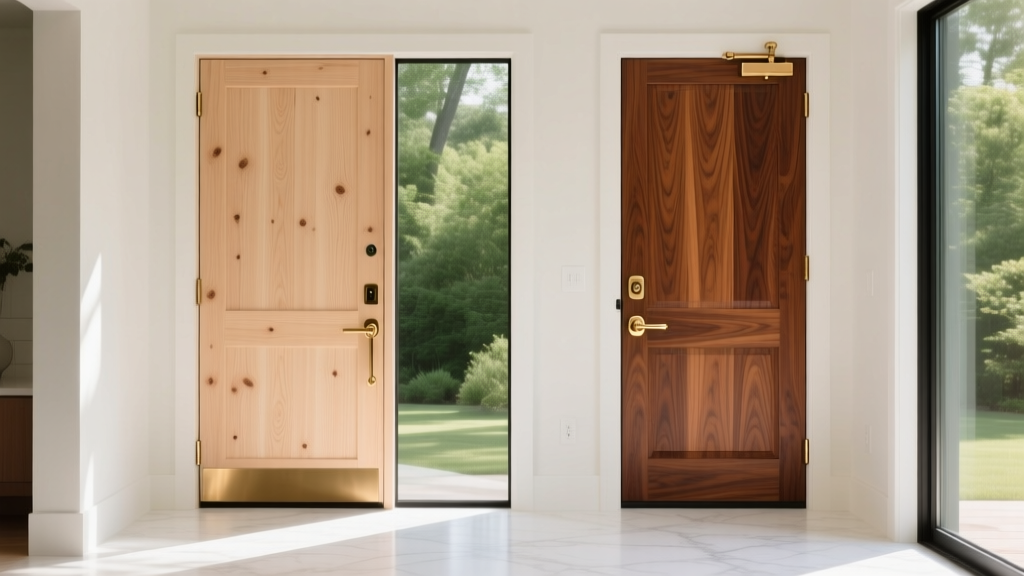
Wood Species and Their Impact on Long-Term Value
For solid wood doors, the botanical species dictates both the upfront cost and the long-term durability. The Janka hardness test measures the resistance of wood to denting and wear, which is a critical metric for high-traffic entryways and homes with children or pets.
- Eastern White Pine (Janka: 380 lbf): The most budget-friendly solid wood option. Pine dents easily and lacks natural rot resistance. It requires heavy sealing for exterior use and is best reserved for interior applications or protected, covered entryways. Cost-to-value ratio is high for budget renovations, but lifecycle maintenance is steep.
- Red Oak (Janka: 1,290 lbf) & White Oak (Janka: 1,360 lbf): Oak provides exceptional structural rigidity and dent resistance. White oak is vastly superior for exterior doors because its cellular structure contains tyloses, which block water penetration and prevent rot. Red oak is highly porous and should be restricted to interior use. A solid white oak entry door offers a premium, heavy feel that significantly boosts curb appeal and appraised value.
- Mahogany (Janka: 800 - 1,000 lbf): Genuine Honduran or African mahogany is the gold standard for exterior entry doors. While softer than oak, its natural oils and interlocking grain make it incredibly dimensionally stable and highly resistant to moisture and insect damage. Mahogany doors command the highest premium in luxury real estate markets, frequently recouping 80% to 90% of their cost upon resale, according to luxury remodeling data tracked by Remodeling Magazine.
- Alder (Janka: 590 lbf): Often used as a budget alternative to cherry or mahogany for interior doors. It takes stain beautifully but is relatively soft. Excellent value for interior solid wood applications where a rich, dark aesthetic is desired without the hardwood price tag.
Energy Efficiency and Hidden HVAC Costs
When evaluating exterior wooden doors, thermal performance is a frequently overlooked financial factor. Wood is a natural insulator, but solid wood doors lack the polyurethane foam cores found in modern fiberglass or steel doors.
A standard 1.75-inch solid wood door has an R-value (thermal resistance) of approximately 2.0 to 2.5. By comparison, an insulated steel or fiberglass door can achieve an R-value of 5.0 to 7.0. The National Fenestration Rating Council (NFRC) evaluates doors based on U-factor (the rate of heat transfer). A lower U-factor indicates better insulation. Solid wood doors typically carry a U-factor between 0.40 and 0.50. If you live in a climate with extreme temperature variances, installing a solid wood entry door without proper weatherstripping and a thermal break threshold can increase your annual HVAC costs by $50 to $150 compared to a high-efficiency insulated alternative.
Value Optimization Tip: If aesthetic authenticity is non-negotiable but energy efficiency is a concern, specify a "stave-core" wood door. These doors feature a thick wood veneer over an engineered core with integrated thermal breaks, achieving U-factors as low as 0.28 while maintaining the exterior appearance of solid lumber.
20-Year Lifecycle Maintenance Costs
The initial purchase price of a wooden door is only the first half of the financial equation. Exterior solid wood doors require rigorous maintenance to protect against ultraviolet (UV) degradation and moisture intrusion. Failure to maintain the finish will lead to wood checking (splitting), veneer delamination, and ultimately, structural failure.
Maintenance Schedule and Cost Projections
- Penetrating Oil Finishes (e.g., Sikkens, Penofin): Require reapplication every 1.5 to 3 years depending on sun exposure. The wood must be lightly scuff-sanded and wiped down. Material cost is roughly $40 per quart, but professional labor will run $250 to $400 per service. Over 20 years, expect to spend $1,500 to $3,000 on maintenance.
- Film-Forming Finishes (e.g., Spar Urethane, Marine Varnish): Last 4 to 6 years. When they fail, they peel and crack. Remediation requires completely stripping the door down to bare wood using chemical strippers and heavy sanding before reapplying 3 to 4 coats. Professional restoration costs $600 to $1,200 per cycle. Over 20 years, expect $1,800 to $3,600 in maintenance.
- Factory-Applied Aluminum Cladding: Some premium manufacturers offer solid wood interior doors with an exterior aluminum cladding. This eliminates exterior wood maintenance entirely while preserving the interior wood aesthetic, adding roughly $800 to the upfront cost but saving thousands in lifecycle maintenance.
Expert Verdict: Maximizing ROI by Application
To maximize financial value, avoid applying a uniform door strategy across an entire build or renovation. Allocate capital based on functional requirements and visibility.
For Exterior Entryways: Invest heavily in a solid mahogany or white oak door with a factory-applied multi-point locking system and premium weatherstripping. The upfront cost of $3,500 to $5,500 is offset by the massive curb appeal and high resale ROI. Do not use pine or red oak for unprotected exterior entries; the maintenance costs and premature failure rates destroy their value proposition.
For Interior Bedrooms and Bathrooms: Solid core MDF doors with a natural wood veneer (such as oak or walnut) offer the highest ROI. At $200 to $350 per door, they provide the acoustic privacy (STC 32+) and heavy, premium feel of solid wood, while remaining entirely immune to the warping and humidity issues that plague solid lumber in bathroom environments.
For Closets and Utility Rooms: Hollow core doors remain the undisputed value champion. Spending more than $100 on a door that is rarely closed and never seen is a poor allocation of construction capital. Redirect the savings from these utility spaces toward the primary entry door, where the financial and aesthetic returns are exponentially higher.
Written by
Sarah WhitfieldSarah Whitfield is a chartered quantity surveyor (MRICS) and construction cost analyst with 15 years of experience in material pricing, procurement strategy, and project budgeting. She earned her degree in Construction Management from the University of Reading (UK) and has worked on projects ranging from $2M custom homes to $180M mixed-use developments across North America and Europe. Sarah currently leads cost estimating for BuildMat Insight, maintaining a proprietary database of 4,000+ material price points updated quarterly. She is a frequent contributor to RSMeans cost data panels and has presented at the International Cost Engineering Council (ICEC) congress. Based in Denver, CO, Sarah is an avid trail runner and volunteer mentor for Women in Construction.
More from Sarah Whitfield
View all
Wood & Lumber
What Are the Different Types of Wood? A Builder's Guide
Compare structural softwoods, finish hardwoods, and engineered lumber. Analyze Janka ratings, MOE values, and 2026 pricing for construction.
Aug 4, 2026

Walls & Panels
Steel Framing vs Wood Framing: Corrosion and Moisture Defense
Compare steel framing vs wood framing for moisture resistance. Learn about galvanized coatings, condensation risks, and corrosion protection strategies.
Jul 21, 2026

Stone & Masonry
How to Cut Stone Veneer: Wet Saw vs Grinder Comparison
Compare the best tools for cutting stone veneer. We review wet saws, angle grinders, and chop saws to help you achieve clean, chip-free cuts.
Jul 21, 2026