What Type of Wood Was Jesus' Cross? Historical Timber Species Guide
Discover what type of wood Jesus' cross was made from. Explore the botanical, historical, and modern structural properties of 1st-century Jerusalem timber.

The New Testament texts are entirely silent regarding the specific botanical species used to construct the cross of Jesus of Nazareth. The original Greek manuscripts utilize the words stauros (an upright pale or stake) and xylon (timber or tree), neither of which denotes a specific genus. However, by cross-referencing 1st-century Roman logistical practices, regional botany, and modern archaeological discoveries in the Levant, wood scientists and historians have identified the exact timber species available in Judea during the early 1st century. For modern builders, woodworkers, and architects, understanding these species provides a fascinating masterclass in Mediterranean timber properties, structural durability, and natural rot resistance.
The Historical and Archaeological Record
Roman execution protocols were governed by brutal efficiency and local resource availability. The Roman military did not import specialty timber for crucifixions; they utilized whatever local wood was structurally sufficient to bear the dynamic loads of a human body and abundant enough to be expendable. Furthermore, the upright post (stipes) was often left permanently in the ground and reused, meaning it required high rot resistance, while the crossbeam (patibulum) was carried by the condemned and could be made of lighter, more abundant timber.
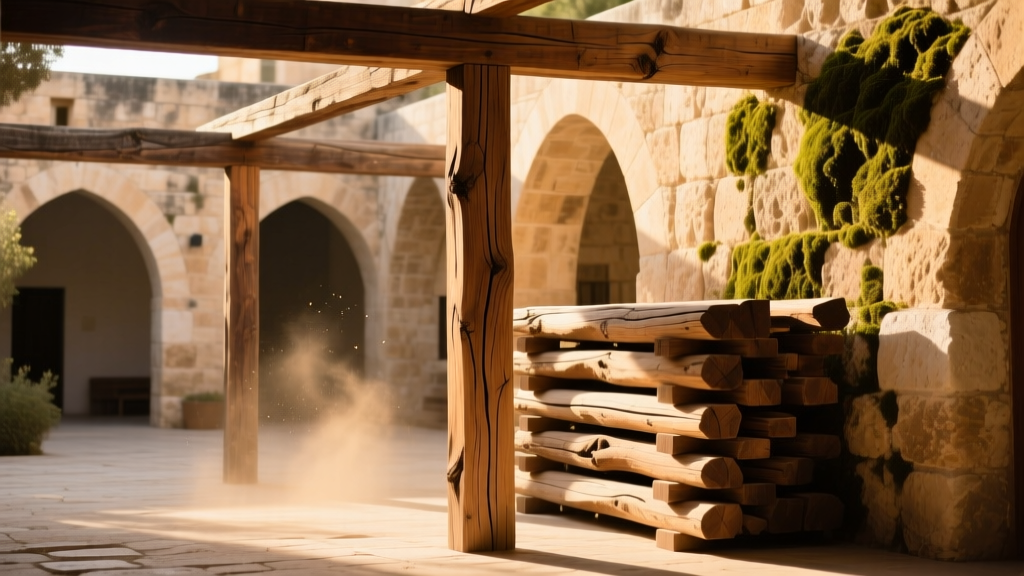
The Primary Timber Candidates: A Species Guide
Based on the dendrological profile of 1st-century Jerusalem and the structural requirements of Roman engineering, four primary species emerge as the most likely candidates. Below is a complete breakdown of their mechanical properties and modern construction applications.
1. Aleppo Pine (Pinus halepensis)
Aleppo Pine was the most abundant and widely used structural softwood in the ancient Levant. It is a fast-growing, highly adaptable conifer that thrives in the rocky, arid limestone soils surrounding Jerusalem. Because it grows relatively straight and can reach heights of 60 feet, it was the default choice for heavy framing, scaffolding, and the permanent upright posts of crosses.
- Janka Hardness: 800 lbf (3,560 N)
- Specific Gravity: 0.45 - 0.55
- Workability: Excellent. Machines well, holds nails securely, and accepts stains evenly.
- Modern Application: Often substituted with Southern Yellow Pine in modern framing. True Aleppo Pine is used in Mediterranean-style architectural millwork, pallets, and rough structural timber.
2. Olive (Olea europaea)
While the Givat HaMivtar discovery confirms olive wood was used in crucifixions, its physical characteristics make it a challenging choice for a full-sized cross. Olive trees are notoriously short, gnarled, and heavily branched. Finding a single, straight, 10-foot section of heartwood large enough for a patibulum is botanically rare. It is highly probable that olive wood was used for smaller structural components, such as the sedecula (the seat peg) or the titulus (the inscribed sign), or in instances where only short crossbeams were utilized.
- Janka Hardness: 2,700 lbf (12,010 N) - Exceptionally dense.
- Specific Gravity: 0.70 - 0.85
- Rot Resistance: Highly resistant to decay and insect attack due to dense heartwood and natural oleuropein compounds.
- Modern Application: Premium interior flooring, high-end turning, and specialty veneers. Rarely used in structural framing due to cost and size limitations.
3. Mediterranean Cypress (Cupressus sempervirens)
Cypress is the quintessential tall, straight evergreen of the Mediterranean basin. In antiquity, it was prized for its exceptional dimensional stability and natural resistance to fungal decay. If the Romans required a timber to remain buried in the damp earth as a permanent stipes without rotting, Cypress was the superior engineering choice. According to the Food and Agriculture Organization (FAO), Cypress has been a cornerstone of Mediterranean forestry and timber production for millennia.
- Janka Hardness: 510 lbf (2,270 N)
- Specific Gravity: 0.40 - 0.48
- Dimensional Stability: Outstanding. Minimal shrinkage and swelling during seasonal moisture fluctuations.
- Modern Application: Exterior siding, boatbuilding, outdoor furniture, and coastal architectural cladding.
4. Acacia (Acacia raddiana / Acacia tortilis)
Growing primarily in the arid Judean desert and the Jordan Rift Valley, Acacia is an incredibly dense, heavy hardwood. While less common in the immediate vicinity of Jerusalem than Pine or Olive, it was heavily utilized for heavy-duty implements and chariot wheels. Its extreme hardness makes driving an iron nail through it difficult without pre-drilling, which may have deterred its use for rapid executions, though it remains a strong candidate for high-stress structural components.
- Janka Hardness: 3,000+ lbf (13,340+ N)
- Specific Gravity: 0.80 - 1.05
- Durability: Virtually impervious to termites and fungal rot.
- Modern Application: Heavy-duty industrial flooring, exterior decking, and specialty tool handles. Detailed profiles on The Wood Database highlight the extreme density variations in desert-hardened Acacias.
Structural Comparison Matrix
For modern builders and specifiers looking to replicate the structural profiles of these historical timbers, the following matrix compares their mechanical properties and modern market availability.
| Species | Janka Hardness (lbf) | Specific Gravity | Rot Resistance | 2026 Avg. Cost (per BF) |
|---|---|---|---|---|
| Aleppo Pine | 800 | 0.45 - 0.55 | Low to Moderate | $4.00 - $7.00 |
| Olive | 2,700 | 0.70 - 0.85 | Very High | $25.00 - $45.00 |
| Mediterranean Cypress | 510 | 0.40 - 0.48 | High | $8.00 - $14.00 |
| Acacia (Desert) | 3,000+ | 0.80 - 1.05 | Exceptional | $18.00 - $30.00 |
Modern Sourcing, Costs, and Alternatives
Procuring authentic Mediterranean timber for modern construction or fine woodworking requires navigating strict environmental regulations and high import tariffs. Olive wood, in particular, is heavily regulated to prevent the over-harvesting of ancient groves. Most commercial olive lumber on the market today is salvaged from trees that have died of natural causes or have been pruned from agricultural orchards.
Cost-Effective Structural Alternatives: If your project requires the structural profile of 1st-century Judean timber without the import costs, consider these domestic substitutions:
- Instead of Aleppo Pine: Use Longleaf Southern Yellow Pine. It shares a similar specific gravity (0.54), high resin content, and excellent nail-holding capacity for rough framing and timber framing.
- Instead of Mediterranean Cypress: Use Tidewater Red Cypress or Western Red Cedar. Both offer the straight grain, lightweight handling, and natural decay resistance required for ground-contact exterior posts.
- Instead of Desert Acacia: Use Black Locust (Robinia pseudoacacia). Black Locust matches the extreme Janka hardness (1,700 - 2,200 lbf) and unparalleled rot resistance of desert Acacia, making it ideal for heavy-duty exterior decking and structural pegs.
Fastening and Finishing Protocols
Working with these dense Mediterranean hardwoods requires specific milling and fastening techniques to prevent structural failure during assembly.
- Pre-Drilling is Mandatory: For Olive and Acacia, driving standard steel nails or wood screws without pre-drilling will result in immediate fastener shearing or severe wood splitting. Use carbide-tipped drill bits to bore pilot holes at 85% of the fastener's shank diameter.
- Moisture Content Targets: Mediterranean hardwoods are prone to severe radial checking if dried too quickly. Kiln-dry Olive wood slowly, targeting a final moisture content (MC) of 8-10% for interior applications. Do not attempt to force-dry green Olive lumber; air-dry it under weight for 12 to 18 months first.
- Finishing Penetration: The natural oils in Olive and Cypress can inhibit the curing of polyurethane and varnish. Before applying a topcoat, wipe the raw wood down with naphtha or acetone to remove surface oleoresins, ensuring proper adhesion of the finish.
Frequently Asked Questions
Did the Romans reuse the wood from crosses?
Yes. Timber was a valuable commodity in the deforested regions surrounding Jerusalem. Historical consensus suggests that the heavy upright post (stipes) was permanently anchored in the ground at execution sites like Golgotha and reused for multiple executions. Only the lighter crossbeam (patibulum) was transported and potentially discarded or repurposed.
Why is Olive wood so expensive in the modern lumber market?
Olive trees rarely grow straight or tall enough to be milled into standard dimensional lumber. The wood is almost exclusively harvested from pruned branches or dead orchard trees, resulting in small, irregular blanks. Combined with high global demand for luxury woodworking and strict agricultural export laws in Mediterranean countries, prices easily exceed $35 per board foot for figured, kiln-dried stock.
Is Cedar of Lebanon a likely candidate for the cross?
While the Cedar of Lebanon (Cedrus libani) is heavily featured in biblical texts regarding the construction of Solomon's Temple, it is highly unlikely to have been used for a Roman execution cross. By the 1st century AD, the massive cedar forests of Lebanon had been heavily depleted by centuries of imperial logging. The remaining timber was far too valuable and heavily guarded to be wasted on criminal executions, making local Pine, Cypress, or Olive the only logical choices.
Written by
James ThorntonJames Thornton is a construction industry veteran with 25 years of hands-on experience in wood framing, lumber grading, and residential building codes. He started as a framing carpenter in rural Oregon, earned his ICC Residential Building Inspector certification, and eventually became a senior plan reviewer for the City of Portland Bureau of Development Services. James holds a B.S. in Wood Science & Technology from Oregon State University and is a certified lumber grader through the West Coast Lumber Inspection Bureau (WCLIB). He has inspected over 3,000 residential construction sites and authored the city's internal guide on advanced framing techniques (2x6 at 24" O.C.). James lives in Bend, OR, where he builds custom timber-frame cabins and competes in lumberjack sports.
More from James Thornton
View all
Insulation
Best Home Insulation Materials: Complete 2026 Guide
Compare top home insulation materials for 2026. Find R-values, installed costs per square foot, and best uses for fiberglass, spray foam, and mineral wool.
Aug 4, 2026

Sustainable Building
Certify Your Green Building Material for LEED and WELL
Step-by-step guide to certifying a green building material for LEED v5 and WELL v2. Master EPDs, HPDs, and VOC limits for 2026 project specifications.
Aug 4, 2026

Stone & Masonry
Veneer Stacked Stone Panels: Interior Design & Style Showcase
Discover how veneer stacked stone panels transform interiors. Explore modern design profiles, material pairings, and technical installation specs.
Aug 4, 2026