Best Type of Wood for Fireplace Surrounds and Mantel Installation
Discover the best type of wood for fireplace surrounds and mantels. Learn installation best practices, code clearances, and fire-safe mounting techniques.

The Intersection of Aesthetics and Fire Code
When contractors and homeowners search for the best type of wood for fireplace applications, they are rarely looking for firewood. In the context of building materials, this refers to the critical selection of wood species for mantels, hearth surrounds, and framing enclosures. Installing wood near a heat source requires balancing architectural beauty with strict adherence to fire safety codes. A poorly chosen or improperly installed wood surround can warp, scorch, or worse, become a fire hazard.
This guide details the exact wood species that perform best under thermal stress, the mandatory building code clearances you must maintain, and the structural installation techniques required to mount heavy timber mantels safely above modern zero-clearance and masonry fireplaces.
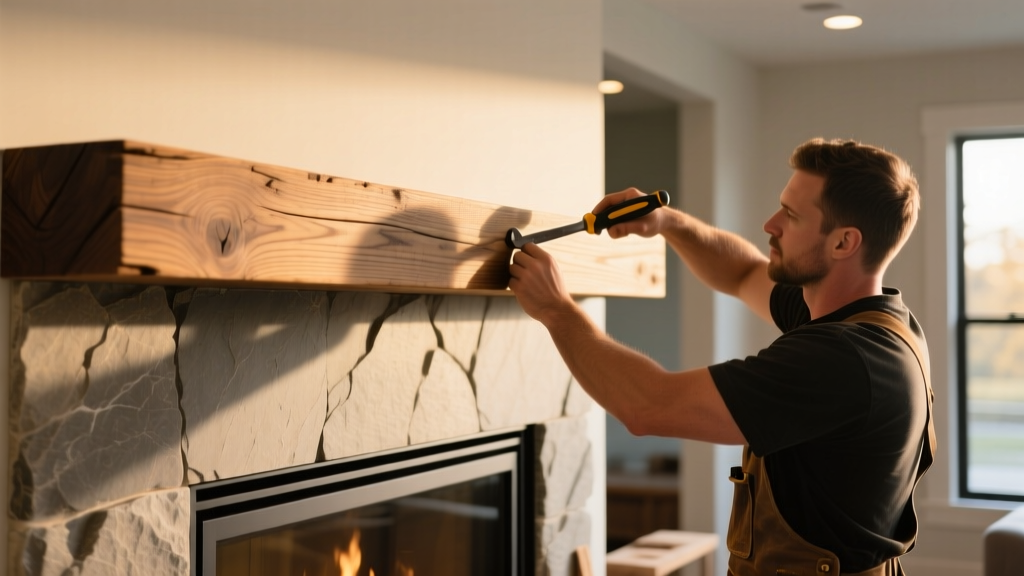
Decoding the Best Type of Wood for Fireplace Surrounds
Not all lumber is created equal when subjected to the radiant heat and fluctuating temperatures of a fireplace environment. The ideal wood must possess high dimensional stability (low shrinkage/swelling rates) and sufficient density to resist surface scorching. Engineered woods like MDF or particleboard must be strictly avoided; they off-gas formaldehyde when heated and lack the structural holding power required for heavy mantel shelves.
| Wood Species | Janka Hardness | Dimensional Stability | Heat & Resin Profile | Best Application |
|---|---|---|---|---|
| White Oak (Quercus alba) | 1,360 lbf | Excellent (Low T/R ratio) | Resists scorching; non-resinous | Heavy timber mantels, modern surrounds |
| Hard Maple | 1,450 lbf | Good | Dense surface resists heat marks | Painted surrounds, traditional mantels |
| Black Walnut | 1,010 lbf | Very Good | Stable, but darkens with UV/heat exposure | High-end custom luxury mantels |
| Reclaimed Heart Pine | 1,225 lbf | Exceptional (Old-growth density) | High resin content; requires sealing | Rustic, farmhouse, or industrial styles |
| MDF / Particleboard | N/A | Poor (Swells with moisture/heat) | Off-gasses under heat; poor screw retention | Do Not Use |
According to the USDA Forest Products Laboratory Wood Handbook, White Oak and Reclaimed Heart Pine offer superior dimensional stability due to their tight growth rings and low tangential-to-radial shrinkage ratios. This means they are significantly less likely to crack or twist when exposed to the dry, radiant heat emitted by a fireplace insert.
Critical Clearances: NFPA 211 and Manufacturer Specs
Before cutting a single piece of lumber, you must establish the legal clearance zones. The National Fire Protection Association outlines strict rules for combustible materials near fireboxes.
NFPA 211 Code Excerpt: "Combustible material, such as wood trim, mantels, and other similar materials, shall not be placed less than 12 inches (305 mm) from the fireplace opening."
— NFPA 211 Standard for Chimneys, Fireplaces, Vents, and Solid Fuel-Burning Appliances
Zero-Clearance Gas Fireplace Warning
While NFPA 211 governs masonry and solid-fuel fireplaces, modern zero-clearance gas fireplaces (e.g., Heatilator, Majestic, Ortal) are tested to UL/CSA standards and have specific manufacturer-mandated clearances. These can sometimes be as close as 6 to 8 inches to the top of the firebox, but only if the manufacturer's specific non-combustible facing requirements are met. Always override general codes with the specific appliance installation manual.
Framing and Backer Board Preparation
The best type of wood for fireplace surrounds will still fail if the substrate behind it is improperly framed. Never attach wood surrounds directly to drywall or raw wood studs near the firebox.
- Steel Stud Framing: Within 24 inches of the firebox opening, transition from wood 2x4 studs to 20-gauge steel studs to eliminate combustible framing material.
- Thermal Break Installation: Install a 1/2-inch cement backer board (such as USG Durock or James Hardie HardieBacker) over the framing. This acts as a non-combustible thermal break.
- Vapor Barrier: In exterior wall fireplace chases, ensure a continuous vapor barrier is maintained behind the cement board to prevent moisture from warping the wood surround from behind.
Heavy Timber Mantel Installation: Step-by-Step
A solid White Oak or Heart Pine mantel shelf measuring 8 inches by 10 inches by 72 inches can easily weigh over 120 pounds. Drywall anchors or basic finishing nails are catastrophic failure points. Use a structural French cleat system for mounting.
- Fabricate the Cleat: Use a 3/16-inch thick steel or heavy-duty aluminum French cleat. Avoid standard hardware store aluminum, which can bend under dynamic loads.
- Locate and Reinforce Studs: Identify the steel or wood studs behind your cement board backer. If the mantel placement doesn't align with studs, install horizontal 2x6 blocking between the studs during the rough-in phase.
- Mount the Wall Cleat: Secure the wall-side cleat using 3-inch Simpson Strong-Drive SDWS structural screws (for wood studs/blocking) or self-drilling Tek screws (for steel studs). Ensure the cleat is perfectly level.
- Route the Mantel: Use a router with a straight bit to cut the mating cleat profile into the back of the timber mantel. The depth of the cut should leave at least 2.5 inches of solid wood at the front face to prevent splitting.
- Lock and Secure: Lift the mantel onto the wall cleat. Once seated, drive 2-inch structural screws up through the bottom of the wall cleat into the mantel to prevent upward dislodgement during seismic events or accidental bumps.
Fire-Resistant Finishes and Maintenance
The finish applied to your wood surround dictates how it will age under thermal cycling. Oil-based polyurethanes tend to amber and become brittle when repeatedly exposed to heat, leading to micro-cracking.
For residential applications, specify a high-quality, water-based commercial finish like Bona Traffic HD. It remains flexible under temperature fluctuations and resists UV yellowing. For commercial installations or high-risk residential builds, apply an intumescent coating (such as Fireguard E-84) as a base layer. Intumescent paints swell when exposed to extreme heat, creating a char barrier that protects the underlying wood substrate and buys critical time in a fire event.
Mounting TVs Above Wood Mantels
If a television will be mounted above the wood mantel, the heat rising from the fireplace can damage the TV's internal components and degrade the wood finish. Install a metal heat deflector shelf just below the TV mount, angled at 45 degrees, to push the convective heat plume outward into the room rather than straight up the wall.
Final Inspection Checklist
Before signing off on the installation, verify the following:
- Clearance from the top of the firebox to the bottom of the wood mantel meets or exceeds NFPA 211 (12") or the specific zero-clearance manufacturer's minimum.
- No exposed combustible framing is visible within the non-combustible facing zone.
- The mantel is secured with structural screws, not drywall screws or lag bolts alone.
- All wood finishes are fully cured and rated for interior thermal environments.
Selecting the best type of wood for fireplace surrounds is only half the battle. By pairing dense, stable species like White Oak with rigorous code-compliant framing and structural mounting hardware, you ensure a fireplace installation that is both architecturally striking and inherently safe.
Written by
David NakamuraDavid Nakamura is a licensed architect (AIA) and construction technology writer focused on sustainable building methods, mass timber engineering, and high-performance building envelopes. He holds a Master of Architecture from the University of Washington and is a certified Passive House Consultant (CPHC). David spent eight years at the Seattle firm Mithun, where he led the design of three LEED Platinum projects, before founding his own practice specializing in net-zero residential design. He serves on the editorial advisory board of GreenBuilder Magazine and has authored peer-reviewed papers on cross-laminated timber (CLT) connections for the Journal of Structural Engineering. In his spare time, David teaches woodworking at Pratt Fine Arts Center and kayaks the Puget Sound.
More from David Nakamura
View all
Construction Cost
Labor Cost to Build a Deck Per Sq Ft: 2026 Installation Guide
Discover the exact labor cost to build a deck per sq ft in 2026. This installation guide breaks down contractor rates, complexity factors, and hidden fees.
Aug 4, 2026

Construction Cost
How Much Does It Cost to Build a 3 Bedroom House? Financing Guide
Learn exactly how much it costs to build a 3 bedroom house and explore 2026 financing options, construction loan types, and budget frameworks for your build.
Aug 4, 2026

Construction Cost
Cost to Build a Tennis Court: 2026 Guide
How much does it cost to build a tennis court in 2026? Breakdowns for asphalt, concrete, and synthetic surfaces plus fencing and lighting.
Jul 30, 2026