Evaluating Laminate Wood Floor Waterproof Specs and AC Ratings
Analyze laminate wood floor waterproof specs, including NALFA swell rates, HDF core densities, and AC wear ratings for 2026 installations.
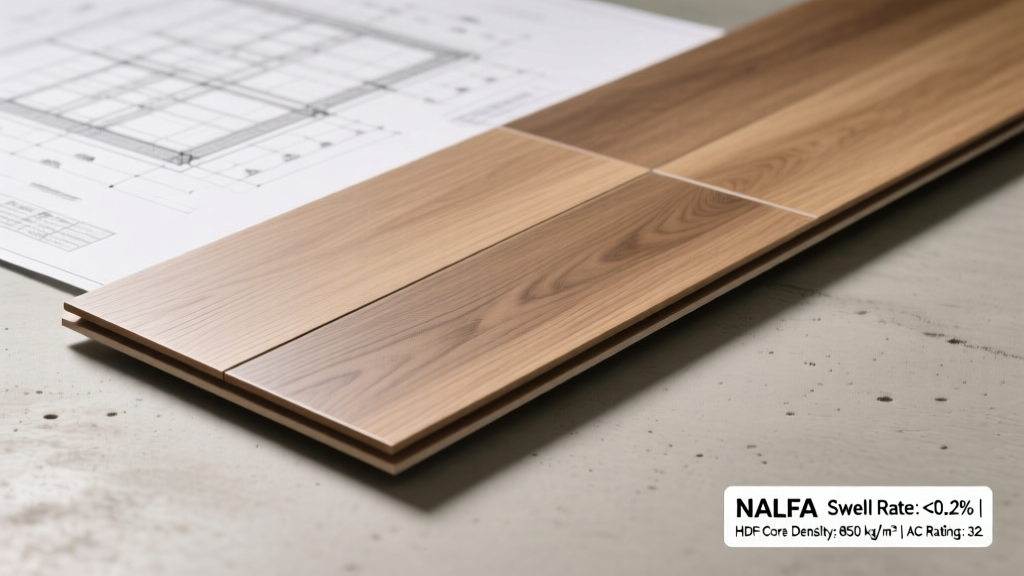
The Marketing Myth vs. Technical Reality of Waterproof Laminate
When evaluating a laminate wood floor waterproof claim, contractors and architects must separate marketing terminology from verifiable material science. Traditional laminate flooring is inherently susceptible to moisture because its structural core consists of High-Density Fiberboard (HDF) or Medium-Density Fiberboard (MDF)—both of which are composed of compressed wood fibers. When exposed to standing water, untreated wood fibers absorb moisture, expand, and cause irreversible edge swelling or 'peaking'.
In 2026, the industry has bifurcated into two distinct categories to address this vulnerability. The first utilizes Wood-Plastic Composite (WPC) or Stone-Plastic Composite (SPC) cores, which are genuinely impervious to water but technically fall under the rigid core luxury vinyl plank (LVP) classification rather than traditional laminate. The second category—which retains the authentic acoustic and tactile properties of wood-based laminate—relies on advanced hydrophobic resin chemistries, ultra-high-density fiberboards, and precision-engineered locking mechanisms to achieve 'waterproof' or 'highly water-resistant' performance ratings.
NALFA Swell Testing: The True Measure of Moisture Tolerance
The North American Laminate Flooring Association (NALFA) establishes the definitive performance standards for laminate moisture resistance. To verify a laminate wood floor waterproof rating, specifiers must look beyond the manufacturer's marketing claims and request the NALFA LF-2011 (or newer) certification data, specifically the Thickness Swell (TS) test results.
The NALFA moisture resistance test involves cutting 50mm x 50mm samples from the flooring plank, submerging them in water at 20°C (68°F) for 24 hours, and measuring the dimensional change using precision calipers. Standard laminate typically exhibits a thickness swell of 12% to 18%. To achieve premium water-resistance classifications required for kitchens, mudrooms, and half-baths, the swell rate must be drastically reduced.
NALFA Moisture Resistance Classifications
| Classification | 24-Hour Edge Swell Rate | Recommended Application Zones |
|---|---|---|
| Standard NALFA | < 18% | Living rooms, bedrooms, dry corridors |
| Moisture Resistant | < 12% | Kitchens, entryways (with prompt cleanup) |
| High-Performance / 'Waterproof' | < 5% (Often < 2%) | Full bathrooms, basements, commercial wet zones |
According to the NALFA Certification Program, products claiming total waterproofing must demonstrate near-zero dimensional change not just on the surface, but critically at the machined click-lock joints where water naturally pools.
Core Density and Resin Chemistry Specifications
The secret to a high-performance laminate wood floor waterproof core lies in the manufacturing chemistry. Standard HDF cores are manufactured using Urea-Formaldehyde (UF) resins, which offer excellent structural binding but break down upon prolonged water exposure. Premium water-resistant laminates utilize Methylene Diphenyl Diisocyanate (MDI) resins or advanced melamine-urea-phenol-formaldehyde (MUPF) blends.
MDI resins react with the moisture naturally present in the wood fibers to create a polyurethane-like bond that is inherently hydrophobic. Furthermore, the physical density of the core plays a critical role in capillary action. Standard HDF operates at a density of 800 to 850 kg/m³. High-moisture laminate cores are compressed to densities between 950 and 1,050 kg/m³. This extreme compression physically reduces the void spaces between wood fibers, leaving less room for water molecules to penetrate.
AC Wear Ratings: Surface Durability Independent of Moisture
While moisture resistance dictates the core's survival, the surface durability of a laminate wood floor waterproof product is governed by the Abrasion Class (AC) rating, standardized under EN 13329. The AC rating is determined by the Taber Abraser test, which measures how many revolutions of abrasive wheels are required to wear through the aluminum oxide decorative layer.
- AC3 (Residential Heavy): Suitable for bedrooms and living rooms. Not recommended for high-traffic commercial or wet-zone entryways.
- AC4 (Commercial General): The minimum specification for 2026 residential wet zones (kitchens, bathrooms) and light commercial spaces. Features a higher concentration of aluminum oxide particles in the wear layer.
- AC5 (Commercial Heavy): Required for retail spaces, restaurants, and heavy-traffic commercial corridors. Offers maximum scratch and scuff resistance, though the surface texture can feel artificially hard underfoot.
Specifiers must ensure that a product's AC rating matches its intended traffic load, as a highly water-resistant core is useless if the decorative wear layer scratches and degrades within two years.
2026 Market Benchmarks: Top-Tier Product Specifications
To provide actionable procurement data, below are the technical specifications of three leading water-resistant laminate systems currently dominating the North American market. These products represent the benchmark for laminate wood floor waterproof performance.
1. AquaGuard Water-Resistant Laminate
- Core Composition: High-Density Fiberboard (HDF) with hydrophobic edge sealing.
- Thickness: 12mm plank + 2mm pre-attached cork/foam underlayment.
- Moisture Warranty: 30-hour surface water resistance guarantee.
- Wear Rating: AC5 (Commercial Heavy).
- Locking Mechanism: 5G vertical click-lock system with micro-bevel water channels.
- Edge Swell Rate: Tested at < 3% after 24-hour submersion.
2. Pergo Outlast+ with SpillProtect24
- Core Composition: Ultra-dense HDF core with Uniclic joint sealing technology.
- Thickness: 10mm plank + 2mm attached underlayment.
- Moisture Warranty: 24-hour spill protection (water must be removed within 24 hours to prevent joint swelling).
- Wear Rating: AC4 (Commercial General).
- Locking Mechanism: Uniclic angle-angle system with integrated hydrophobic wax coating on the tongues.
3. Mohawk RevWood Plus (WetProtect)
- Core Composition: Moisture-resistant HDF with GenuEdge tight-seal technology.
- Thickness: 12mm plank (underlayment sold separately).
- Moisture Warranty: Lifetime surface moisture and subfloor moisture warranty (when installed with Mohawk's proprietary sealant system).
- Wear Rating: AC4.
- Locking Mechanism: Valinge 5G drop-lock with proprietary edge waxing.
Installation Tolerances for Warranty Compliance
The most advanced laminate wood floor waterproof technology will fail if installation tolerances are ignored. Manufacturer warranties for wet-zone installations are strictly contingent upon the following site conditions and installation protocols:
- Perimeter Expansion Gaps: A strict 3/8-inch (10mm) expansion gap must be maintained at all vertical obstructions (walls, cabinets, door jambs). If the plank expands due to ambient humidity and presses against a wall, the compressive stress will cause the click-lock joints to separate, creating a direct pathway for water ingress.
- Wet Zone Joint Sealing: For installations in full bathrooms or commercial kitchens, manufacturers require the application of a 100% silicone sealant or a proprietary joint adhesive (such as Pergo's Sealant) to the short-end click-lock joints during assembly. This creates a continuous, flexible waterproof membrane across the entire floor plane.
- Vapor Retarders: When installing over below-grade concrete, a minimum 6-mil polyethylene vapor barrier must be laid beneath the flooring, with seams overlapped by at least 8 inches and taped with moisture-resistant sheathing tape. If the product features a pre-attached underlayment, verify whether the attached pad includes an integrated vapor barrier; if not, a separate film is mandatory.
By demanding verifiable NALFA swell data, specifying MDI-resin HDF cores, and enforcing strict subfloor moisture testing, architects and contractors can confidently deploy laminate flooring in moisture-prone environments without risking catastrophic material failure.