Best Type of Paint for Outdoor Wood: A Complete Species Guide
Discover the best type of paint for outdoor wood based on species. Expert primer and topcoat pairings for cedar, pine, pressure-treated, and hardwoods.
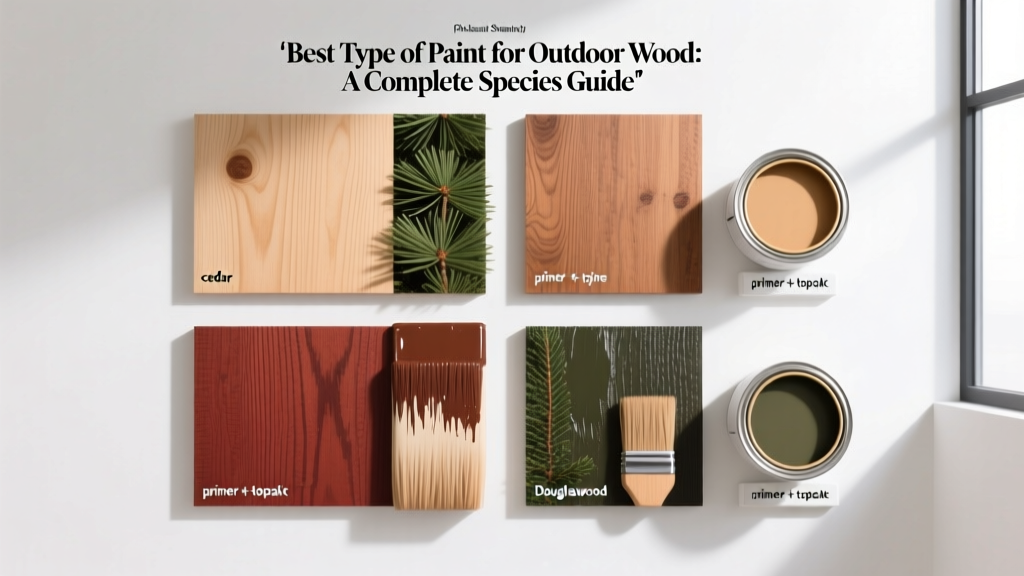
The Myth of the Universal Exterior Paint
Searching for the best type of paint for outdoor wood often leads to a single, misleading recommendation: 100% acrylic latex. While acrylic topcoats are the industry standard for exterior flexibility and UV resistance, applying them directly over the wrong wood species without the correct chemical primer is a guaranteed path to peeling, blistering, and tannin bleed. Wood is a hygroscopic, chemically active material. The cellular structure of porous Southern Yellow Pine behaves entirely differently under a paint film than the dense, oil-rich cellular structure of Ipe or the tannin-heavy Western Red Cedar.
To achieve a 10-to-15-year exterior paint lifespan, you must match the primer chemistry and topcoat build to the specific wood species. This guide breaks down the exact product categories, chemical requirements, and failure modes for painting the most common exterior lumber species in 2026.
Category 1: The Tannin Bleeders (Cedar & Redwood)
Western Red Cedar and California Redwood are prized for their natural rot resistance, which comes from high concentrations of water-soluble tannins. When you apply a standard water-based acrylic primer to bare cedar, the moisture in the primer dissolves these tannins, pulling them through the paint film and leaving ugly brown and yellow streaks on your finished surface.
The Species-Specific Protocol
- Primer Requirement: You must use a solvent-based alkyd or a pigmented shellac primer to seal the tannins. Shellac is the ultimate tannin blocker because it is entirely impermeable to water-soluble compounds.
- Recommended Primer: Zinsser B-I-N (Shellac-based) for heavily weathered or bleeding boards, or Benjamin Moore Fresh Start Alkyd Primer for new, clean cedar.
- Topcoat: 100% Acrylic Latex Exterior (e.g., Sherwin-Williams Emerald Exterior or Benjamin Moore Regal Select Exterior High Build). The acrylic topcoat provides the necessary elastomeric flexibility to handle cedar's high expansion and contraction rates.
Category 2: The Sap & Resin Producers (Pine, Spruce, Fir)
Softwoods like Pine, Spruce, and Fir (SPF) are the most common framing and trim lumbers, but they present a unique challenge: resinous knots. As the wood heats up in direct sunlight, the solidified sap inside the knots liquefies, expands, and pushes through the paint film, causing localized blistering and amber-colored sap bleed.
The Species-Specific Protocol
Do not paint over knots with standard wall primers. The knot must be isolated from the rest of the wood surface.
- Spot Treatment: Scrape any loose sap, wipe the knot with denatured alcohol, and apply two coats of a dedicated knotting solution or pigmented shellac (like Zinsser B-I-N) strictly to the knot and the surrounding 2-inch radius.
- Full Prime: Once the knots are sealed, apply an exterior acrylic or alkyd wood primer to the entire surface.
- Topcoat: High-build acrylic latex. Pine is relatively dimensionally stable compared to cedar, but it is highly porous. A high-build paint fills the deep summer wood grain lines, creating a smoother, more water-resistant shell.
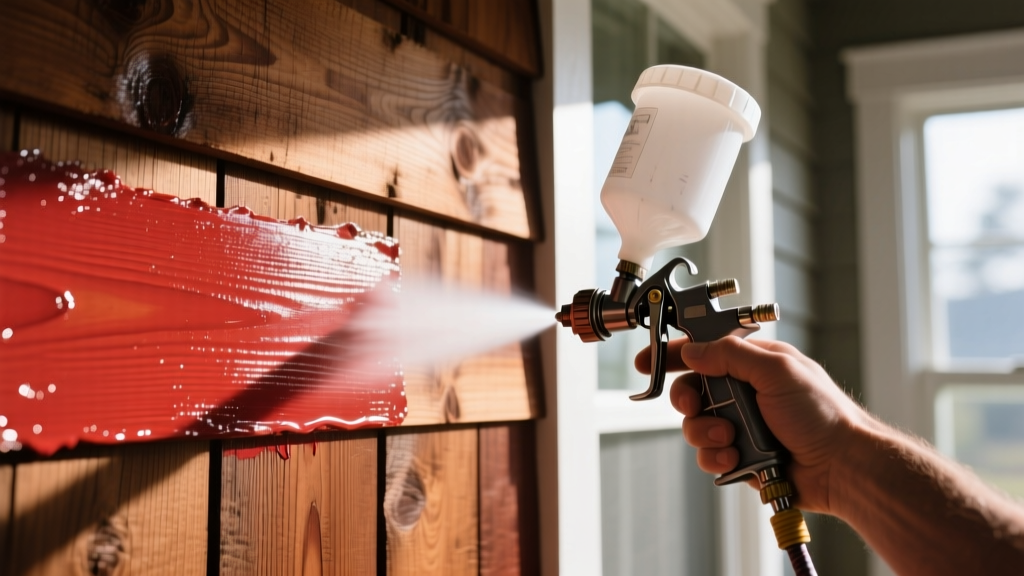
Category 3: Pressure-Treated Lumber (Southern Yellow Pine)
Pressure-treated (PT) wood is infused with copper-based preservatives (like ACQ or Copper Azole) to prevent rot. This process leaves the wood highly alkaline and saturated with moisture. Painting PT wood too soon or with the wrong chemistry results in saponification—a chemical reaction where the alkalinity breaks down the paint binder, turning it into a soapy substance that washes right off the wood.
The Species-Specific Protocol
- Primer Requirement: An alkali-resistant, 100% acrylic exterior primer. Alkyd/oil primers will saponify and fail on PT wood.
- Recommended Primer: Sherwin-Williams Loxon Concrete & Masonry Primer (often used by pros on PT wood due to its extreme alkali resistance) or a dedicated exterior acrylic wood primer labeled for pressure-treated lumber.
- Topcoat: 100% Acrylic Latex. Avoid dark colors on PT decking or steps, as heat absorption will force residual deep-moisture to vaporize, causing blisters.
Category 4: Tropical Hardwoods (Ipe, Teak, Cumaru)
Tropical hardwoods are incredibly dense (Ipe sinks in water) and packed with natural oils and waxes. These oils exist to protect the tree in humid jungles, but they act as a bond-breaker for exterior paints. Furthermore, the density of the wood means it absorbs virtually no primer, leaving the coating sitting on the surface where it will quickly peel under UV and thermal stress.
Expert Consensus: The best type of paint for outdoor wood like Ipe is no paint at all. Film-forming coatings (paints and solid stains) will almost always fail on tropical hardwoods within 2 to 3 years. The industry standard is to use penetrating oil finishes (like Messmer's UV Plus for Hardwoods) that soak into the microscopic surface pores without forming a surface film.
If You Absolutely Must Paint Hardwood:
If architectural requirements demand a painted finish on mahogany or teak, you must use a two-part epoxy primer to mechanically lock onto the dense fibers and block the natural oils, followed by a urethane or high-end acrylic topcoat. This is labor-intensive, expensive, and requires rigorous maintenance.
Species-to-Paint Compatibility Matrix
| Wood Species | Primary Threat to Paint | Required Primer Chemistry | Ideal Topcoat | Expected Lifespan |
|---|---|---|---|---|
| Cedar / Redwood | Water-soluble Tannins | Pigmented Shellac or Alkyd | 100% Acrylic Latex | 10–15 Years |
| Pine / Spruce / Fir | Resinous Sap Bleed | Spot Shellac + Acrylic Base | High-Build Acrylic | 8–12 Years |
| Pressure-Treated Pine | Alkalinity & Trapped Moisture | Alkali-Resistant Acrylic | 100% Acrylic Latex | 7–10 Years |
| Ipe / Teak / Cumaru | Natural Oils & Extreme Density | 2-Part Epoxy (Not Recommended) | Penetrating Oil (No Film) | 1–3 Years (Paint) |
The Non-Negotiable Preparation Steps
Even the most expensive, chemically matched exterior paint will fail if the wood substrate is improperly prepared. The Painting Contractors Association notes that over 80% of exterior coating failures are due to poor surface prep, not product defects.
1. Mechanical Abrasion (Not Just Power Washing)
Power washing removes dirt and mildew, but it often leaves behind "mill glaze" on new wood or dead, oxidized wood fibers on old wood. Oxidized wood is essentially dust; if you paint over it, the paint sticks to the dust, not the wood, and peels off in sheets. You must sand exterior wood with 60- to 80-grit abrasive after washing and drying to expose sound, fresh cellulose fibers.
2. The 30-Minute Water Drop Test
Before priming, splash clean water onto the wood surface. If the water beads up, the wood still contains natural oils, mill glaze, or old water-repellent preservatives. The wood must be sanded or treated with a chemical deglosser until the water absorbs into the grain within 30 seconds.
3. End-Grain Sealing
The end grain of a board acts like a bundle of microscopic straws, wicking moisture directly into the core of the wood. This is the primary cause of rot and paint blistering at the bottom of trim boards and siding. Before installation, or during the priming phase, heavily saturate all end grains with a penetrating epoxy sealer (like System Three RotFix) or a heavy coat of oil-based primer to plug these capillaries.
Cost and Coverage Expectations for 2026
When budgeting your exterior painting project, factor in the coverage rates dictated by the wood species. Rough-sawn cedar and deeply grained SPF will absorb significantly more primer than smooth-planed pine.
- Shellac Primers (Tannin Blockers): $75 – $95 per gallon. Covers ~300 sq ft. High VOC, requires mineral spirits for cleanup.
- Exterior Acrylic Primers: $45 – $65 per gallon. Covers ~350 sq ft. Low VOC, soap and water cleanup.
- Premium 100% Acrylic Topcoats: $85 – $115 per gallon. Covers ~350-400 sq ft per coat. Two coats are mandatory for warranty validation.
Ultimately, identifying the best type of paint for outdoor wood requires looking past the marketing on the topcoat can and focusing on the chemistry happening at the wood-to-primer interface. By matching your primer to the specific biological threats of your wood species—tannins, sap, alkalinity, or natural oils—you transform a vulnerable organic material into a durable, weather-resistant architectural asset.
Written by
Marcus ChenMarcus Chen is a licensed structural engineer (PE) and building materials analyst with over 12 years of experience across residential, commercial, and industrial construction. He holds a Master of Science in Civil Engineering from UC Berkeley and spent six years at Thornton Tomasetti before transitioning to independent consulting and technical writing. Marcus specializes in material selection for seismic-prone regions, concrete reinforcement strategies, and lifecycle cost analysis. His work has been cited by the American Concrete Institute (ACI) and the Structural Engineers Association of California (SEAOC). When he is not on a job site or at his desk, you will find him hiking the Sierra Nevada or restoring a 1920s craftsman bungalow in Oakland, CA.
More from Marcus Chen
View all
Construction Cost
How Much Did the Eiffel Tower Cost to Build?
How much did the Eiffel Tower cost to build in 1889? We adjust for inflation and compare its budget to modern skyscraper construction.
Aug 4, 2026

Fire Resistance
What Is a Fire Resistant Material? Testing & Certification Guide
Discover what is a fire resistant material through ASTM and UL testing. Learn how fire ratings, certifications, and assemblies work in construction.
Aug 4, 2026

Construction Cost
How Much Did the Burj Khalifa Cost to Build?
How much did the Burj Khalifa cost to build? We break down the $1.5B project and extract 5 money-saving strategies for your next build.
Jul 30, 2026