How Experts List the Types of Wood for Construction
Learn how experts list the types of wood for construction. Compare structural timber, framing lumber, and finish species with engineering and span data.

The Engineering Framework for Species Selection
When structural engineers and architects list the types of wood for a commercial or residential build, they do not rely on generic categories like 'pine' or 'oak'. Instead, they reference specific species combinations, stress grades, and moisture contents defined by the American Wood Council's National Design Specification (NDS). The distinction between a visually graded #2 Southern Yellow Pine and a machine stress-rated (MSR) 2400f-2.0E SPF dictates everything from joist spans to lateral load resistance. This guide breaks down the exact species classifications, mechanical properties, and application protocols required for modern construction.
Structural Softwoods: The Framing Backbone
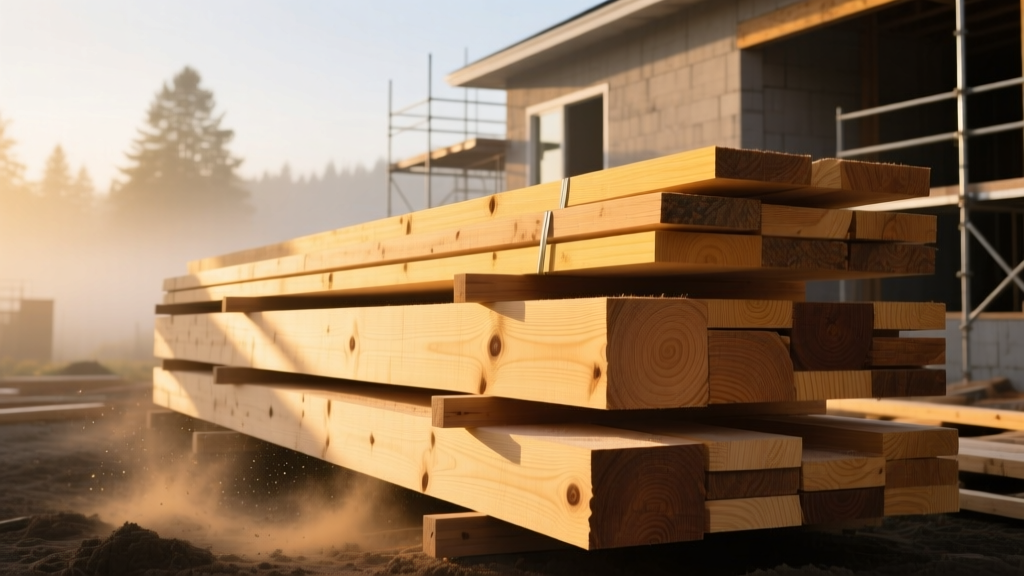
Softwoods account for the vast majority of dimensional lumber used in light-frame and heavy-timber construction. When professionals list the types of wood for structural framing, they group them into specific commercial combinations rather than single botanical species.
Douglas Fir-Larch (DF-L)
Douglas Fir-Larch is the benchmark for high-strength structural framing in North America. It offers an excellent strength-to-weight ratio and high fastener-holding capacity. For a standard 2x6, #2 grade DF-L, the allowable bending stress (Fb) is 1,500 psi, and the modulus of elasticity (E) is 1,900,000 psi. It is the preferred species for roof rafters in high-snow-load regions and for structural beams where depth is constrained.
Southern Pine (SYP)
Southern Yellow Pine is exceptionally dense and holds fasteners better than almost any other softwood. It is heavily utilized in the southeastern United States and is the primary species for pressure-treated lumber. A #2 grade 2x6 SYP boasts an Fb of 1,750 psi and an E of 1,800,000 psi. Its high density makes it ideal for floor joists where stiffness and vibration control are critical, as well as for ledger boards and deck framing.
Spruce-Pine-Fir (SPF)
SPF is a commercial grouping that includes Engelmann spruce, lodgepole pine, and alpine fir. It is lighter and slightly weaker than DF-L or SYP, with a #2 grade 2x6 Fb of 1,000 psi and an E of 1,500,000 psi. SPF is predominantly used for vertical wall studs where axial compression is the primary load, rather than bending. It is also highly favored for prefabricated wood trusses due to its lightweight nature and ease of fabrication.
If you are using SPF for ground-contact or exterior applications, it must be incised before pressure treatment. The dense cellular structure of spruce and alpine fir prevents preservative chemicals from penetrating deeply without mechanical incising. Always verify the 'INC' stamp on treated SPF lumber to ensure code compliance and warranty validity.
Hardwoods: Heavy Timber and Architectural Finishes
While softwoods dominate framing, hardwoods are specified when architects list the types of wood for exposed heavy timber, high-wear flooring, and architectural millwork. Hardwoods are graded primarily by the National Hardwood Lumber Association (NHLA) based on the percentage of clear, defect-free cuttings, rather than structural stress values.
White Oak (Quercus alba)
White oak is highly rot-resistant due to its tyloses-clogged pores, making it one of the few hardwoods suitable for exterior architectural elements, sill plates in historic restorations, and marine applications. With a Janka hardness of 1,360 lbf, it is durable enough for high-traffic commercial flooring. Structurally, it is occasionally used in heavy timber post-and-beam construction where an exposed, high-end aesthetic is required.
Hard Maple (Acer saccharum)
Hard maple is the standard for gymnasium floors, bowling alleys, and heavy-duty industrial workbenches. Its Janka hardness rating of 1,450 lbf and tight, closed grain make it highly resistant to abrasion and indentation. It is rarely used in structural framing due to its high cost, heavy weight, and tendency to check (crack) if not kiln-dried slowly and properly.
Species Selection Matrix: Matching Wood to Structural Loads
To optimize material costs and structural integrity, builders must match the specific mechanical properties of the wood species to the structural demand. The following matrix outlines how engineers evaluate species for specific framing applications based on the USDA Forest Products Laboratory Wood Handbook.
| Species Group | Bending (Fb) psi | Stiffness (E) psi | Optimal Application |
|---|---|---|---|
| Southern Pine (SYP) #2 | 1,750 | 1,800,000 | Floor joists, treated sill plates, heavy decking |
| Douglas Fir-Larch #2 | 1,500 | 1,900,000 | Roof rafters, structural beams, shear walls |
| Spruce-Pine-Fir (SPF) #2 | 1,000 | 1,500,000 | Vertical wall studs, prefabricated trusses |
| Hem-Fir #2 | 1,300 | 1,600,000 | General framing, non-load bearing partitions |
Engineered Wood: Transcending Solid Sawn Limitations
When spans exceed 20 feet or loads surpass the capacity of solid sawn lumber, engineers transition to engineered wood products. Organizations like APA - The Engineered Wood Association provide rigorous standards for these composite materials, which offer superior dimensional stability and predictable engineering values.
Laminated Veneer Lumber (LVL)
LVL is manufactured by bonding thin wood veneers with parallel grain orientation using structural adhesives. It eliminates the natural defects (knots, slope of grain) found in solid lumber. A standard 1.75-inch LVL beam typically offers an Fb of 2,800 to 3,100 psi and an E of 2,000,000 psi. It is the default choice for flush beams, ridge beams, and long-span headers in open-concept residential designs.
Glued Laminated Timber (Glulam)
Glulam consists of dimensional lumber laminations bonded with structural adhesives, often cambered to offset deflection under dead loads. Glulam is specified for massive commercial and civic structures, offering spans of 60 to 100 feet without intermediate support. It is also highly fire-resistant; in a fire, the outer layers char at a predictable rate (typically 1.5 inches per hour), protecting the inner core and maintaining structural integrity long after unprotected steel would fail.
Moisture Content and Acclimatization Protocols
The mechanical properties of wood are inextricably linked to its moisture content (MC). As wood dries below the fiber saturation point (typically 28-30% MC), it gains strength and stiffness, but it also shrinks. Mismanaging moisture is the leading cause of structural callbacks, drywall cracking, and floor squeaks.
- S-DRY (Surfaced Dry): Indicates the lumber had a maximum MC of 19% at the time of surfacing. This is standard for interior framing.
- MC15: Indicates a maximum MC of 15% at surfacing. Required for precision millwork and situations where minimal post-installation shrinkage is critical.
- KD (Kiln Dried): The lumber was dried in a kiln, but without a specific MC stamp, it only guarantees it was heated to kill pests. Always look for the specific S-DRY or MC15 stamp for structural assurance.
For every 1% drop in moisture content below 19%, a standard 2x4 SPF stud will shrink approximately 0.002 inches radially and 0.005 inches tangentially. In a multi-story wood-frame building, cumulative shrinkage across top and bottom plates can result in 1/2 inch to 3/4 inch of total vertical settlement per floor. Engineers must detail slip joints for plumbing and cladding to accommodate this movement.
Fastener Corrosion and Treated Lumber Compatibility
When you list the types of wood for exterior or ground-contact applications, you must simultaneously specify the fastener corrosion requirements. Modern alkaline copper quaternary (ACQ) and copper azole (CA) preservatives are highly corrosive to standard zinc-coated nails and joist hangers.
For any lumber treated with ACQ or CA, building codes mandate the use of hot-dipped galvanized fasteners meeting ASTM A153 standards (minimum 1.0 oz/ft2 zinc coating) or stainless steel (Type 304 for above ground, Type 316 for saltwater environments). Electroplated galvanized hardware is strictly prohibited with modern treated wood, as the copper in the preservative will rapidly corrode the thin zinc layer, leading to catastrophic connection failure.
Written by
Priya KapoorPriya Kapoor is a real estate market analyst and construction economics researcher with expertise in housing affordability, development feasibility, and infrastructure investment. She holds a Master of Regional Planning from Cornell University and previously worked as a senior analyst at CBRE's Investment Properties group, where she modeled returns for $4B in mixed-use development pipelines. Priya now runs an independent research practice advising developers, municipalities, and REITs on construction cost forecasting and market timing. She publishes the quarterly "BuildMat Market Pulse" report tracking material price indices across 12 commodity categories. Based in Austin, TX, Priya serves on the board of Habitat for Humanity Austin and is a marathon runner.
More from Priya Kapoor
View all
Construction Cost
Cost to Build a 1600 Sq Ft Home in 2026: Full Breakdown
Accurate 2026 cost to build a 1600 sq ft home—material, labor, and regional pricing breakdowns included. Plan your budget with real-time estimates.
Aug 11, 2026

Wood & Lumber
Name the Types of Wood for Pressure Treatment and Preservation
Learn how to name the types of wood best suited for pressure treatment. Compare species treatability, chemical retention levels, and 2026 preservation costs.
Aug 4, 2026

Stone & Masonry
Stone Veneer Suppliers Lindenhurst: 2026 Cost Analysis
Analyze 2026 stone veneer costs in Lindenhurst, NY. Compare local supplier pricing, delivery fees, and Suffolk County installation labor rates.
Aug 4, 2026