Types of Soft Wood Compared: Pine, Fir, Spruce & Cedar
Compare the top types of soft wood for construction. Analyze SPF, Douglas Fir, SYP, and Cedar for framing, trim, and exterior uses with 2026 pricing.

The Softwood Hierarchy in Modern Construction
Botanically, softwoods are derived from gymnosperm trees—primarily conifers with needle-like leaves and exposed seeds. In the construction industry, however, the term encompasses a vast spectrum of structural and finish materials. When evaluating the different types of soft wood for a 2026 building project, specifiers must look beyond the generic 'softwood' label. The mechanical properties, dimensional stability, and natural durability vary drastically between a lightweight Spruce-Pine-Fir (SPF) stud and a dense Southern Yellow Pine (SYP) timber.
Choosing the correct species group is not merely a matter of budget; it dictates fastener withdrawal capacities, allowable span lengths, and long-term moisture performance. This comparison review breaks down the primary softwood species groups used in North American construction, analyzing their structural metrics, workability, and optimal applications.
Structural Framing: SPF vs. Douglas Fir vs. Southern Yellow Pine
The backbone of light-frame residential and commercial construction relies on three primary softwood species groups. While they may look similar once painted behind drywall, their engineering values dictate where and how they can be used.
Spruce-Pine-Fir (SPF)
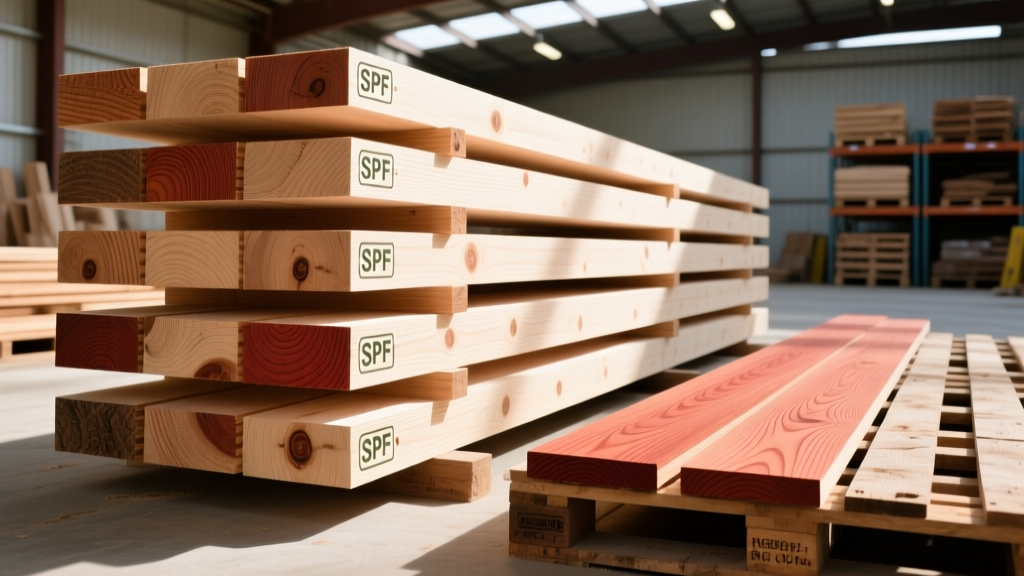
SPF is a marketing designation that blends several species with similar mechanical properties, primarily White Spruce, Lodgepole Pine, and Alpine Fir. It is the standard for interior wall framing and basic roof trusses.
- Modulus of Elasticity (E): 1.5 to 1.9 million psi (depending on specific grade).
- Janka Hardness: 380 to 480 lbf.
- Best Application: Standard 2x4 and 2x6 interior wall studs, non-load-bearing partitions, and engineered truss chords where high bending strength is not the primary driver.
- Failure Mode: SPF is prone to twisting and bowing if exposed to moisture cycles after installation. It also has lower fastener-holding power compared to denser pines, requiring specific nail schedules for shear walls.
Douglas Fir-Larch (DF-L)
Douglas Fir is the premier structural softwood in North America. Despite its name, it is not a true fir but a distinct species (Pseudotsuga menziesii) known for exceptional strength-to-weight ratios and dimensional stability.
- Modulus of Elasticity (E): 1.9 million psi.
- Janka Hardness: 660 lbf.
- Best Application: Long-span floor joists, exposed structural beams, headers, and ridge beams. According to the American Wood Council span tables, DF-L consistently allows for longer spans than SPF at the same dimensional grade.
- Failure Mode: DF-L is susceptible to surface checking (small cracks along the grain) as it dries, though this rarely compromises structural integrity. It can also be brittle in high-impact scenarios.
Southern Yellow Pine (SYP)
Grown primarily in the US Southeast, SYP is actually a cluster of four pine species (Loblolly, Shortleaf, Longleaf, and Slash). It is the densest and heaviest of the major framing lumbers.
- Modulus of Elasticity (E): 1.7 to 2.0 million psi.
- Janka Hardness: 690 to 870 lbf.
- Best Application: Pressure-treated sill plates, deck framing, ledger boards, and high-load floor systems. Its high density and resin content make it the most receptive species for deep chemical preservative penetration.
- Failure Mode: High shrinkage rates. If SYP is installed at a high moisture content (above 19%) and dries in place, severe cupping and warping can occur.
| Species Group | Specific Gravity (Oven-Dry) | Bending Strength (Fb psi) | Fastener Withdrawal |
|---|---|---|---|
| SPF | 0.36 - 0.42 | 1,000 - 1,500 | Low |
| Douglas Fir-Larch | 0.45 - 0.50 | 1,500 - 2,200 | Medium-High |
| Southern Yellow Pine | 0.51 - 0.55 | 1,800 - 2,400 | Very High |
*Values represent typical ranges for No. 2 grade structural lumber. Source: USDA Forest Products Laboratory.
Exterior and Moisture-Exposed Applications: Cedar vs. Redwood
When structural framing meets the elements, builders pivot to softwoods with natural biochemical defenses. Western Red Cedar (WRC) and Coast Redwood are the undisputed leaders in exterior cladding, decking, and landscape timbers.
Western Red Cedar (WRC)
WRC contains natural extractives called thujaplicins, which act as potent fungicides and decay inhibitors. It is exceptionally lightweight and possesses one of the lowest shrinkage factors of any commercial softwood.
- Pros: Unmatched dimensional stability; resists warping and checking in exterior environments; naturally repels insects; excellent thermal insulator.
- Cons: Low bending strength makes it unsuitable for structural framing; surface can turn silvery-gray if left untreated; relatively soft (Janka ~350 lbf), meaning it dents easily from hail or debris.
Coast Redwood
Harvested primarily in California, Redwood relies on high tannin content for its decay resistance. It is slightly denser and stronger than Cedar but faces tighter supply constraints and higher price points in 2026.
- Pros: Superior fire resistance compared to Cedar; holds finishes and stains exceptionally well; rich, deep color that ages gracefully.
- Cons: Tannins can bleed through light-colored paints and stains if not properly sealed with an oil-based or stain-blocking primer; limited availability outside the Western US.
Interior Trim and Millwork: Ponderosa Pine and Hemlock
For baseboards, window casings, and crown molding, structural strength is secondary to workability, paintability, and grain aesthetics.
Ponderosa Pine is the industry standard for paint-grade trim. It machines cleanly, holds routed profiles sharply, and its light color provides a neutral base for primers. However, builders must specify 'kiln-dried' and 'clear' grades, as lower-grade Ponderosa contains pitch pockets that can bleed through paint years after installation.
Western Hemlock is frequently used as a cost-effective alternative to Pine for trim and interior doors. It has a uniform, straight grain and lacks the resin canals found in pine, eliminating the risk of pitch bleed. Its primary drawback is a tendency to splinter during cross-cutting if saw blades are not kept razor-sharp.
Decoding the Grade Stamp: Procurement Specifications
Specifying the right type of soft wood is only half the battle; verifying the grade stamp ensures the material meets engineering requirements. A standard softwood stamp contains five critical data points:
- Grading Agency: Look for WWPA (Western Wood Products Association), SPIB (Southern Pine Inspection Bureau), or NLGA (National Lumber Grades Authority). This ensures third-party verification.
- Species Designation: E.g., 'DF-L' (Douglas Fir-Larch) or 'SPF'. Never accept 'Mixed' for engineered load paths.
- Grade: 'Select Structural' (highest strength, visually graded), 'No. 1', 'No. 2' (standard framing), or 'Stud' (specifically graded for vertical wall loads).
- Mill Number: Identifies the specific manufacturing facility for traceability.
- Moisture Content: 'S-DRY' (Surface-Dry, max 19% moisture) or 'S-GRN' (Surface-Green, >19%). Always specify S-DRY for interior framing to prevent drywall nail pops and truss uplift.
2026 Market Pricing and Supply Chain Realities
Softwood lumber pricing remains subject to regional supply chains, milling capacities, and transportation costs. The table below reflects average Q1 2026 wholesale pricing for standard dimensional lumber in North America.
| Species / Grade | Nominal Size | Est. Price per Board Foot (BF) | Market Availability |
|---|---|---|---|
| SPF No. 2 (S-DRY) | 2x4 x 8' | $0.65 - $0.85 | Abundant (National) |
| Douglas Fir No. 2 | 2x6 x 12' | $1.10 - $1.40 | High (West/Midwest) |
| SYP No. 2 Pressure-Treated | 2x6 x 16' | $1.30 - $1.65 | High (South/East) |
| Western Red Cedar Clear | 1x6 x 8' | $4.50 - $6.00 | Moderate (Regional) |
Note: Prices reflect bulk contractor pricing. Retail markups at big-box stores typically add 30-50%.
Specification Decision Tree: Which Softwood to Choose?
Use this practical framework to finalize your lumber schedule based on project-specific constraints:
- IF the application is interior, non-load-bearing partition framing AND budget is the primary constraint THEN specify SPF Stud grade.
- IF the application requires long-span floor joists (exceeding 14 feet) or exposed architectural beams THEN specify Douglas Fir No. 1 or Select Structural to minimize deflection and bounce.
- IF the lumber will be in direct contact with concrete, masonry, or exterior soil THEN specify Pressure-Treated Southern Yellow Pine (UC4A or UC4B retention levels).
- IF the project requires exterior siding or decking in a high-humidity climate without chemical treatment THEN specify Western Red Cedar (Select Tight Knot or Clear grade).
- IF the application is high-end interior paint-grade millwork THEN specify Ponderosa Pine (C & Btr) or Western Hemlock, ensuring strict moisture content verification upon delivery.
By aligning the specific biological and mechanical traits of these softwood species with the structural demands of your project, you eliminate premature material failure, optimize span efficiencies, and control long-term lifecycle costs.
Written by
Marcus ChenMarcus Chen is a licensed structural engineer (PE) and building materials analyst with over 12 years of experience across residential, commercial, and industrial construction. He holds a Master of Science in Civil Engineering from UC Berkeley and spent six years at Thornton Tomasetti before transitioning to independent consulting and technical writing. Marcus specializes in material selection for seismic-prone regions, concrete reinforcement strategies, and lifecycle cost analysis. His work has been cited by the American Concrete Institute (ACI) and the Structural Engineers Association of California (SEAOC). When he is not on a job site or at his desk, you will find him hiking the Sierra Nevada or restoring a 1920s craftsman bungalow in Oakland, CA.
More from Marcus Chen
View all
Construction Cost
How Much Did the Eiffel Tower Cost to Build?
How much did the Eiffel Tower cost to build in 1889? We adjust for inflation and compare its budget to modern skyscraper construction.
Aug 4, 2026

Fire Resistance
What Is a Fire Resistant Material? Testing & Certification Guide
Discover what is a fire resistant material through ASTM and UL testing. Learn how fire ratings, certifications, and assemblies work in construction.
Aug 4, 2026

Construction Cost
How Much Did the Burj Khalifa Cost to Build?
How much did the Burj Khalifa cost to build? We break down the $1.5B project and extract 5 money-saving strategies for your next build.
Jul 30, 2026