Best Softwood Types of Wood for Structural Framing and Joists
Compare the best softwood types of wood for structural framing. Analyze Douglas Fir, SYP, and SPF design values, grades, and 2026 framing costs.

The Structural Hierarchy: Why Softwoods Dominate Load-Bearing Design
In commercial and residential construction, the selection of framing lumber is dictated by cellular geometry, specific gravity, and standardized engineering design values. While hardwoods possess superior Janka hardness ratings for flooring, softwoods (gymnosperms) offer the optimal strength-to-weight ratio, dimensional predictability, and fastener-holding capacity required for load-bearing walls, floor joists, and roof rafters. The USDA Forest Products Laboratory establishes that the long, hollow tracheid cells in softwoods provide exceptional longitudinal tensile strength and compression resistance, making them the undisputed baseline for structural timber.
- Fb (Bending Stress): The maximum stress a board can withstand before failing under a bending load (measured in psi).
- E (Modulus of Elasticity): A measure of stiffness; higher E values mean less deflection (sag) under load.
- G (Specific Gravity): The density of the wood relative to water; directly correlates with fastener withdrawal strength.
Top Softwood Types of Wood for Framing and Heavy Timber
Not all softwoods perform equally under structural stress. The 2024 National Design Specification (NDS) for Wood Construction categorizes species into combinations that dictate allowable span tables and load capacities. Below is the technical breakdown of the primary species used in 2026 structural applications.
Douglas Fir-Larch (DF-L): The Span Champion
Douglas Fir-Larch remains the premium choice for long-span floor joists, exposed timber beams, and heavily loaded headers. With a baseline bending design value (Fb) of 1,500 psi for No. 2 grade, DF-L outperforms most other dimensional lumber in resisting sag over time. Its high modulus of elasticity (E = 1,900,000 psi) makes it the mandatory choice for floor systems where deflection limits are strictly capped at L/360 to prevent drywall cracking and bouncy floors. In 2026, DF-L commands a premium, typically costing 15% to 22% more per linear foot than standard SPF, but it eliminates the need for intermediate support beams in spans up to 18 feet for 2x12 joists.
Southern Yellow Pine (SYP): The Density and Fastener King
Southern Yellow Pine is the heaviest and densest of the common framing softwoods, boasting a specific gravity (G) of 0.55. This density translates to superior fastener withdrawal resistance, making SYP the required species for hurricane tie-downs, shear walls, and structural screw applications in high-wind and seismic zones. According to the NDS, SYP No. 2 yields an Fb of 1,750 psi—the highest among standard dimensional lumber. However, its density comes with a trade-off: SYP is highly susceptible to longitudinal shrinkage and twisting if installed above 19% moisture content. Framers must specify S-DRY (surfaced dry) rather than S-GRN (surfaced green) when using SYP for interior load-bearing partitions to avoid drywall nail pops and framing distortion.
Spruce-Pine-Fir (SPF): The Economical Wall Stud Standard
SPF is a marketing grouping of Engelmann Spruce, Lodgepole Pine, and Alpine Fir. With a lower specific gravity (0.42) and an Fb of 1,180 psi for No. 2 grade, SPF lacks the spanning capability of DF-L or the shear strength of SYP. However, it is exceptionally stable, lightweight, and cost-effective. SPF is the undisputed standard for vertical wall studs, top and bottom plates, and non-load-bearing partitions. In multi-family and commercial wood-frame construction, SPF reduces dead load on the foundation and lowers labor fatigue. For a standard 2x6 exterior wall, SPF provides ample compression strength parallel to the grain (Fc = 1,150 psi) to support multi-story roof and floor loads.
Hem-Fir: The Versatile Middle-Ground
Hem-Fir (Western Hemlock and True Firs) bridges the gap between SPF and DF-L. It offers moderate design values (Fb = 1,300 psi for No. 2) and excellent machining properties, meaning it holds nails well without the pre-drilling sometimes required for dense SYP. Hem-Fir is widely used in roof rafters and general framing. One critical edge case with Hem-Fir is its susceptibility to 'creep'—a slow, permanent deformation under continuous long-term loading. Engineers must apply specific creep factors when specifying Hem-Fir for cantilevered beams or heavily loaded ridge boards.
Structural Lumber Grades: Decoding the Mill Stamp
Species alone does not determine structural capacity; the visual or machine-stress-rated (MSR) grade is equally critical. The Western Wood Products Association enforces strict grading rules based on knot size, slope of grain, and wane.
- Select Structural: The highest visual grade. Minimal knots, straight grain. Reserved for critical tension members, truss chords, and engineered wood laminations.
- No. 1: Tight knots, high strength. Used for heavily loaded rafters and joists where maximum span is required.
- No. 2: The structural workhorse. Allows larger knots and slight slope of grain. This is the baseline grade used for 90% of residential span tables.
- No. 3: Lower strength, larger knots. Restricted to light-load applications, blocking, and bracing.
- Stud: A specific grade optimized for vertical compression loads. It may contain larger edge knots that would fail in bending, but it is perfectly adequate for vertical wall framing.
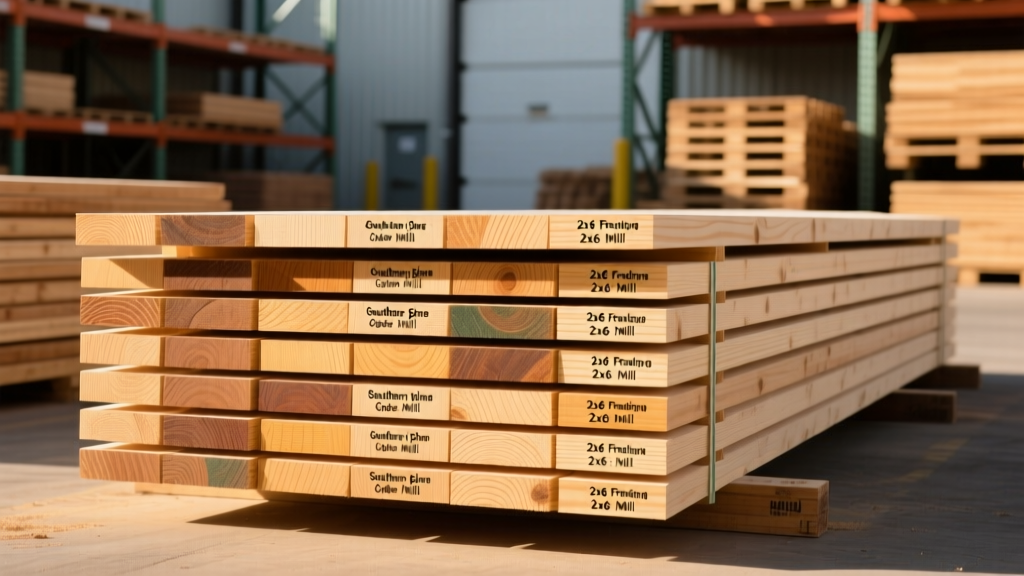
Comparative Matrix: Design Values and 2026 Market Pricing
The following matrix compares the baseline engineering properties and average regional material costs for No. 2 grade 2x6 dimensional lumber. Pricing reflects early 2026 wholesale averages and fluctuates based on regional mill proximity and tariff conditions.
| Species Combination | Bending (Fb) psi | Stiffness (E) psi | Specific Gravity (G) | Avg Cost / LF (2x6) |
|---|---|---|---|---|
| Southern Yellow Pine (SYP) | 1,750 | 1,800,000 | 0.55 | $1.45 - $1.65 |
| Douglas Fir-Larch (DF-L) | 1,500 | 1,900,000 | 0.50 | $1.60 - $1.85 |
| Hem-Fir | 1,300 | 1,600,000 | 0.46 | $1.25 - $1.40 |
| Spruce-Pine-Fir (SPF) | 1,180 | 1,400,000 | 0.42 | $1.10 - $1.25 |
Critical Edge Cases: Moisture, Creep, and Fastener Withdrawal
Specifying the correct softwood type requires anticipating how the material behaves post-installation. Ignoring these edge cases leads to structural callbacks and failed inspections.
SYP and Hem-Fir are frequently shipped as S-GRN (moisture content >19%). When S-GRN lumber dries to interior equilibrium (8-12%), it shrinks significantly across the grain. A 2x10 S-GRN SYP joist can shrink up to 1/4 inch in depth. If plumbed and leveled during rough framing, this shrinkage will cause sloping floors and drywall tears. Always specify S-DRY (max 19% MC) for interior floor joists, or account for shrinkage in your plumbing and HVAC rough-in clearances.
- Fastener Withdrawal in SPF: Because SPF has a low specific gravity (0.42), structural screws and lag bolts have lower withdrawal capacities. When attaching heavy ledger boards for decks or lateral bracing, you must increase the fastener count by 20-30% compared to SYP schedules to achieve the same pull-out resistance.
- Checking in Douglas Fir: DF-L is prone to surface checking (longitudinal cracks) as it acclimates. While surface checks do not typically compromise the bending strength of a joist, they can allow moisture intrusion in exterior applications. DF-L used in exposed exterior beams must be treated with a penetrating end-sealer and water-repellent preservative.
- Resin Bleed in SYP: Southern Yellow Pine contains high levels of pitch and resin. When exposed to direct sunlight or high heat (such as in unvented attics), the resin can bleed through primer and paint. Specify kiln-dried (KD) SYP and use a shellac-based or high-solids primer if the framing will be exposed or painted.
Specification Framework: Choosing the Right Species for the Job
To systematically select the optimal softwood for your structural application, follow this decision framework during the design phase:
- Calculate the Governing Load: Determine if the member is governed by bending stress (floor joists, rafters) or compression perpendicular to the grain (studs, bearing plates). If bending governs, prioritize high Fb species (SYP, DF-L).
- Check Deflection Limits: For floor systems, deflection often dictates the design before bending failure. If your span requires a high L/360 or L/480 stiffness rating, DF-L is the superior choice due to its 1,900,000 psi E-value.
- Evaluate Fastener Schedules: Review the engineer's hold-down and shear wall schedules. If the plans call for high-capacity structural screws or dense nailing patterns for hurricane straps, SYP is mandatory to prevent edge-splitting and ensure withdrawal capacity.
- Optimize for Dead Load and Labor: For multi-story shear walls and vertical studs where spanning is not an issue, switch to SPF. The 15% weight reduction per board foot significantly reduces crane time, foundation dead loads, and carpenter fatigue over a 50,000 sq ft commercial build.
By aligning the specific mechanical properties of DF-L, SYP, Hem-Fir, and SPF with the exact load paths of your structure, you eliminate over-engineering, reduce material waste, and ensure long-term structural integrity.
Written by
James ThorntonJames Thornton is a construction industry veteran with 25 years of hands-on experience in wood framing, lumber grading, and residential building codes. He started as a framing carpenter in rural Oregon, earned his ICC Residential Building Inspector certification, and eventually became a senior plan reviewer for the City of Portland Bureau of Development Services. James holds a B.S. in Wood Science & Technology from Oregon State University and is a certified lumber grader through the West Coast Lumber Inspection Bureau (WCLIB). He has inspected over 3,000 residential construction sites and authored the city's internal guide on advanced framing techniques (2x6 at 24" O.C.). James lives in Bend, OR, where he builds custom timber-frame cabins and competes in lumberjack sports.
More from James Thornton
View all
Insulation
Best Home Insulation Materials: Complete 2026 Guide
Compare top home insulation materials for 2026. Find R-values, installed costs per square foot, and best uses for fiberglass, spray foam, and mineral wool.
Aug 4, 2026

Sustainable Building
Certify Your Green Building Material for LEED and WELL
Step-by-step guide to certifying a green building material for LEED v5 and WELL v2. Master EPDs, HPDs, and VOC limits for 2026 project specifications.
Aug 4, 2026

Stone & Masonry
Veneer Stacked Stone Panels: Interior Design & Style Showcase
Discover how veneer stacked stone panels transform interiors. Explore modern design profiles, material pairings, and technical installation specs.
Aug 4, 2026