MDF Baseboard Performance Ratings: Density, Moisture, and Emissions
Compare MDF baseboard performance ratings including moisture resistance, density specs, and CARB2 emission standards for interior trim selection.
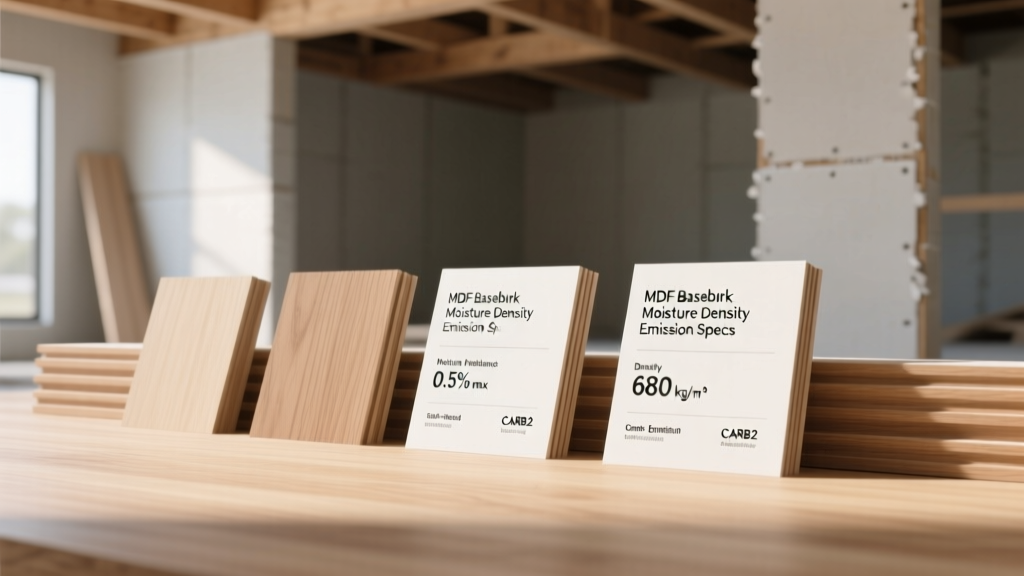
Core Material Standards and Density Classifications
Medium Density Fiberboard (MDF) baseboard is engineered from lignocellulosic fibers combined with a synthetic resin, typically urea-formaldehyde (UF), and formed under heat and pressure. For architectural trim applications, the governing manufacturing standard in North America is ANSI A208.2, which dictates the physical and mechanical properties required for interior millwork. Understanding these specifications is critical for predicting how the material will handle routing, fastening, and long-term environmental stress.
Quick Specification Matrix: Standard vs. High-Density MDF
- Standard MDF (Grade 110/130): Density of 40–50 lbs/ft³ (pcf). Modulus of Rupture (MOR) typically around 5,000 psi. Suitable for painted, simple-profile baseboards where deep routing is not required.
- High-Density MDF / HDF (Grade 155+): Density of 50–65+ pcf. MOR exceeding 7,500 psi. Required for intricate colonial or ogee profiles, as the tighter fiber matrix prevents "fuzzing" or tear-out during the CNC routing process and offers superior dent resistance against impact from vacuums and footwear.
Unlike solid wood, MDF baseboard lacks a grain structure, providing isotropic strength. This means its dimensional stability and bending strength are uniform in all directions parallel to the panel surface. However, its internal bond (IB) strength—the measure of how well the fibers are bonded together through the thickness—averages between 100 and 150 psi. This relatively low IB strength is the primary reason MDF baseboard is susceptible to splitting if fastened incorrectly near the edges.
Moisture Resistance Ratings: Standard vs. MR-MDF vs. HMR
Moisture vulnerability is the most significant failure mode for MDF baseboard, particularly in areas prone to wet mopping, plumbing leaks, or high ambient humidity. Moisture resistance is evaluated using the ASTM D1037 24-hour thickness swell test, which measures the percentage increase in board thickness after complete submersion in water.
| Material Classification | Resin Chemistry | 24-Hr Thickness Swell | Best Application Environment |
|---|---|---|---|
| Standard MDF | Urea-Formaldehyde (UF) | 15% – 25% | Dry living rooms, bedrooms, hallways |
| MR-MDF (Moisture Resistant) | Melamine-Urea-Formaldehyde (MUF) | 8% – 12% | Kitchens, powder rooms, entryways |
| HMR (High Moisture Resistant) | Methylene Diphenyl Diisocyanate (MDI) | < 5% | Full bathrooms, basements, commercial wet zones |
Expert Insight: MR-MDF is frequently dyed with a green pigment for visual identification on the job site. However, color alone is not a performance guarantee. Always verify the manufacturer's stamp for ANSI A208.2 Grade 130 (or higher) compliance. Furthermore, moisture-resistant resins only protect the core; the machined profile edges remain highly porous. All routed edges of MR-MDF baseboard must be sealed with a high-solids primer or edge-sealer prior to installation to prevent localized wicking.
Formaldehyde Emission Standards and Indoor Air Quality
Because MDF relies on formaldehyde-based resins (with the exception of MDI-bonded HMR), off-gassing is a critical specification for interior trim, which often accounts for hundreds of linear feet of exposed surface area in a single home. In the United States, all MDF baseboard must comply with the EPA TSCA Title VI regulations, which align with the California Air Resources Board (CARB) Phase 2 limits.
- CARB Phase 2 / EPA TSCA Title VI Limit: Maximum formaldehyde emission of 0.11 parts per million (ppm) for MDF. Products meeting this standard will carry a compliance label on the packaging or the back of the board.
- UL GREENGUARD Gold Certification: For sensitive environments like schools, healthcare facilities, or homes with severe chemical sensitivities, specifiers should require UL GREENGUARD Gold certified MDF baseboard. This stringent standard limits formaldehyde emissions to 0.05 ppm (half the CARB Phase 2 limit) and tests for over 360 individual volatile organic compounds (VOCs).
- NAF (No Added Formaldehyde): MDF baseboard manufactured with MDI resins contains zero added formaldehyde. While more expensive and less common in standard retail trim, NAF MDF is the ultimate specification for strict IAQ mandates.
Mechanical Fastening and Adhesive Specifications
The homogeneous fiber structure of MDF baseboard lacks the lateral shear strength of solid wood grain, making it highly prone to splitting when pneumatic nails are driven too close to the edge or end. Proper fastener selection and placement are non-negotiable for a lasting installation.
Fastener Gauges and Placement Rules
- Primary Fastening (18-Gauge Brad Nails): Use 1.5-inch to 2-inch 18-gauge brad nails. The smaller head and shank diameter minimize fiber displacement and prevent blowouts on the delicate routed profiles.
- Edge Clearance: Never drive a fastener closer than 3/8 inch from the side edge or 1 inch from the end grain of the MDF baseboard. If end-nailing is unavoidable (such as coping joints), pre-drill a 1/16-inch pilot hole to displace the fibers rather than wedging them apart.
- Avoid 16-Gauge Finish Nails: Unless the baseboard is exceptionally thick (over 1 inch) and high-density, 16-gauge nails act like wedges and will frequently cause micro-fractures that manifest as raised bumps or split paint lines months after installation.
Adhesive Compatibility
When supplementing nails with construction adhesive to eliminate wall waviness, avoid high-water-content acrylic adhesives. The exposed end grains and routed bottom edges of MDF will wick the water from the adhesive, causing irreversible localized swelling. Specify polyurethane-based adhesives (e.g., PL Premium) or silicone-modified polymer (SMP) adhesives, which cure via moisture absorption from the air rather than water evaporation, ensuring zero moisture transfer to the MDF substrate.
Thermal Expansion and Paint Adhesion Metrics
MDF baseboard exhibits excellent dimensional stability regarding temperature fluctuations. Its coefficient of linear thermal expansion is approximately 3.0 x 10⁻⁶ in/in/°F, which is roughly half that of solid pine and significantly lower than PVC or polyurethane foam trim. This means MDF baseboards will rarely show open miters or pulled caulk joints due to seasonal temperature shifts.
However, paint adhesion requires strict adherence to primer chemistry. The machined surfaces of MDF expose thousands of microscopic fiber ends. If a standard water-based latex primer is applied directly to raw MDF, the water carrier is absorbed instantly, causing the fibers to swell and "raise the grain," resulting in a rough, fuzzy finish that requires extensive sanding.
Critical Priming Protocol for Raw MDF Trim
To achieve a factory-smooth finish on site-built MDF baseboard, the first coat must be a solvent-based or high-solids barrier primer. Use a shellac-based primer (such as B-I-N) or an oil-based alkyd primer. These solvents penetrate and bind the exposed fibers without causing them to swell. Once the solvent primer is sanded smooth (typically with 220-grit sandpaper), subsequent topcoats of water-based acrylic or urethane-enamel can be applied safely.
Summary Decision Matrix for Trim Selection
Selecting the correct MDF baseboard specification requires balancing budget, environmental exposure, and profile complexity. Use the following framework to finalize your material schedule:
- Choose Standard MDF (45 pcf, UF Resin): For dry, climate-controlled residential living spaces utilizing simple, single-curve profiles (e.g., colonial stop, speed base) where budget is the primary constraint.
- Choose High-Density MR-MDF (55+ pcf, MUF Resin): For kitchens, mudrooms, and entryways subject to wet mopping, or when specifying deep, multi-stepped ogee profiles that require crisp, tear-free CNC routing and high impact resistance.
- Choose HMR / NAF MDF (MDI Resin): For commercial healthcare facilities, LEED-certified green building projects requiring strict VOC limits, or below-grade basement finishes where ambient humidity frequently exceeds 60%.
By matching the ANSI grade, resin chemistry, and density specifications to the exact environmental and mechanical demands of the space, contractors and architects can eliminate the callbacks associated with swelling, splitting, and off-gassing in MDF millwork.