Types of Wood Grain: A Lumber Grading and Quality Selection Guide
Master the types of wood grain to optimize lumber grading, structural integrity, and visual quality. Expert guide on slope of grain and NHLA standards.

The Anatomy of Wood Grain: Why It Dictates Lumber Quality
Wood grain is not merely an aesthetic feature; it is the physical manifestation of a tree's cellular structure and the primary determinant of lumber strength, stability, and grade. For architects, structural engineers, and procurement managers, misidentifying grain types leads to catastrophic structural failures, excessive warping, and rejected shipments. The alignment of cellulose fibers relative to the longitudinal axis of the board dictates how the wood will respond to mechanical loads, moisture fluctuations, and machining processes.
According to the Forest Products Laboratory (FPL) Wood Handbook, the mechanical properties of wood are highly directional. Wood is strongest in compression and tension parallel to the grain, but exceptionally weak in shear and tension perpendicular to it. Understanding the specific types of wood grain present in a batch of lumber is the foundational step in both visual grading and Machine Stress Rating (MSR) calibration.
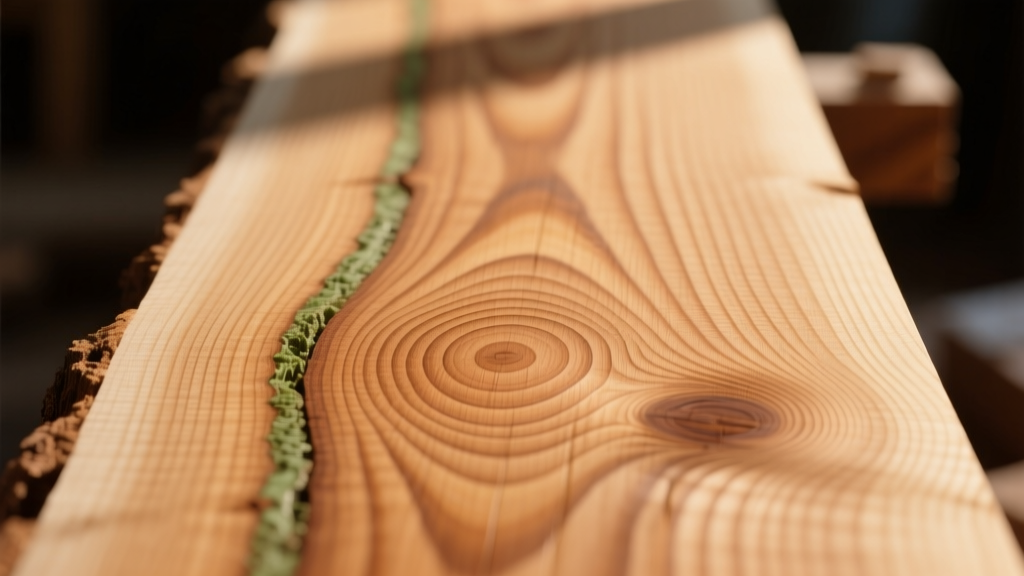
The 4 Primary Types of Wood Grain in Milled Lumber
When logs are processed at the sawmill, the resulting lumber exhibits one of four primary grain patterns based on the tree's natural growth characteristics and the sawing technique employed.
- Straight Grain: Fibers run parallel to the board edges. Highest structural grade potential.
- Cross Grain: Fibers deviate from the longitudinal axis. Reduces bending strength drastically.
- Spiral Grain: Fibers twist around the tree trunk in a helix. Causes severe twisting upon drying.
- Wavy/Curly Grain: Fibers undulate in a wave pattern. Prized for aesthetics, poor for structural framing.
1. Straight Grain
In straight-grained lumber, the wood fibers run parallel or nearly parallel to the longitudinal axis of the board. This is the ideal configuration for structural framing, joists, and load-bearing beams. Straight grain maximizes the Modulus of Elasticity (MOE) and Modulus of Rupture (MOR), allowing the lumber to achieve top-tier grading classifications such as Select Structural or MSR 2400f-2.0E.
2. Cross Grain (Slope of Grain)
Cross grain occurs when fibers are angled across the width or thickness of the board rather than running along its length. This deviation, technically termed "Slope of Grain" (SOG), is the most heavily penalized defect in structural lumber grading. A board with a steep cross grain will fail under bending loads at a fraction of the capacity of a straight-grained board, as the load induces shear stress along the weak fiber boundaries rather than tension across them.
3. Spiral Grain
Spiral grain is a natural growth defect where the tree's fibers grow in a helical pattern around the trunk, much like a barber pole. When milled, spiral grain manifests as a severe cross grain that changes direction depending on where the board is cut from the log. Lumber with pronounced spiral grain is highly susceptible to twisting and warping during the kiln-drying process and is typically downgraded to utility or stud grades.
4. Wavy, Curly, and Interlocked Grain
Wavy and curly grains feature fibers that undulate in a regular wave pattern, while interlocked grain alternates direction every few years of growth. While these types of wood grain are highly sought after in architectural millwork, cabinetry, and musical instruments for their light-reflecting "chatoyance," they are structurally compromised. Interlocked grain, common in species like Mahogany and Sapele, makes the wood highly resistant to splitting but notoriously difficult to machine, often resulting in severe tear-out during planing.
Slope of Grain (SOG): The Hidden Structural Killer
The American Wood Council's National Design Specification (NDS) mandates strict limits on the Slope of Grain for structural lumber. SOG is expressed as a ratio (1 in X), representing the deviation of the grain line over a given distance along the board's length. A 1 in 12 slope means the grain line deviates 1 inch from the board's edge over a 12-inch length.
| Lumber Grade | Maximum Allowable SOG | Strength Reduction Factor | Typical Application |
|---|---|---|---|
| Select Structural | 1 in 12 | Minimal (Baseline) | Heavy timber framing, long-span beams |
| No. 1 Grade | 1 in 10 | ~15% reduction in bending | Standard floor joists, roof rafters |
| No. 2 Grade | 1 in 8 | ~30% reduction in bending | Wall studs, short-span blocking |
| Stud / Utility | 1 in 4 or worse | Severe (>50% reduction) | Non-load bearing partitions, temporary bracing |
Shrinkage Mechanics: Tangential vs. Radial Grain Orientation
Understanding wood grain requires analyzing how the board was cut from the log, which dictates its shrinkage behavior. Wood shrinks unequally depending on the orientation of the growth rings relative to the board's face. As detailed by the Wood Database's anatomy guides, tangential shrinkage (parallel to the growth rings) is typically twice as great as radial shrinkage (perpendicular to the rings).
Flat Sawn (Plain Sawn) Lumber
Flat sawn boards are cut tangentially to the growth rings. The grain pattern on the face displays a "cathedral" arch. Because the tangential shrinkage rate is high (e.g., 7.8% for Red Oak), flat sawn boards are highly prone to cupping across their width as moisture content equalizes. They are the most economical to produce, yielding the highest board-foot recovery from a log, making them the standard for structural framing and budget-conscious flooring.
Quarter Sawn and Rift Sawn Lumber
Quarter sawn boards are cut radially, with the growth rings intersecting the face of the board at a 60 to 90-degree angle. The face grain appears as tight, straight, parallel lines. Because radial shrinkage is significantly lower (e.g., 4.2% for Red Oak), quarter sawn lumber remains exceptionally flat and dimensionally stable. It is the mandatory specification for high-end hardwood flooring, exterior millwork, and stair treads where cupping would cause joint failure. Expect to pay a 25% to 40% premium for quarter sawn material over flat sawn equivalents due to the increased sawing time and lower yield.
Visual Grading vs. Machine Stress Rated (MSR) Lumber
The types of wood grain present in a batch directly influence whether the lumber should be visually graded or machine rated.
- Visual Grading (NHLA & WCLIB Standards): Inspectors evaluate knots, wane, splits, and grain slope by eye. Visual grading is highly effective for identifying severe cross grain and spiral grain but cannot detect internal density variations or microfissures within straight-grained boards.
- Machine Stress Rated (MSR) & Machine Evaluated Lumber (MEL): Boards are passed through mechanical deflectors that measure stiffness (MOE) non-destructively. MSR grading bypasses visual grain biases. A board with minor visual grain deviations but exceptionally dense latewood bands can achieve an MSR 2400f-2.0E grade, whereas visual grading might have downgraded it to a No. 2.
For engineered floor systems spanning 16 feet or more, specifying MSR 2400f-2.0E joists is critical. While standard #2 SPF (Spruce-Pine-Fir) joists cost approximately $0.85 to $0.95 per linear foot in current markets, MSR 2400f joists command $1.25 to $1.45 per linear foot. The premium eliminates "bouncy" floors by guaranteeing a high, consistent modulus of elasticity that visual grain inspection simply cannot verify.
Purchasing Framework: Matching Grain Type to Project Specs
Procurement teams must align the specified grain characteristics with the functional demands of the project. Use this decision matrix to optimize material spend and performance:
- Heavy Timber / Exposed Beams (Glulam or Solid Sawn): Demand Select Structural grade with a strict 1 in 12 SOG limit. Specify quarter-sawn or rift-sawn heart-free timbers to prevent deep checking and twisting as the massive cross-sections dry in situ.
- Standard Floor Joists (16" or 19.2" O.C.): Machine Stress Rated (MSR) lumber is superior to visually graded #2 lumber. The automated MOE testing ensures uniform floor stiffness regardless of minor visual grain deviations.
- Exterior Cladding and Decking: Prioritize vertical grain (quarter sawn) orientation. Flat sawn decking boards will cup, creating water pools that accelerate rot. Vertical grain sheds water and wears evenly under foot traffic.
- Interior Millwork and Cabinetry: Specify FAS (Firsts and Seconds) grade hardwoods with straight or aesthetically wavy grain. Reject boards with interlocked grain if the design requires extensive routing or profiling, as tear-out will ruin the finish.
Common Grain Defects and Quality Rejection Criteria
During site delivery inspections, reject lumber bundles that exhibit the following grain-related anomalies:
- Compression Wood: Found on the underside of leaning branches or trunks. It appears as unusually dense, opaque latewood bands. Compression wood has high longitudinal shrinkage and low tensile strength, making it a critical failure point in structural members.
- Tension Wood: Occurs in hardwoods on the upper side of leaning trees. It is characterized by a fuzzy, woolly surface texture when sawn due to the high cellulose content in the gelatinous fibers. Tension wood warps unpredictably and binds saw blades during machining.
- Honeycomb Checking: Internal splits caused by severe grain stresses during improper kiln drying. While not a grain type itself, it is a direct result of attempting to dry interlocked or spiral grain lumber using standard flat-sawn drying schedules. Tap the board with a hammer; a dull thud indicates internal honeycombing, requiring immediate rejection.
By rigorously evaluating the types of wood grain and their corresponding slope, orientation, and growth anomalies, construction professionals can eliminate material failures before they reach the job site. Precision in lumber grading and procurement directly translates to structural longevity, reduced callbacks, and optimized project budgets.
Written by
Elena RodriguezElena Rodriguez is a civil engineer and technical writer specializing in concrete technology, masonry systems, and ASTM/ACI compliance. She earned her B.S. in Civil Engineering from Texas A&M University and spent a decade at a materials testing laboratory, performing over 2,000 concrete compressive strength tests and masonry prism evaluations. Elena is an ACI-certified Field Testing Technician (Grade I) and a member of ASTM Committee C12 on Natural Building Stone. She currently consults on forensic engineering cases involving concrete failures and moisture intrusion. Based in San Antonio, TX, Elena is a proud member of the Society of Women Engineers (SWE) and coaches her daughter's FIRST Robotics team.
More from Elena Rodriguez
View all
Walls & Panels
Cost Analysis: Light Gauge Steel Framing Advantages and Disadvantages
Evaluate light gauge steel framing advantages and disadvantages through a strict cost analysis lens, comparing material, labor, and lifecycle expenses.
Aug 4, 2026

Walls & Panels
Gypsum Board Types: Exact Specifications, Thickness & Dimensions
Compare standard, Type X, and moisture-resistant gypsum board types. Get exact specifications, thicknesses, dimensions, and ASTM standards for your project.
Aug 4, 2026

Fire Resistance
Best Fire-Resistant Outdoor Decking Materials: 2026 Buyer Guide
Discover the best fire-resistant outdoor decking materials for 2026. Compare Class A PVC, aluminum, and hardwood options for WUI compliance and safety.
Aug 4, 2026