Which Type of Wood Turns Green? Lumber Quality & Treatment Guide
Discover which type of wood turns green, from copper-treated Southern Yellow Pine to tannin reactions. Learn AWPA grades and fastener rules.

The Short Answer: Preservatives vs. Wood Species
When builders, inspectors, and homeowners ask which type of wood turns green, the answer rarely points to a natural wood species. In over 95% of residential and commercial construction scenarios, the green coloration is not an inherent property of the timber itself. Instead, it is the direct result of copper-based chemical preservatives forced into the cellular structure of porous softwoods—primarily Southern Yellow Pine (SYP) and Douglas Fir—during the pressure-treating process.
However, chemical treatments are not the only culprit. Tannin reactions, biological growth, and a small subset of exotic marine hardwoods can also present green or greenish-black hues on a job site. Understanding the exact cause of the greening is critical for material grading, structural integrity assessments, and selecting the correct corrosion-resistant fasteners.
Copper-Based Preservatives: Why Pressure-Treated Pine Turns Green
The vast majority of green lumber found at building supply yards is Southern Yellow Pine treated with copper-based biocides. Since the construction industry phased out Chromated Copper Arsenate (CCA) for residential use, manufacturers have relied on alternative copper formulations to prevent rot and termite infestation.
MCA vs. ACQ Treatments
- Micronized Copper Azole (MCA-C): This is the most common treatment for residential decking and framing. MCA utilizes finely ground copper particles suspended in water, rather than dissolved copper. The micronized copper gives the wood a distinct, bright green-to-olive hue immediately after treatment. Over time, UV exposure and oxidation will fade this green tint to a natural gray or brown.
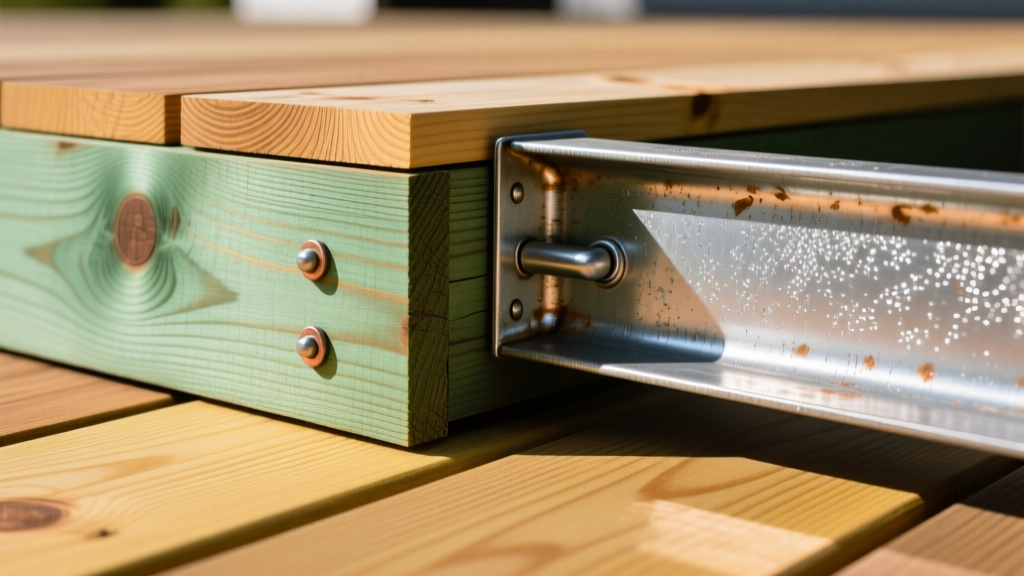
- Alkaline Copper Quaternary (ACQ-D): ACQ relies on dissolved copper oxide and a quaternary ammonium compound. ACQ-treated lumber often presents a slightly darker, more brownish-green tint compared to MCA. Because ACQ is highly corrosive to standard metals, it strictly mandates the use of hot-dipped galvanized or stainless steel fasteners.
To minimize the intense green coloration and reduce warping, specify Kiln-Dried After Treatment (KDAT) lumber. KDAT processes remove the excess moisture introduced during the pressure-treating phase, stabilizing the wood at a moisture content (MC) of 15-19%. While KDAT lumber still retains the green copper tint, it is significantly more dimensionally stable and ready for immediate finishing or staining compared to wet, drip-dried treated pine.
Tannin Reactions: Cedar, Redwood, and Copper Flashings
If you are working with naturally rot-resistant, tannin-rich species like Western Red Cedar, Redwood, or White Oak, the wood itself will not turn green. However, a chemical reaction between the wood's natural tannic acids and incompatible metals can cause severe green or black streaking.
When copper flashings, copper roof runoff, or non-isolated brass hardware come into contact with wet Cedar or Redwood, the tannins react with the copper ions to form copper tannate. This manifests as vivid green or teal streaks running down the face of the boards. According to the Western Red Cedar Association, preventing this requires isolating copper flashing with peel-and-stick waterproofing membranes or using stainless steel and aluminum alternatives where direct contact is unavoidable.
Naturally Green Heartwoods: Marine and Specialty Timbers
While rare in standard residential framing, a few exotic hardwood species possess naturally green heartwood due to unique extractives and lipids. These are typically specified for heavy-duty marine construction, industrial flooring, or specialty exterior applications.
- Greenheart (Chlorocardium rodiei): Native to Guyana, this incredibly dense timber (Janka hardness of 2,500 lbf) features a heartwood that ranges from pale yellow-green to dark olive-brown. It is highly resistant to marine borers and is frequently used for dock pilings and seawalls.
- Lignum Vitae (Guaiacum officinale): Famous for its natural oils and extreme density, the heartwood of true Lignum Vitae often exhibits a distinct greenish-brown or olive-green cast, which darkens upon exposure to light.
- Verawood (Bulnesia arborea): Often sold as a substitute for Lignum Vitae, Verawood features a striking yellow-green to olive-green heartwood that is highly prized for heavy-duty structural bearings and mallet heads.
Comparison Matrix: Causes, Species, and Fastener Requirements
Selecting the right fastener is the most critical quality control step when dealing with lumber that turns green. Using the wrong fastener will lead to galvanic corrosion, structural failure, and unsightly staining.
| Wood Type / Condition | Cause of Greening | Required Fastener Standard | Corrosion Risk Level |
|---|---|---|---|
| MCA-C Treated SYP | Micronized Copper Particles | ASTM A153 Class D (HDG) or SS Type 304 | Moderate |
| ACQ-D Treated SYP | Dissolved Copper Oxide | Stainless Steel Type 304 or 316 | High |
| Western Red Cedar | Tannin + Copper Flashing Reaction | Stainless Steel or Hot-Dipped Galvanized | Low (Staining Risk) |
| Greenheart / Lignum Vitae | Natural Heartwood Extractives | Stainless Steel Type 316 (Marine) | Low |
Reading the Grade Stamp: AWPA Use Categories Explained
To ensure you are purchasing the correct grade of pressure-treated lumber for your specific application, you must read the end-tag stapled to the board. The American Wood Protection Association (AWPA) establishes the Use Category (UC) system, which dictates the minimum chemical retention rates (measured in pounds per cubic foot, or pcf) required to protect the wood.
- UC3B (Above Ground, Exposed): Requires a minimum retention of 0.15 pcf for MCA-C. Used for deck joists, railings, and framing where water can pool but the wood does not touch the soil. The green tint will be prominent but will fade as the surface weathers.
- UC4A (Ground Contact, General Use): Requires a minimum retention of 0.31 pcf for MCA-C. Used for fence posts, structural columns, and ledger boards. The higher copper concentration often results in a deeper, more saturated green color straight from the treatment plant.
- UC4B (Ground Contact, Heavy Duty): Requires 0.40 pcf or higher. Reserved for critical structural components, permanent wood foundations, and freshwater pilings.
Site Warning: Exposing Untreated Cores
When you cut, drill, or notch pressure-treated lumber on site, you expose the untreated inner core of the wood. According to the USDA Forest Products Laboratory, these exposed areas are highly susceptible to moisture ingress and fungal decay. You must field-treat all cut ends and bored holes with a copper naphthenate or borate-based end-cut preservative (such as Copper-Green) to maintain the warranty and structural integrity of the AWPA grade.
Troubleshooting Unwanted Greening on Site
If lumber that is not pressure-treated begins turning green on your job site, you are likely dealing with a biological issue rather than a chemical one. Differentiating between chemical greening and biological growth is a fundamental quality control skill for site supervisors.
Biological Growth vs. Chemical Greening
Mold, mildew, and algae thrive on lumber that is stored improperly or installed with a moisture content (MC) above 19%. If you observe a fuzzy, powdery, or slimy green substance on the surface of untreated spruce, pine, or fir framing lumber, it is biological growth feeding on the starches in the sapwood.
Remediation Steps:
- Test the Moisture: Use a pin-type moisture meter. If the MC reads above 19%, the wood is at risk for active decay, not just surface mold.
- Clean the Surface: Scrub the affected area with a solution of oxygen bleach (sodium percarbonate) and water. Avoid chlorine bleach, as it only kills surface spores and does not penetrate the wood fibers to eradicate the root structure.
- Improve Airflow: Restack the lumber using 1-inch stickers (spacers) to allow cross-ventilation. Cover the top of the stack with a tarp, but leave the sides completely open to prevent a greenhouse effect that accelerates fungal growth.
- Verify Grade Stamp: Ensure the lumber is graded for your application. Standard SPF (Spruce-Pine-Fir) #2 framing lumber is not rot-resistant and must be kept dry prior to enclosure.
By understanding the specific chemical, biological, and natural mechanisms that cause wood to turn green, construction professionals can accurately grade materials, specify compatible hardware, and prevent long-term structural degradation on the job site.
Written by
James ThorntonJames Thornton is a construction industry veteran with 25 years of hands-on experience in wood framing, lumber grading, and residential building codes. He started as a framing carpenter in rural Oregon, earned his ICC Residential Building Inspector certification, and eventually became a senior plan reviewer for the City of Portland Bureau of Development Services. James holds a B.S. in Wood Science & Technology from Oregon State University and is a certified lumber grader through the West Coast Lumber Inspection Bureau (WCLIB). He has inspected over 3,000 residential construction sites and authored the city's internal guide on advanced framing techniques (2x6 at 24" O.C.). James lives in Bend, OR, where he builds custom timber-frame cabins and competes in lumberjack sports.
More from James Thornton
View all
Insulation
Best Home Insulation Materials: Complete 2026 Guide
Compare top home insulation materials for 2026. Find R-values, installed costs per square foot, and best uses for fiberglass, spray foam, and mineral wool.
Aug 4, 2026

Sustainable Building
Certify Your Green Building Material for LEED and WELL
Step-by-step guide to certifying a green building material for LEED v5 and WELL v2. Master EPDs, HPDs, and VOC limits for 2026 project specifications.
Aug 4, 2026

Stone & Masonry
Veneer Stacked Stone Panels: Interior Design & Style Showcase
Discover how veneer stacked stone panels transform interiors. Explore modern design profiles, material pairings, and technical installation specs.
Aug 4, 2026