Types of Wood Timber for Framing: A Structural Comparison
Compare the primary types of wood timber for structural framing. Analyze SPF, Douglas Fir, SYP, and Hem-Fir mechanical properties, grading, and costs.
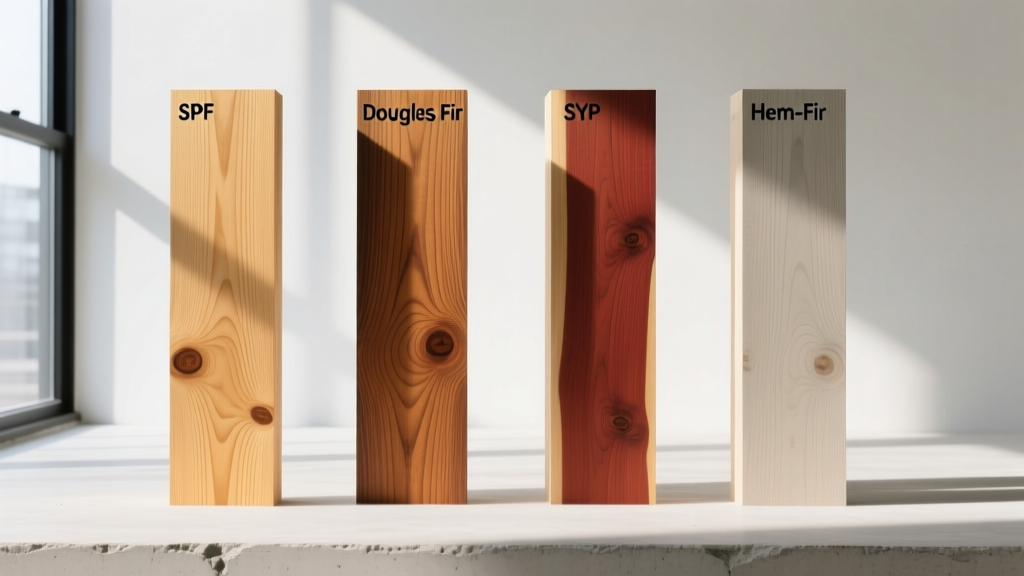
The Structural Timber Hierarchy: Quick Decision Framework
Selecting the correct structural lumber dictates the load-bearing capacity, fastener retention, and long-term dimensional stability of any building envelope. When evaluating the primary types of wood timber for light-frame and structural applications in North America, architects and builders generally choose between four dominant species groups: Spruce-Pine-Fir (SPF), Douglas Fir-Larch (DF-L), Southern Yellow Pine (SYP), and Hemlock-Fir (Hem-Fir). Each possesses distinct mechanical properties governed by the National Design Specification (NDS) for Wood Construction.
Procurement Decision Matrix
- Maximize Span & Bending Strength: Specify Douglas Fir-Larch (DF-L) Select Structural.
- High Fastener Withdrawal & Pressure Treatment: Specify Southern Yellow Pine (SYP) No. 2 or better.
- Cost-Effective Standard Wall Framing: Specify Spruce-Pine-Fir (SPF) No. 2.
- West Coast Sourcing & Moderate Loads: Specify Hemlock-Fir (Hem-Fir) No. 2.
Spruce-Pine-Fir (SPF): The Baseline Standard
SPF is a commercially grouped species combination primarily harvested from the Canadian boreal forest and the northern United States. It is the default species for pre-fabricated wall panels and standard residential stick framing due to its high availability and economical pricing.
Mechanical Profile & Best Applications
For a standard 2x6 No. 2 grade SPF stud, the allowable bending stress (Fb) is 875 psi, and the Modulus of Elasticity (E) is 1,400,000 psi. This provides adequate stiffness for standard 8-foot to 10-foot wall heights and conventional roof rafter spans. SPF machines cleanly and holds paint and stain exceptionally well, making it a preferred choice for exposed interior timber framing where a uniform, light-colored aesthetic is desired.
Limitations & Edge Cases
SPF has relatively low natural decay resistance and poor fastener withdrawal values compared to denser pines. When designing sheer walls that rely heavily on nail-holding capacity to resist lateral wind or seismic loads, engineers often increase the nail schedule or switch to a denser species. Furthermore, SPF is highly susceptible to checking and twisting if installed at a moisture content above 19% (S-GRN).
Douglas Fir-Larch (DF-L): High-Load & Long-Span Champion
Douglas Fir-Larch is the premium benchmark for structural timber in North America. Harvested predominantly in the Pacific Northwest and British Columbia, DF-L offers the highest strength-to-weight ratio among the conventional framing species.
A 2x6 No. 2 DF-L member yields an Fb of 900 psi and an E of 1,600,000 psi. However, its true advantage emerges in higher grades. A Select Structural 2x10 DF-L beam achieves an Fb of 1,500 psi, allowing for significantly longer clear spans in floor joist and ridge beam applications without requiring engineered wood products like LVL or PSL. According to structural guidelines published by WoodWorks, DF-L's high modulus of elasticity minimizes deflection, making it the mandatory choice for floors where vibration criteria (L/360 or stricter) govern the design.
Southern Yellow Pine (SYP): Density, Treatment, and Fastener Retention
Southern Yellow Pine is not a single species but a grouping of four principal pines (loblolly, shortleaf, longleaf, and slash). Grown in managed plantations across the US South, SYP is characterized by its high density, distinct grain, and exceptional structural capacity.
SYP boasts the highest design values of the conventional framing lumbers. A 2x6 No. 2 SYP member delivers an Fb of 1,010 psi and an E of 1,600,000 psi. More importantly, SYP's high specific gravity (averaging 0.55) translates to superior nail and screw withdrawal resistance. This makes it the undisputed leader for shear wall framing, heavy timber truss connections, and ledger boards.
Pressure Treatment Compatibility
Because of its cellular structure, SYP readily accepts preservative treatments (like ACQ or Micronized Copper Azole) deeply into the sapwood. For any timber in direct contact with concrete, masonry, or ground-level environments (Use Category UC4A or UC4B), SYP is the default substrate. Builders must note that the incising process required for deep pressure treatment reduces the structural capacity; the NDS mandates a 15% reduction in bending and tension values for incised SYP.
Hemlock-Fir (Hem-Fir): The West Coast Workhorse
Hem-Fir combines Western Hemlock and the true firs (like Noble and Silver Fir). It is a staple in western US markets, offering a middle ground between the economy of SPF and the strength of DF-L.
With an Fb of 850 psi and an E of 1,300,000 psi for a 2x6 No. 2 grade, Hem-Fir is slightly less stiff than SPF but offers excellent nailing characteristics and resistance to splitting. It is highly favored for trim, millwork, and general framing where a straight, uniform grain with minimal resin bleed is required. However, Hem-Fir has a higher tendency to splinter during cross-cutting and requires sharper tooling on the job site.
NDS Mechanical Properties Comparison Matrix
The following table outlines the baseline allowable stress design (ASD) values for the four primary types of wood timber, based on the American Wood Council's National Design Specification. Values represent standard 2x6, No. 2 grade, dry service conditions (MC ≤ 19%).
| Species Group | Bending (Fb) psi | Tension Parallel (Ft) psi | Shear Parallel (Fv) psi | Modulus of Elasticity (E) psi |
|---|---|---|---|---|
| SPF | 875 | 450 | 135 | 1,400,000 |
| Douglas Fir-Larch | 900 | 575 | 180 | 1,600,000 |
| Southern Yellow Pine | 1,010 | 675 | 175 | 1,600,000 |
| Hem-Fir | 850 | 525 | 150 | 1,300,000 |
Moisture Content, Grade Stamps, and Treatment Factors
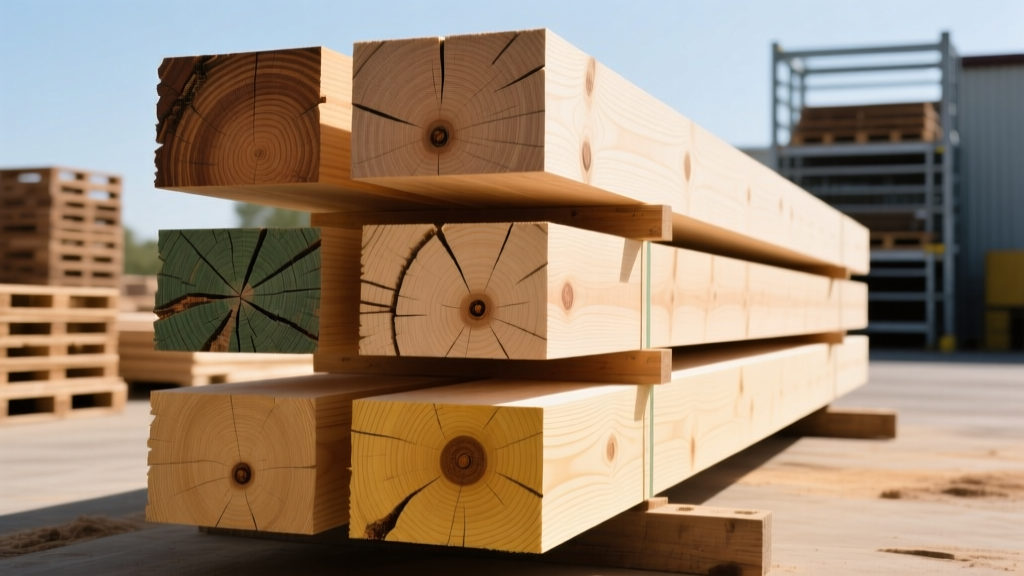
Understanding the grade stamp is critical when procuring structural timber. A stamp from an accredited agency (such as WWPA, WCLIB, or SPIB) verifies the species, grade, and moisture content at the time of surfacing.
Decoding the Moisture Metrics
- S-DRY (Surfaced Dry): Moisture content was 19% or less at the time of planing. Standard for interior framing and protected structural applications.
- MC-15: Moisture content was 15% or less. Premium dimensional stability, essential for finish carpentry and exposed timber applications where shrinkage must be minimized.
- S-GRN (Surfaced Green): Moisture content was above 19%. Common in heavy timbers and pressure-treated SYP. Engineers must apply the Wet Service Factor (CM) to reduce allowable design stresses, as wet wood exhibits lower shear and bearing capacities.
Adjustment Factors in Practice
The tabulated NDS values are baseline metrics. Real-world structural design requires applying adjustment factors. For instance, if timber is subjected to continuous high heat (such as in a mechanical room or kiln), the Temperature Factor (Ct) reduces the capacity. Similarly, the Repetitive Member Factor (Cr = 1.15) allows a 15% increase in bending capacity when SPF or DF-L joists are spaced 24 inches on center or less and sheathed with structural panels, as the sheathing distributes localized loads across adjacent members.
2026 Pricing & Procurement Strategy
Lumber markets remain subject to volatility driven by mill capacity, transportation costs, and regional demand. Below is the estimated average retail pricing for standard dimensional framing lumber (No. 2 & Btr) across major North American markets.
| Species Group | 2x4x8 Price (Avg) | 2x6x10 Price (Avg) | 2x10x16 Price (Avg) | Primary Market Region |
|---|---|---|---|---|
| SPF | $3.85 | $7.20 | $16.50 | National / Midwest / Northeast |
| Douglas Fir-Larch | $5.10 | $9.80 | $24.00 | Pacific Northwest / Mountain |
| Southern Yellow Pine | $4.25 | $8.10 | $18.90 | South / Southeast / Texas |
| Hem-Fir | $4.60 | $8.50 | $19.50 | California / West Coast |
Procurement strategy should prioritize regional availability to minimize freight surcharges. Specifying DF-L for a project in Atlanta will incur severe logistical premiums compared to utilizing locally milled SYP, negating the structural advantages unless long-span engineering strictly dictates it.
Final Procurement Verdict
There is no universal 'best' timber; the optimal choice is dictated by the structural engineering requirements and the environmental exposure of the assembly. Use SPF for cost-effective, standard vertical wall framing. Mandate SYP for treated sill plates, high-shear panels, and heavy decking. Reserve DF-L for long-span floor joists, ridge beams, and applications where minimizing deflection is critical. Always verify the grade stamp upon delivery to ensure the moisture content and species designation align precisely with the engineered framing plans and local building code requirements.
Written by
Elena RodriguezElena Rodriguez is a civil engineer and technical writer specializing in concrete technology, masonry systems, and ASTM/ACI compliance. She earned her B.S. in Civil Engineering from Texas A&M University and spent a decade at a materials testing laboratory, performing over 2,000 concrete compressive strength tests and masonry prism evaluations. Elena is an ACI-certified Field Testing Technician (Grade I) and a member of ASTM Committee C12 on Natural Building Stone. She currently consults on forensic engineering cases involving concrete failures and moisture intrusion. Based in San Antonio, TX, Elena is a proud member of the Society of Women Engineers (SWE) and coaches her daughter's FIRST Robotics team.
More from Elena Rodriguez
View all
Walls & Panels
Cost Analysis: Light Gauge Steel Framing Advantages and Disadvantages
Evaluate light gauge steel framing advantages and disadvantages through a strict cost analysis lens, comparing material, labor, and lifecycle expenses.
Aug 4, 2026

Walls & Panels
Gypsum Board Types: Exact Specifications, Thickness & Dimensions
Compare standard, Type X, and moisture-resistant gypsum board types. Get exact specifications, thicknesses, dimensions, and ASTM standards for your project.
Aug 4, 2026

Fire Resistance
Best Fire-Resistant Outdoor Decking Materials: 2026 Buyer Guide
Discover the best fire-resistant outdoor decking materials for 2026. Compare Class A PVC, aluminum, and hardwood options for WUI compliance and safety.
Aug 4, 2026