Best Type of Wood for Cutting Boards: Grain, Hardness & Care
Discover the best type of wood for cutting boards based on Janka hardness, grain porosity, and preservation treatments for lasting kitchen durability.

The Intersection of Wood Anatomy and Kitchen Preservation
Selecting the best type of wood for cutting boards requires looking past aesthetics and focusing on cellular anatomy, moisture dynamics, and preservation chemistry. A cutting board is not merely a static surface; it is a hygroscopic biological material subjected to extreme fluctuations in humidity, acidic food compounds, and mechanical shear forces from steel blades. When evaluating wood species for culinary use, the primary metrics are Janka hardness, pore structure (open vs. closed grain), and the wood's affinity for food-safe hydrophobic treatments.
The FDA Food Code mandates that food-contact surfaces must be smooth, easily cleanable, and non-absorbent. While wood inherently challenges the 'non-absorbent' rule, proper species selection combined with rigorous preservation protocols creates a surface that naturally inhibits bacterial colonization through capillary action and desiccation.
Cellular Porosity: The Tyloses Factor
The most critical biological feature in cutting board selection is the presence of tyloses—balloon-like outgrowths of parenchyma cells that plug the xylem vessels in hardwoods. This anatomical feature dictates whether a wood is 'closed-grain' or 'open-grain', directly impacting its ability to wick moisture and harbor pathogens.
Janka Hardness Matrix for Culinary Surfaces
The Janka hardness test measures the force required to embed a 0.444-inch steel ball halfway into the wood. For cutting boards, the ideal Janka range is between 900 and 1,500 lbf (pounds-force). Woods softer than 900 lbf gouge easily, creating deep trenches where bacteria thrive. Woods harder than 1,600 lbf will prematurely dull high-carbon steel knife edges and often reject penetrating preservation oils due to extreme density.
| Wood Species | Janka Hardness (lbf) | Grain Structure | Silica Content | Preservation Profile |
|---|---|---|---|---|
| Hard Maple (Sugar) | 1,450 | Closed | 0% | Excellent oil absorption; industry standard for commercial butcher blocks. |
| Black Walnut | 1,010 | Closed | 0% | Forgiving on knife edges; requires slightly more frequent oiling than maple. |
| Teak | 1,070 | Semi-Ring | ~1.4% | High natural tectoquinone repels water, but silica blunts knives and resists glue joints. |
| Cherry | 995 | Closed | 0% | Oxidizes to a rich patina; softer surface shows knife scarring more readily. |
| Red Oak (Avoid) | 1,290 | Open | 0% | Wicks moisture and bacteria; structurally unsuitable for raw meat preparation. |
End-Grain vs. Edge-Grain: Capillary Dynamics
The orientation of the wood fibers drastically alters how the board interacts with preservation oils and mechanical stress.
End-Grain Construction
End-grain boards are constructed with the wood fibers oriented vertically, perpendicular to the cutting surface. When a knife strikes end-grain, it parts the fibers rather than severing them, allowing the wood to 'self-heal' and close back up. However, because the vascular bundles are exposed vertically, end-grain boards exhibit intense capillary action. They will absorb up to three times more mineral oil during the initial seasoning phase compared to edge-grain boards. According to moisture dynamic studies by the USDA Forest Products Laboratory, end-grain surfaces also experience faster moisture exchange with the ambient environment, making them more prone to cupping if not properly sealed on all six sides.
Edge-Grain and Face-Grain Construction
Edge-grain boards lay the fibers parallel to the surface. They are more dimensionally stable, require less maintenance oil, and are generally less expensive. The trade-off is that knife cuts physically sever the fibers, leaving permanent scarring over time. Face-grain (flat-sawn) showcases the most figure but is the softest and most prone to warping; it is rarely recommended for heavy-duty culinary use.
Treatment & Preservation Protocols
Wood preservation in a culinary environment is strictly limited to food-contact-safe compounds. The goal is to achieve maximum hydrophobic saturation without introducing toxic chemical driers or compounds prone to rancidity.
The Chemistry of Food-Safe Finishes
- Non-Drying Oils (Mineral Oil, Fractionated Coconut Oil): These are the gold standard. They do not polymerize or cross-link; they simply occupy the cellular voids, preventing water ingress. Because they don't cure, they must be reapplied periodically.
- Semi-Drying Oils (Walnut Oil, Hemp Oil): These undergo slow oxidation and partial polymerization. They offer slightly better water resistance but pose a severe allergy risk to users with tree-nut sensitivities.
- Waxes (Beeswax, Carnauba): Waxes do not penetrate deeply but form a hydrophobic barrier on the surface. They are best used in a 4:1 ratio (oil to wax) to suspend the wax in the oil for easier application.
The 15-Minute Flood Protocol
To properly preserve a new or severely dried Hard Maple cutting board, follow this precise saturation schedule:
- Preparation: Ensure the board is completely dry. If recently washed, wait 24 hours in a climate-controlled room (40-50% relative humidity).
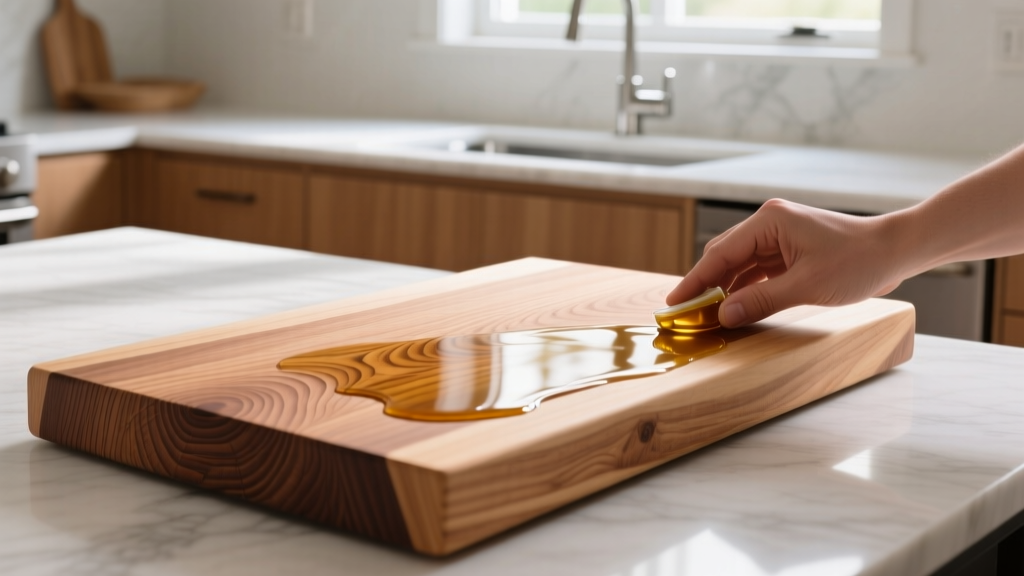
- The Flood: Pour pharmaceutical-grade USP mineral oil generously across the surface. Use a lint-free cloth to spread it evenly over all six sides of the board.
- Capillary Draw: Allow the oil to sit for exactly 15 minutes. End-grain will drink this rapidly; edge-grain will pool.
- Wipe and Buff: Wipe away all unabsorbed surface oil. Leaving pooled oil will result in a sticky, gummy residue that attracts dust.
- Wax Seal: Apply a food-safe board wax (like Howard Butcher Block Conditioner or John Boos Mystery Oil) to lock the mineral oil into the cellular structure. Buff vigorously with a microfiber cloth to generate mild friction heat, melting the wax into the micro-pores.
Ongoing Maintenance: The Water Drop Test
Determining when to re-treat a cutting board should not be based on an arbitrary calendar schedule, but on empirical surface testing. Perform the Water Drop Test monthly: place three drops of water in different zones on the board. If the water beads up tightly, the hydrophobic wax barrier is intact. If the water flattens out and begins to darken the wood fibers within 60 seconds, the cellular voids are exposed, and immediate re-oiling is required to prevent warping and bacterial ingress.
"A well-preserved cutting board is a dynamic surface. By respecting the cellular anatomy of closed-grain hardwoods and maintaining rigorous hydrophobic saturation, you create a culinary tool that will outlast synthetic alternatives by decades."
Written by
Priya KapoorPriya Kapoor is a real estate market analyst and construction economics researcher with expertise in housing affordability, development feasibility, and infrastructure investment. She holds a Master of Regional Planning from Cornell University and previously worked as a senior analyst at CBRE's Investment Properties group, where she modeled returns for $4B in mixed-use development pipelines. Priya now runs an independent research practice advising developers, municipalities, and REITs on construction cost forecasting and market timing. She publishes the quarterly "BuildMat Market Pulse" report tracking material price indices across 12 commodity categories. Based in Austin, TX, Priya serves on the board of Habitat for Humanity Austin and is a marathon runner.
More from Priya Kapoor
View all
Construction Cost
Cost to Build a 1600 Sq Ft Home in 2026: Full Breakdown
Accurate 2026 cost to build a 1600 sq ft home—material, labor, and regional pricing breakdowns included. Plan your budget with real-time estimates.
Aug 11, 2026

Wood & Lumber
Name the Types of Wood for Pressure Treatment and Preservation
Learn how to name the types of wood best suited for pressure treatment. Compare species treatability, chemical retention levels, and 2026 preservation costs.
Aug 4, 2026

Stone & Masonry
Stone Veneer Suppliers Lindenhurst: 2026 Cost Analysis
Analyze 2026 stone veneer costs in Lindenhurst, NY. Compare local supplier pricing, delivery fees, and Suffolk County installation labor rates.
Aug 4, 2026