The Best Type of Wooden Cutting Board for Long-Term Preservation
Discover the best type of wooden cutting board for longevity. Compare wood species, grain structures, and food-safe preservation treatments.

The Science of Wood Porosity and Cutting Board Longevity
Wood is a hygroscopic, anisotropic material, meaning it absorbs moisture from its environment and expands or contracts at different rates depending on the grain direction. When evaluating the best type of wooden cutting board for a professional or high-use home kitchen, structural durability is only half the equation. The true determinant of a board's lifespan is its cellular anatomy and how it responds to preservation treatments. A board that cannot effectively hold food-safe mineral oils and waxes will quickly succumb to warping, micro-fissures, and bacterial ingress.
The primary metric for evaluating preservation potential is the wood's porosity. Woods are broadly categorized into ring-porous and diffuse-porous species. Ring-porous woods feature large, open earlywood vessels that act like microscopic straws, drawing in water, meat juices, and excess oil, which eventually leads to rancidity and structural degradation. Diffuse-porous woods, characterized by uniformly sized, tightly packed cellular structures, naturally resist deep moisture penetration while maintaining just enough capillary action to hold preservation oils.
Evaluating the Best Type of Wooden Cutting Board by Species
Not all hardwoods are suitable for culinary surfaces. The ideal cutting board species must balance Janka hardness (resistance to knife scarring) with closed-grain anatomy (resistance to bacterial trapping). According to data from The Wood Database, the optimal Janka range for cutting boards is between 900 and 1,500 lbf. Woods softer than 900 lbf scar too easily, creating deep grooves that harbor pathogens, while woods harder than 1,500 lbf will rapidly dull high-carbon steel knife edges.
| Wood Species | Janka Hardness (lbf) | Grain Structure | Preservation Profile & Oil Retention |
|---|---|---|---|
| Hard Maple (Sugar Maple) | 1,450 | Diffuse-porous, closed | Excellent. Tight grain limits deep water ingress while accepting surface-level mineral oil beautifully. |
| Black Walnut | 1,010 | Diffuse-porous, closed | Very Good. Naturally contains juglone and tannins; slightly more porous than maple, requiring more frequent waxing. |
| Teak | 1,070 | Ring-porous, high silica | Poor for knives. High natural oil content repels water but high silica content severely dulls knife edges. |
| Red Oak | 1,290 | Ring-porous, open | Fail. Large open pores trap food particles and bacteria; absorbs oil unevenly, leading to rancid pockets. |
| White Oak | 1,360 | Ring-porous, tyloses-blocked | Good. Cellular tyloses block the pores (used in whiskey barrels), but surface scarring can still expose open end-grain. |
Hard Maple: The Gold Standard for Treatment
Hard Maple (Acer saccharum) remains the undisputed champion of culinary wood preservation. Its diffuse-porous structure means the pores are so tight they are virtually invisible to the naked eye. When treated with USP-grade mineral oil, maple achieves a perfect equilibrium: the oil polymerizes slightly on the surface to create a hydrophobic barrier without penetrating so deeply that it becomes trapped and stagnant. Furthermore, maple lacks the strong natural pigments and tannins found in darker woods, meaning it will not leach colors or flavors into acidic foods like citrus or tomatoes.
Black Walnut: The Dark, Oily Alternative
For those seeking aesthetic contrast, Black Walnut (Juglans nigra) is the only dark wood recommended for cutting surfaces. While its Janka hardness of 1,010 lbf makes it slightly more prone to knife scarring than maple, its preservation characteristics are excellent. Walnut requires a heavier initial conditioning phase—typically three coats of oil compared to maple's two—due to its slightly larger pore diameter. Once saturated, it holds a carnauba wax topcoat exceptionally well, resulting in a deep, matte luster that highlights the chocolate-brown heartwood.
Never use Red Oak, Ash, or Hickory for cutting boards. Despite their high Janka hardness ratings, their ring-porous anatomy features large, open vascular bundles. These pores will absorb meat juices and blood deep into the board's core where sanitizing solutions cannot reach, creating a permanent biohazard regardless of how much surface oil you apply.
Grain Orientation and Oil Absorption Rates
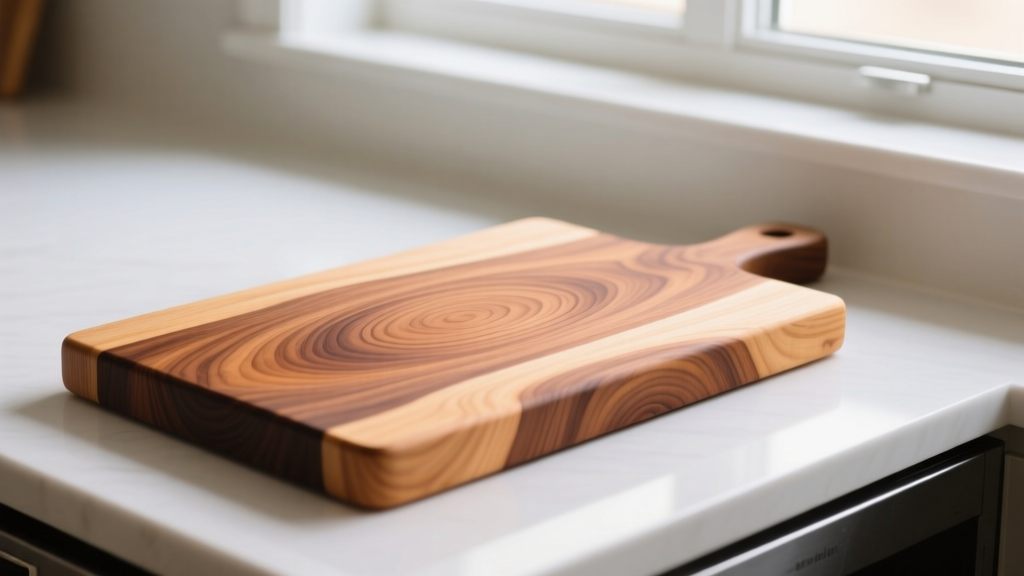
The species of wood is only one variable; the orientation of the cut drastically alters the preservation protocol. Understanding how end-grain, edge-grain, and face-grain boards interact with preservation oils is critical for long-term maintenance.
- End-Grain Boards: Constructed by gluing blocks of wood with the growth rings facing up. This exposes the vascular tubes directly to the surface. End-grain boards are self-healing (knives slip between the fibers rather than cutting them) but act like a bundle of straws during oiling. They require 300% more mineral oil during the initial conditioning phase than edge-grain boards.
- Edge-Grain Boards: Cut parallel to the growth rings. The long, continuous grain lines provide excellent structural stability and moderate oil absorption. They are the most forgiving for beginners learning preservation routines.
- Face-Grain (Flat-Sawn) Boards: Show the widest face of the board. While visually striking, face-grain boards are highly susceptible to warping and cupping if the moisture content fluctuates. They require strict, bi-monthly waxing to seal the broad surface area against ambient humidity.
The Definitive Preservation Protocol: Oils and Waxes
The most common failure point in wooden cutting board maintenance is the use of incorrect finishes. Many well-meaning consumers use culinary oils from their pantry, which inevitably oxidize, polymerize into a sticky resin, and turn rancid. According to FDA guidelines on food contact substances, any finish used on culinary surfaces must be non-toxic and stable.
Approved vs. Banned Finishes
| Finish Type | Status | Chemical Behavior & Rationale |
|---|---|---|
| USP-Grade Mineral Oil | Approved | A highly refined, inert petroleum byproduct. It does not oxidize, go rancid, or support microbial growth. It remains liquid within the wood fibers, repelling water. |
| Fractionated Coconut Oil (MCT) | Approved | Unlike standard coconut oil, the long-chain triglycerides are removed, leaving a stable, liquid oil that will never turn rancid. Excellent vegan alternative to mineral oil. |
| Beeswax / Carnauba Wax | Approved (Topcoat) | Used strictly as a topcoat over oil. Fills microscopic surface pores and provides a physical barrier against acidic liquids. Must be blended with oil for penetration. |
| Raw Linseed / Tung Oil | Banned | Drying oils that polymerize into a hard plastic. Unless specifically certified as food-safe and fully cured (which takes weeks), they can off-gas toxic solvents and heavy metal driers. |
| Walnut / Olive / Vegetable Oil | Banned | Non-drying or semi-drying culinary oils. They will oxidize, turn rancid, emit foul odors, and pose severe anaphylaxis risks to guests with nut allergies. |
Step-by-Step Deep Conditioning Routine
To properly preserve a new or recently sanded hard maple end-grain board, follow this exact protocol:
- Surface Preparation: Ensure the board is completely dry. If raising the grain, lightly mist the board with water, let it dry for 12 hours, and sand with 220-grit aluminum oxide sandpaper. Wipe away all dust with a tack cloth.
- The Flood Coat (End-Grain Only): Apply roughly 2 tablespoons of USP-grade mineral oil per square foot of surface area. Use a lint-free cloth to work the oil in circular motions. For end-grain boards, the oil will be absorbed within 15 minutes. Reapply until the wood stops absorbing and a slight sheen remains on the surface.
- Curing Time: Let the board rest horizontally on a wire cooling rack (to allow air circulation to the bottom face) for a minimum of 8 hours, preferably overnight.
- The Wax Seal: Melt a 4:1 ratio of mineral oil to beeswax in a double boiler. Once cooled to a soft paste, buff a thin layer onto the board using a clean microfiber cloth. Allow it to haze for 20 minutes, then buff vigorously to a satin finish.
Sanitization Without Stripping the Finish
Preservation is useless if the board cannot be safely sanitized. The USDA Food Safety and Inspection Service recommends specific protocols for preventing cross-contamination on wooden surfaces. The critical rule is to avoid prolonged water exposure and harsh chemical strippers.
Never use bleach on a wooden cutting board; it degrades the lignin binding the wood fibers and strips the mineral oil. For deep sanitization after cutting raw poultry, spray the board with a 5% white vinegar solution (which kills E. coli and Salmonella), let it sit for 5 minutes, then scrub with coarse kosher salt and half a lemon. The salt acts as an abrasive to lift debris from the grain, while the mild citric acid neutralizes odors. Rinse quickly with warm water and immediately towel dry.
Frequently Asked Questions
How often should I oil my wooden cutting board?
For a board used daily, apply a light coat of mineral oil once a month. A reliable visual indicator is the water-drop test: flick a few drops of water onto the surface. If the water beads up, the preservation is intact. If the water immediately darkens the wood and absorbs, the board requires immediate conditioning.
Can I put a preserved wooden board in the dishwasher?
Never. Dishwashers subject the wood to sustained temperatures exceeding 140°F (60°C) and prolonged water immersion. This will instantly melt the beeswax topcoat, wash out the mineral oil, and cause catastrophic differential shrinkage, leading to severe warping or splitting along the glue lines.
Is bamboo a good alternative to hardwood for preservation?
Bamboo is technically a grass, not a wood. While it is highly water-resistant and requires less frequent oiling, bamboo cutting boards are manufactured using heavy amounts of formaldehyde-based or polyurethane adhesives to bind the stalks together. Furthermore, bamboo's high silica content will prematurely dull your knives. For culinary performance and non-toxic preservation, solid diffuse-porous hardwoods remain superior.
Written by
Sarah WhitfieldSarah Whitfield is a chartered quantity surveyor (MRICS) and construction cost analyst with 15 years of experience in material pricing, procurement strategy, and project budgeting. She earned her degree in Construction Management from the University of Reading (UK) and has worked on projects ranging from $2M custom homes to $180M mixed-use developments across North America and Europe. Sarah currently leads cost estimating for BuildMat Insight, maintaining a proprietary database of 4,000+ material price points updated quarterly. She is a frequent contributor to RSMeans cost data panels and has presented at the International Cost Engineering Council (ICEC) congress. Based in Denver, CO, Sarah is an avid trail runner and volunteer mentor for Women in Construction.
More from Sarah Whitfield
View all
Wood & Lumber
What Are the Different Types of Wood? A Builder's Guide
Compare structural softwoods, finish hardwoods, and engineered lumber. Analyze Janka ratings, MOE values, and 2026 pricing for construction.
Aug 4, 2026

Walls & Panels
Steel Framing vs Wood Framing: Corrosion and Moisture Defense
Compare steel framing vs wood framing for moisture resistance. Learn about galvanized coatings, condensation risks, and corrosion protection strategies.
Jul 21, 2026

Stone & Masonry
How to Cut Stone Veneer: Wet Saw vs Grinder Comparison
Compare the best tools for cutting stone veneer. We review wet saws, angle grinders, and chop saws to help you achieve clean, chip-free cuts.
Jul 21, 2026