Metal Fence Posts for Wood Fence: Application & Scenario Guide
Discover when to use metal fence posts for wood fence structures. Compare soil types, wind loads, and lifecycle costs to choose the right post system.
The Grade-Line Failure Problem in Traditional Fencing
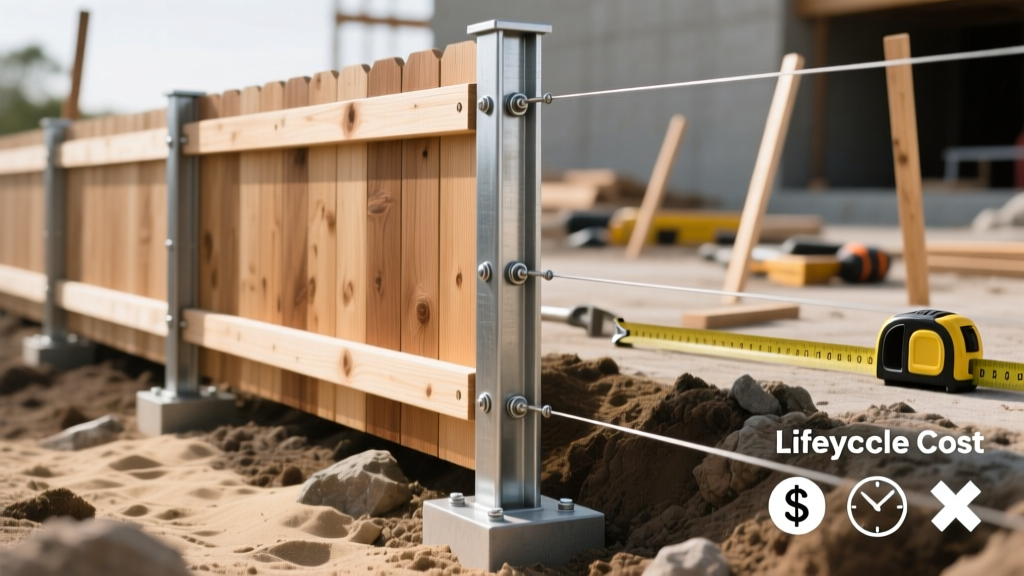
For decades, the standard for residential privacy fencing has been the 4x4 pressure-treated pine post. However, structural failure almost always occurs at the exact same location: the grade line. The zone extending one inch above to six inches below the soil surface provides the perfect intersection of oxygen, moisture, and fungal spores. Even heavily treated wood eventually succumbs to rot, Formosan termites, or mechanical snapping in this zone, typically within 7 to 12 years. Integrating metal fence posts for wood fence systems—using steel C-channels, round pipes, or proprietary flanged systems like PostMaster Plus—eliminates this biological vulnerability entirely. But steel is not a universal panacea; its application must be matched to specific environmental and structural scenarios to justify the upfront premium.
Application-Fit Decision Matrix
Use the following framework to determine if steel posts are required for your specific site conditions, or if traditional timber remains a viable, cost-effective alternative.
| Site Scenario | Traditional 4x4 PT Pine | Steel C-Channel / Pipe Post | Verdict |
|---|---|---|---|
| Expansive Clay / High Moisture Soil | Poor (Traps water, accelerates rot) | Excellent (Impervious to soil fungi) | Mandatory Steel |
| Coastal / High-Wind Zones (90+ mph) | Moderate (Prone to grade-line snapping) | Superior (High tensile/yield strength) | Mandatory Steel |
| Heavy Wood Cladding (Ipe, Cumaru) | Poor (Warping causes racking under load) | Excellent (Zero warp, high load capacity) | Highly Recommended |
| Arid Climate / Sandy Soil | Good (Low fungal activity) | Excellent | Optional (Wood is viable) |
| Standard Suburban Privacy (Cedar/Pine) | Good (10-15 year lifespan) | Excellent (40+ year lifespan) | Optional (Budget dependent) |
Scenario 1: High Wind and Hurricane-Prone Zones
In regions subjected to severe wind events, a privacy fence acts as a massive sail. The Insurance Institute for Business & Home Safety (IBHS) notes that wind uplift and sheer forces concentrate at the post base. A standard 4x4 wood post has a bending modulus that frequently fails under 90+ mph gusts, especially if the wood has internal checks or knots near the base.
Matching Steel Gauge to Wind Loads
When specifying metal fence posts for wood fence structures in high-wind zones, gauge thickness is critical. Do not use 16-gauge or 14-gauge steel for structural corner or gate posts.
- Line Posts (8-foot spans): 14-gauge (0.0747 inches) steel C-channels are sufficient for standard 6-foot tall cedar picket fences in zones with 110 mph wind ratings.
- Corner and Gate Posts: Upgrade to 12-gauge (0.1046 inches) or 10-gauge (0.1345 inches) round steel pipe (minimum 2-3/8 inch outer diameter). Gate posts endure dynamic kinetic loads every time the gate is slammed, which will gradually bend lighter C-channel steel.
Scenario 2: Expansive Clay and High-Moisture Soils
Expansive clay soils swell when wet and shrink when dry, creating immense lateral pressure on fence posts. This frost heave and soil movement easily snaps wood posts below grade. Steel posts possess the yield strength to withstand this lateral pressure without fracturing. However, the primary enemy of steel in high-moisture soils is oxidation.
Coating Requirements for Soil Contact
Bare or lightly painted steel will rust through in 5 to 7 years when buried in wet clay. For direct earth contact, the steel must be protected by one of the following:
- Hot-Dipped Galvanized (HDG): The post is submerged in molten zinc, creating a metallurgical bond. This is the gold standard for round pipe posts set directly in concrete or soil.
- Polyester Powder Coating over Zinc: Many modern C-channel posts use a dual-coat system (zinc primer + exterior-grade polyester powder coat). This provides excellent UV and moisture resistance, but if the coating is scratched during installation down to the bare steel, it will rust from the inside out.
Scenario 3: Heavy Wood Cladding and Dimensional Lumber
The rising popularity of horizontal privacy fences using heavy, dense tropical hardwoods (like Ipe or Cumaru) or thick 5/4x6 Western Red Cedar introduces significant dead-load challenges. The Western Red Cedar Lumber Association highlights that while cedar is naturally durable, its weight when saturated with rainwater can cause traditional wood posts to bow, warp, and twist over time. When a wood post warps, it pulls the horizontal rails out of plumb, ruining the fence's aesthetic and structural integrity.
Steel posts remain perfectly plumb indefinitely. When mounting heavy 1x6 Ipe boards horizontally across 8-foot spans, the sheer weight requires rigid steel line posts spaced no more than 6 feet apart, utilizing 12-gauge steel to prevent mid-span deflection of the post itself.
The Galvanic Corrosion Trap: Wood Chemistry vs. Steel
A frequently overlooked failure mode when installing metal fence posts for wood fence systems is galvanic corrosion caused by modern wood preservatives. If you are attaching pressure-treated pine rails or kickboards to steel posts, you must understand the chemical interaction.
The Solution: Isolation and Fastener Selection
To prevent this, you must isolate the treated wood from the steel. Use heavy-duty polymer or PVC shims between the treated wood rail and the steel post bracket. Furthermore, all fasteners penetrating the steel must be Type 305 or Type 316 stainless steel, or heavily hot-dipped galvanized structural screws (like Simpson Strong-Tie SDWS). Never use standard zinc-plated deck screws or self-drilling tek screws to attach treated wood to steel posts.
Installation Protocol: The Concrete Collar Method
The longevity of a steel post is entirely dependent on how it is anchored. Dumping a bag of wet concrete directly into a hole with the post resting on the dirt is a guaranteed way to trap water and accelerate base corrosion. Follow this engineered installation protocol:
- Excavation: Dig a 10-inch diameter hole to a depth of 36 inches (or 6 inches below your local frost line).
- Gravel Base: Drop 4 inches of 3/4-inch crushed angular gravel into the bottom. Tamp it firmly. This provides a drainage plane so water never pools at the base of the steel.
- Post Setting: Set the HDG steel post on the gravel. Plumb it perfectly using a magnetic torpedo level.
- Concrete Pour: Pour 5000 PSI high-early-strength concrete into the hole, stopping 2 inches below grade level.
- The Crown: Use a trowel to slope the top of the concrete away from the steel post (a 'crown'). This ensures surface rainwater runs away from the metal-concrete interface, preventing freeze-thaw spalling and moisture wicking.
Lifecycle Cost Analysis: Upfront Premium vs. Long-Term Value
Contractors and homeowners often hesitate at the initial material cost of steel. Let us break down the actual economics for a standard 150-linear-foot privacy fence (requiring approximately 21 posts).
- Wood Post Material Cost: ~$12.00 per 4x4x8' PT Pine post = $252 total.
- Steel Post Material Cost: ~$38.00 per 14-gauge HDG C-channel post = $798 total.
- Upfront Delta: Steel costs $546 more for the entire project.
However, by year 12, a wood fence in a moderate climate will typically require the replacement of 3 to 5 rotted posts. The cost to excavate, break out old concrete, set new posts, and reattach pickets averages $150 to $200 per post in labor and materials. Replacing just four posts costs $600 to $800, instantly erasing the upfront savings of using wood. Over a 25-year lifecycle, metal fence posts for wood fence structures yield a net positive return on investment, while entirely eliminating the aesthetic disaster of a leaning, wavy fence line.