Wood Species Guide for All Types of Wooden Privacy Fences
Compare the best wood species for types of wooden privacy fences. Includes Janka ratings, 2026 costs, fastener rules, and rot resistance data.

The Core Criteria: Janka Hardness, Rot Resistance, and Dimensional Stability
Selecting the right material among the various types of wooden privacy fences requires looking past the visual style and analyzing the cellular structure of the lumber. A fence board's lifespan is dictated by three measurable metrics: Janka hardness (resistance to impact and denting), natural decay resistance (heartwood extractives), and dimensional stability (tangential vs. radial shrinkage rates). According to the Wood Database, a species' Janka rating directly correlates to its ability to withstand hail, debris, and physical wear over decades of exposure.
When buying Cedar or Redwood for fencing, always verify the grade. Sapwood (the outer, living rings of the tree) contains no natural rot-resistant extractives and will decay within 3-5 years in ground contact. Only the heartwood provides the Class 1 or Class 2 durability ratings necessary for exterior privacy fences.
Premium Hardwoods: The Lifetime Investments
Tropical hardwoods offer unmatched density and natural oils that repel water and insects without chemical treatments. However, their density introduces specific installation challenges.
Ipe (Handroanthus spp.)
- Janka Hardness: 3,680 lbf
- Shrinkage: Tangential 6.6%, Radial 5.9% (Exceptionally stable)
- Lifespan: 40-75 years above ground
Ipe is the gold standard for high-end privacy screens. Its extreme density means it sinks in water and resists virtually all physical damage. Installation caveat: Ipe requires pre-drilling every fastener hole with carbide-tipped bits. Furthermore, all cut ends must be immediately sealed with a paraffin-based end-grain sealer (like Anchorseal) to prevent checking (splitting at the ends).
Cumaru (Dipteryx odorata)
- Janka Hardness: 3,330 lbf
- Shrinkage: Tangential 7.9%, Radial 6.6%
- Lifespan: 30-50 years
Cumaru offers 90% of Ipe's performance at roughly 65% of the cost. It features a slightly higher interlocked grain, which can cause minor surface checking if not properly acclimated to local humidity before installation.
The Softwood Standards: Cedar, Redwood, and Pressure-Treated Pine
Softwoods dominate the North American fencing market due to their workability, availability, and cost-effectiveness. The USDA Forest Products Laboratory categorizes these species based on their natural extractive content or chemical retention levels.
| Species / Treatment | Recommended Grade for Fencing | Natural/Chemical Durability | Avg. 2026 Cost (Linear Ft) | Movement / Warping Risk |
|---|---|---|---|---|
| Western Red Cedar | Select Tight Knot (STK) | Class 1 (Heartwood) | $25 - $35 | Low (High dimensional stability) |
| Coastal Redwood | Construction Heart | Class 1 (Heartwood) | $35 - $50 | Very Low |
| Southern Yellow Pine (PT) | #2 Prime (AWPA UC4A) | Chemical (Copper-based) | $15 - $22 | High (Prone to cupping/twisting) |
| White Pine | #3 Common | Class 4 (Non-durable) | $18 - $24 | Moderate |
Western Red Cedar (Thuja plicata)
Western Red Cedar contains thujaplicins, natural fungicides that give the heartwood exceptional rot resistance. For privacy fences, Select Tight Knot (STK) is the optimal grade. It allows small, tight knots that add character without compromising structural integrity, costing significantly less than 'Clear' grades. Avoid 'Select Structural' or framing grades for pickets, as they are milled for load-bearing, not visual finish.
Pressure-Treated Southern Yellow Pine (SYP)
SYP is the budget standard, but its longevity depends entirely on the chemical retention level. For fence posts set in concrete or soil, the American Wood Protection Association (AWPA) mandates a UC4A (Ground Contact) or UC4B (Heavy Duty Ground Contact) retention level. For the privacy pickets themselves, UC3B (Above Ground) is sufficient. Modern treatments use MCA (Micronized Copper Azole) or ACQ (Alkaline Copper Quaternary). Both require specific fasteners to prevent galvanic corrosion.
Emerging & Modified Woods: Thermally Modified Ash and Accoya
As tropical hardwoods face stricter Lacey Act import regulations and supply chain bottlenecks, thermally and chemically modified domestic woods are capturing market share in the premium fence sector.
Accoya undergoes an acetylation process that alters the wood's cell walls, reducing its ability to absorb water by up to 80%. It carries a 50-year above-ground warranty. It is completely non-toxic, dimensionally stable, and takes opaque finishes better than any natural timber. Expect to pay $45-$65 per linear foot for Accoya privacy screens.
Thermally Modified Ash (e.g., Thermory): Baking ash wood at 400°F+ in an oxygen-depleted environment caramelizes the sugars (removing the food source for insects) and permanently reduces moisture absorption. It achieves Class 1 durability without chemicals, though it becomes more brittle, requiring careful handling during routing and cutting.
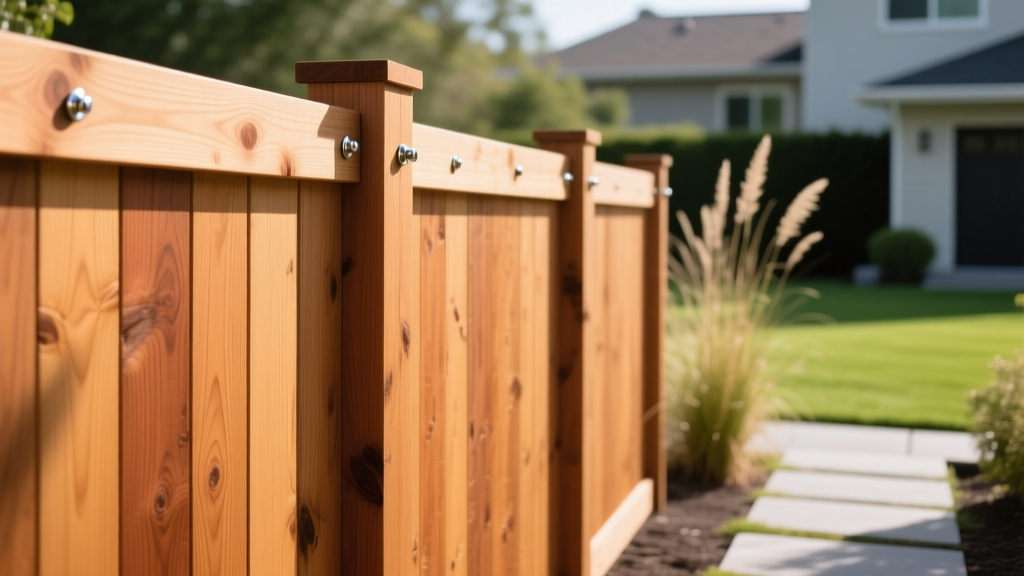
Fastener and Hardware Compatibility by Species
The most common cause of premature fence failure is not the wood rotting, but the hardware failing due to chemical reactions between the wood's extractives/preservatives and the metal fasteners.
- Cedar & Redwood: These species are rich in tannic acid. When tannins mix with moisture and react with standard galvanized zinc, they produce severe black streaking and accelerate nail corrosion. Rule: Use only 304 or 316 Stainless Steel ring-shank nails or screws.
- Pressure-Treated Pine (MCA/ACQ): The copper in modern wood preservatives acts as a cathode to zinc, eating through standard galvanized nails in months. Rule: Use G185 Hot-Dipped Galvanized (HDG) or Stainless Steel. Never use aluminum hardware or flashing with PT lumber.
- Tropical Hardwoods (Ipe/Cumaru): Due to extreme density and natural oils, standard nails will bend or snap. Rule: Use 316 Stainless Steel trim-head screws, pre-drilled to the exact shank diameter.
Troubleshooting Common Wood Fence Failures
Even the best wood species will fail if the structural geometry ignores wood movement. Use this diagnostic framework to address common privacy fence issues:
Symptom: Picket Cupping (Edges curling inward)
- Cause: Moisture differential. The outside face of the picket dries and shrinks faster than the inside face (which is trapped against the rail). This is especially prevalent in flat-sawn PT Pine boards.
- Fix: Install a third horizontal backrail in the middle of the fence. Use two fasteners per picket per rail (not just one) to mechanically force the board flat. Seal all six sides of the pickets with a penetrating oil-based sealer before installation to equalize moisture absorption.
Symptom: Black Staining Around Fasteners
- Cause: Tannin bleed in Cedar/Redwood reacting with electro-galvanized (EG) or hot-dipped galvanized nails, or iron nails.
- Fix: Pull the offending nails and replace with 316 stainless steel. Clean existing stains with a 5% oxalic acid solution, rinsing thoroughly. Do not use chlorine bleach, as it will destroy the wood's lignin and accelerate surface degradation.
Symptom: End-Grain Checking (Vertical splits at the top/bottom)
- Cause: Moisture escapes from the end grain 10 to 15 times faster than from the face grain, causing rapid, uneven shrinkage.
- Fix: Apply a wax-based end-grain sealer to all cuts immediately. For existing splits, route out the crack with a V-bit and fill with a flexible, paintable exterior polyurethane sealant, avoiding rigid wood fillers that will crack again during seasonal expansion.
Written by
Elena RodriguezElena Rodriguez is a civil engineer and technical writer specializing in concrete technology, masonry systems, and ASTM/ACI compliance. She earned her B.S. in Civil Engineering from Texas A&M University and spent a decade at a materials testing laboratory, performing over 2,000 concrete compressive strength tests and masonry prism evaluations. Elena is an ACI-certified Field Testing Technician (Grade I) and a member of ASTM Committee C12 on Natural Building Stone. She currently consults on forensic engineering cases involving concrete failures and moisture intrusion. Based in San Antonio, TX, Elena is a proud member of the Society of Women Engineers (SWE) and coaches her daughter's FIRST Robotics team.
More from Elena Rodriguez
View all
Walls & Panels
Cost Analysis: Light Gauge Steel Framing Advantages and Disadvantages
Evaluate light gauge steel framing advantages and disadvantages through a strict cost analysis lens, comparing material, labor, and lifecycle expenses.
Aug 4, 2026

Walls & Panels
Gypsum Board Types: Exact Specifications, Thickness & Dimensions
Compare standard, Type X, and moisture-resistant gypsum board types. Get exact specifications, thicknesses, dimensions, and ASTM standards for your project.
Aug 4, 2026

Fire Resistance
Best Fire-Resistant Outdoor Decking Materials: 2026 Buyer Guide
Discover the best fire-resistant outdoor decking materials for 2026. Compare Class A PVC, aluminum, and hardwood options for WUI compliance and safety.
Aug 4, 2026