Hardwood Flooring Types of Wood: A Selection Framework
A technical selection framework for hardwood flooring types of wood, covering Janka hardness, dimensional stability, grain finishing, and 2026 costs.
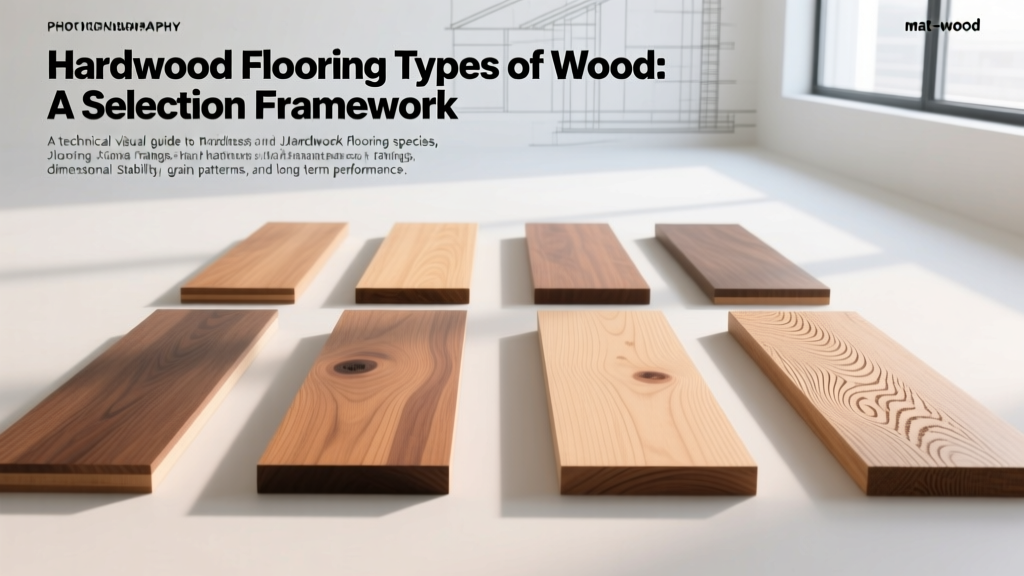
The Hardwood Selection Matrix: Matching Wood to Environment
Selecting the right species for hardwood flooring requires balancing mechanical durability, dimensional stability, and aesthetic compatibility. The hardwood flooring types of wood available on the market range from soft domestic pines to ultra-dense tropicals, but choosing blindly based on appearance leads to premature finish failure, seasonal gapping, or severe cupping. According to the USDA Forest Products Laboratory Wood Handbook, wood is a hygroscopic material that continuously exchanges moisture with its environment, meaning the cellular structure of the species dictates its long-term performance far more than the surface finish.
This framework evaluates hardwood species across three critical vectors: Janka impact resistance, tangential-to-radial (T/R) shrinkage ratios, and cellular grain structure. By applying these metrics to your specific subfloor conditions and traffic loads, you can eliminate species that are structurally incompatible with your environment.
Janka Hardness & Traffic Tolerance: The Durability Baseline
The Janka hardness test measures the force required to embed a 0.444-inch steel ball halfway into a wood sample, expressed in pounds-force (lbf). While often marketed as the sole indicator of quality, Janka ratings must be contextualized against the specific wear layer thickness and finish system. A 1900 lbf Hickory floor with a cheap aluminum oxide finish will still show white scratch marks under dog claws, whereas a 1300 lbf White Oak floor with a high-quality waterborne polyurethane will dent slightly but resist surface marring.
Species Durability & Application Matrix
| Wood Species | Janka Rating (lbf) | Best Application Environment | Limitations & Failure Modes |
|---|---|---|---|
| Brazilian Walnut (Ipe) | 3,684 | High-traffic commercial, active residential with large dogs. | Extremely difficult to sand/refinish; requires specialized carbide tooling. |
| Hickory / Pecan | 1,820 | Active households, mudrooms, kitchens. | High dimensional movement; prone to cupping in wide-plank formats. |
| Hard Maple | 1,450 | Residential living areas, basketball courts, light commercial. | Closed grain causes blotching with dark penetrating stains. |
| White Oak | 1,360 | Universal residential, kitchens, over radiant heat (if quartersawn). | React with iron and water to create black tannin stains. |
| Red Oak | 1,290 | Standard residential bedrooms, low-moisture living areas. | Pronounced open grain traps dirt; highly susceptible to water damage. |
| Black Walnut | 1,010 | Low-traffic residential, formal dining rooms, primary suites. | Dents easily from dropped objects or high heels; fades in UV light. |
For homes with large breed dogs (e.g., German Shepherds, Labs), target a minimum Janka rating of 1,300 lbf and pair it with a textured or wire-brushed surface profile. Wire-brushing removes the soft summerwood grain, leaving the harder winterwood ridges exposed, which naturally camouflages micro-scratches that would otherwise be glaringly obvious on a smooth, high-gloss finish.
Dimensional Stability: Navigating Moisture and Climate
Dimensional stability is arguably the most critical, yet frequently ignored, metric when evaluating hardwood flooring types of wood. Wood shrinks and swells at different rates along its tangential, radial, and longitudinal axes. Longitudinal shrinkage is negligible, but the ratio between tangential and radial shrinkage (the T/R ratio) determines how much a board will cup or warp when exposed to humidity fluctuations.
If you are installing planks wider than 7 inches, dimensional stability is non-negotiable. Plainsawn boards wider than 7 inches are highly susceptible to severe cupping (edges raising higher than the center) during winter months when interior relative humidity drops below 30%. Always specify quartersawn or rift-sawn lumber for wide-plank applications, or switch to an engineered hardwood core.
The Quartersawn Advantage for Radiant Heat
When installing solid hardwood over hydronic radiant heating systems, National Wood Flooring Association (NWFA) guidelines strongly recommend Quartersawn White Oak. In a quartersawn cut, the growth rings intersect the face of the board at a 60 to 90-degree angle. This aligns the board's width with the radial plane, which shrinks and swells at roughly half the rate of the tangential plane. Consequently, quartersawn White Oak exhibits superior dimensional stability, resisting the rapid moisture cycling caused by radiant heat systems.
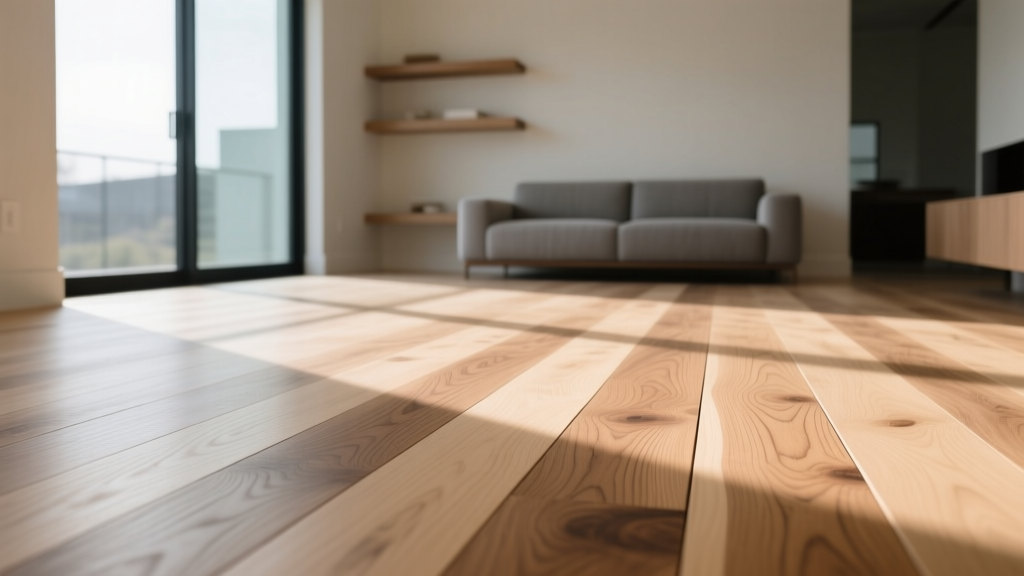
Aesthetic Grain & Finish Compatibility
The cellular structure of the wood dictates how it interacts with stains and topcoats. Ignoring grain porosity leads to expensive refinishing mistakes.
- Open-Grain Species (Red Oak, White Oak, Ash, Hickory): These species have large, visible pores. They accept penetrating oil stains evenly and deeply, making them ideal for achieving rich, dark, or highly customized colors. However, the open pores require a grain filler if a perfectly smooth, glass-like polyurethane topcoat is desired.
- Closed-Grain Species (Hard Maple, Birch, Cherry): These woods have tight, uniform cellular structures with minimal pore visibility. While they look beautiful with clear or natural finishes, they are notorious for absorbing penetrating stains unevenly, resulting in a splotchy, amateurish appearance. If a darker color is required on Maple, use a pre-stain wood conditioner or opt for factory-applied reactive stains.
Finish System Pairing Guide
The choice of topcoat must align with the wood's natural oils and movement characteristics:
- Waterborne Polyurethane (e.g., Bona Traffic HD): Best for Hard Maple and White Oak. It dries clear, resists ambering over time, and maintains the wood's natural, raw appearance. Excellent for high-traffic areas.
- Oil-Modified Polyurethane: Best for Red Oak and Hickory. It adds a warm, amber tone that enhances the natural reddish/brown undertones of these species. It offers slightly better moisture resistance than standard waterborne options but requires longer cure times.
- Hardwax Oils (e.g., Rubio Monocoat, Osmo Polyx): Best for White Oak and Black Walnut. These penetrate the wood fibers and create a matte, tactile surface. While they offer lower initial scratch resistance than polyurethane, they allow for spot-repairs without sanding the entire floor, making them highly practical for active households.
The 4-Step Hardwood Flooring Decision Framework
Use this sequential framework to narrow down your species selection based on structural and environmental constraints.
Step 1: Assess the Subfloor and Moisture Environment
Test the subfloor moisture content using a pin-type moisture meter. For concrete slabs, perform a calcium chloride test or an in-situ relative humidity probe test (ASTM F2170). If the concrete moisture vapor emission rate (MVER) exceeds 3 lbs per 1,000 square feet per 24 hours, solid hardwood is disqualified. You must use an engineered hardwood with a vapor barrier or a moisture-mitigating epoxy primer.
Step 2: Calculate Traffic and Impact Load
Evaluate the household. If you have large dogs or plan to use the space for heavy commercial foot traffic, eliminate species below 1,300 lbf (Walnut, Cherry, Pine). Select Hickory, Hard Maple, or White Oak. If the space is a low-traffic primary suite or formal dining room, you can safely utilize Black Walnut or American Cherry for their rich aesthetic profiles.
Step 3: Determine Plank Width and Cut
Decide on the visual scale. For standard 2.25-inch to 3.25-inch strips, plainsawn lumber is perfectly stable and cost-effective. For 5-inch to 10-inch wide planks, you must specify quartersawn or rift-sawn lumber to prevent seasonal cupping, or transition to an engineered core with a thick (4mm+) hardwood veneer.
Step 4: Select the Fastening and Finish Method
For solid 3/4-inch hardwood over a wood subfloor, use a pneumatic flooring cleat nailer (16-gauge or 15.5-gauge staple) placed every 8 to 10 inches along the joists. For widths exceeding 5 inches, supplement mechanical fasteners with a urethane-based wood flooring adhesive applied in ribbons to the subfloor to restrict lateral movement. Finally, match the finish system to the grain type as outlined in the compatibility guide above.
2026 Cost Breakdown: Material vs. Installed
Budgeting for hardwood requires separating raw material costs from site-preparation and finishing labor. The following table reflects average national pricing for 2026, assuming a standard 500-square-foot installation over a plywood subfloor.
| Species & Cut | Raw Material (per sq. ft.) | Sand, Stain & Finish (per sq. ft.) | Total Installed Estimate (per sq. ft.) |
|---|---|---|---|
| Red Oak (Plainsawn, Unfinished) | $4.50 - $6.00 | $5.00 - $7.50 | $9.50 - $13.50 |
| White Oak (Plainsawn, Unfinished) | $6.50 - $8.50 | $5.00 - $7.50 | $11.50 - $16.00 |
| White Oak (Quartersawn, Unfinished) | $9.00 - $13.00 | $5.50 - $8.00 | $14.50 - $21.00 |
| Hard Maple (Unfinished) | $5.50 - $7.50 | $5.00 - $7.00 | $10.50 - $14.50 |
| Hickory (Unfinished) | $6.00 - $9.00 | $5.50 - $8.00 | $11.50 - $17.00 |
| Pre-finished Engineered White Oak | $8.00 - $14.00 | $3.00 - $5.00 (Glue/Staple only) | $11.00 - $19.00 |
Note: Site-finishing costs have risen significantly due to the increased material cost of high-performance waterborne polyurethanes and the specialized labor required for dustless sanding systems. Pre-finished engineered hardwood often presents a lower total installed cost because it eliminates the multi-day sanding, staining, and curing process, allowing immediate foot traffic upon installation.
Regardless of the species selected, solid hardwood must be acclimated to the home's interior environment before installation. Deliver the wood to the site only after the HVAC system has been running for a minimum of 14 days. Use a moisture meter to ensure the wood's moisture content is within 2% to 4% of the subfloor's moisture content, and that the interior relative humidity is maintained between 35% and 55%. Installing wood that has not reached Equilibrium Moisture Content (EMC) guarantees seasonal gapping or buckling.
Written by
Elena RodriguezElena Rodriguez is a civil engineer and technical writer specializing in concrete technology, masonry systems, and ASTM/ACI compliance. She earned her B.S. in Civil Engineering from Texas A&M University and spent a decade at a materials testing laboratory, performing over 2,000 concrete compressive strength tests and masonry prism evaluations. Elena is an ACI-certified Field Testing Technician (Grade I) and a member of ASTM Committee C12 on Natural Building Stone. She currently consults on forensic engineering cases involving concrete failures and moisture intrusion. Based in San Antonio, TX, Elena is a proud member of the Society of Women Engineers (SWE) and coaches her daughter's FIRST Robotics team.
More from Elena Rodriguez
View all
Walls & Panels
Cost Analysis: Light Gauge Steel Framing Advantages and Disadvantages
Evaluate light gauge steel framing advantages and disadvantages through a strict cost analysis lens, comparing material, labor, and lifecycle expenses.
Aug 4, 2026

Walls & Panels
Gypsum Board Types: Exact Specifications, Thickness & Dimensions
Compare standard, Type X, and moisture-resistant gypsum board types. Get exact specifications, thicknesses, dimensions, and ASTM standards for your project.
Aug 4, 2026

Fire Resistance
Best Fire-Resistant Outdoor Decking Materials: 2026 Buyer Guide
Discover the best fire-resistant outdoor decking materials for 2026. Compare Class A PVC, aluminum, and hardwood options for WUI compliance and safety.
Aug 4, 2026