Best Type of Wood for Table Top Structural Stability and Span Limits
Analyze the best type of wood for table top applications based on MOE, span limits, and load capacity for structurally sound furniture design.

The Physics of Horizontal Furniture Panels
A table top is not merely a decorative surface; it is a horizontally loaded structural panel subject to both dead loads (its own mass) and live loads (dining ware, elbows, workshop equipment, or leaning adults). When engineers and master woodworkers evaluate the right type of wood for table top applications, they look past grain aesthetics and focus on deflection limits, dimensional stability, and fastener withdrawal strength.
In structural timber design, the standard deflection limit for floor joists is L/360 (the span length divided by 360). For a 72-inch dining table, an L/360 limit allows a maximum sag of 0.2 inches before the deflection becomes visually apparent or causes objects to roll. However, premium furniture design often targets a stricter L/480 or L/600 limit to ensure absolute rigidity. Achieving this requires selecting species with a high Modulus of Elasticity (MOE) and pairing them with appropriate apron support and thickness.
Key Structural Metrics Defined
- Modulus of Elasticity (MOE): Measured in psi, this dictates stiffness. A higher MOE means the wood resists sagging under heavy, distributed live loads.
- Modulus of Rupture (MOR): The maximum bending stress the wood can withstand before catastrophic structural failure (snapping).
- Tangential/Radial Shrinkage: The ratio of dimensional change from green to oven-dry. High ratios indicate a higher risk of warping or cupping across the table's width.
- Janka Hardness: While primarily a surface metric, high Janka ratings correlate with better structural integrity at joinery points and resistance to impact denting.
Species Analysis: Stiffness vs. Surface Integrity
Not all hardwoods perform equally under load. According to data from the USDA Forest Products Laboratory Wood Handbook, cellular density and grain interlock dictate how a species behaves when milled into wide, flat panels.
Hard Maple (Acer saccharum): The High-Load Standard
Hard Maple boasts an MOE of 1,830,000 psi and an MOR of 15,800 psi, making it one of the stiffest domestic hardwoods available. For heavy-duty workshop tables or large dining tables that must support significant weight without a heavy underlying steel frame, Hard Maple is the benchmark. Its tight, closed grain also provides a Janka hardness of 1,450 lbf, ensuring the surface resists mechanical denting. In the 2026 lumber market, 8/4 (2-inch) rough-sawn Hard Maple typically ranges from $9.50 to $12.00 per board foot, reflecting its premium structural status.
White Oak (Quercus alba): The Balanced Spanner
White Oak offers an MOE of 1,780,000 psi and an exceptional MOR of 15,200 psi. Its primary structural advantage over maple is its superior dimensional stability and rot resistance, making it the definitive choice for outdoor structural table tops or high-humidity environments. The tyloses in its pores prevent moisture ingress, reducing the seasonal swelling and shrinking that can compromise structural fasteners over time. Current pricing for 8/4 White Oak hovers between $10.00 and $14.50 per board foot.
Black Walnut (Juglans nigra): Managing Deflection in Softer Hardwoods
Black Walnut is highly prized for its aesthetics, but structurally, it requires more careful engineering. With an MOE of 1,680,000 psi and a Janka hardness of just 1,010 lbf, it is more prone to sagging and surface marring. When using Walnut for spans exceeding 48 inches, you must either increase the panel thickness to a minimum of 1.5 inches (finished) or reduce the distance between the underlying support aprons to prevent long-term creep and deflection.
Deflection and Span Limit Matrix
The following matrix outlines the maximum unsupported span (distance between underlying aprons or cross-braces) for a uniform live load of 300 lbs. These calculations assume a standard 30-inch table depth and a target deflection limit of L/480 to prevent visible sagging. Data is synthesized from The Wood Database mechanical properties and standard beam deflection formulas.
| Wood Species | Thickness: 3/4' (19mm) | Thickness: 1.5' (38mm) | Recommended Max Apron Spacing |
|---|---|---|---|
| Hard Maple | 32 inches | 58 inches | 30' (3/4') / 54' (1.5') |
| White Oak | 30 inches | 56 inches | 28' (3/4') / 52' (1.5') |
| Black Walnut | 26 inches | 50 inches | 24' (3/4') / 46' (1.5') |
| Douglas Fir (Softwood) | 34 inches* | 60 inches* | 32' (3/4') / 56' (1.5') |
*Note: While Douglas Fir has a surprisingly high MOE (1,950,000 psi) allowing for longer spans, its low Janka hardness (660 lbf) makes it structurally vulnerable to surface impact damage, requiring thick epoxy or polyurethane coatings for heavy-use table tops.
Structural Fastening: Accommodating Cross-Grain Movement
The most common structural failure in table design is not the wood snapping, but the top splitting due to restricted cross-grain movement. Wood expands and contracts tangentially (across the width) with seasonal humidity shifts. A 30-inch wide White Oak table top can easily expand or contract by 1/4 to 3/8 of an inch between winter and summer.
To maintain structural integrity while allowing movement, utilize specialized mechanical fasteners:
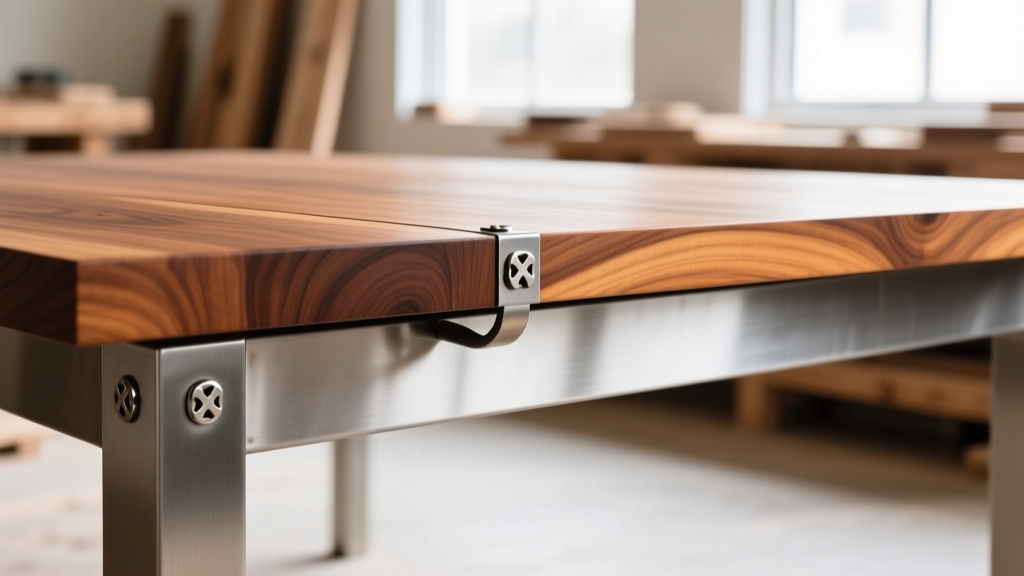
- Figure-8 Fasteners: Ideal for lighter to medium-duty tops. Install them every 12 to 16 inches along the apron. The figure-8 design pivots slightly, accommodating lateral movement while holding the top firmly against the base.
- Z-Clips (S-Clips): The professional standard for heavy, thick table tops. A Z-clip slides into a router-cut groove (typically 1/4' wide by 1/2' deep) on the inside of the apron. Space Z-clips every 10 to 12 inches. They provide superior withdrawal resistance compared to figure-8s and keep the top perfectly flush with the base frame.
- Slotted Hole Cleats: For massive conference or dining tables, use wooden or metal cleats screwed to the underside of the top, with lag bolts passing through elongated slots in the steel base frame. This allows the heavy top to slide laterally over the base without lifting.
Cantilevered Overhangs and Edge Support
When designing a table with an overhang (such as a kitchen island or a desk with an extended edge), the unsupported portion acts as a cantilever beam. The structural rule of thumb for solid wood cantilevers is the 1/3 Rule: the unsupported overhang should never exceed one-third of the total supported span, or an absolute maximum of 12 inches for 3/4-inch thick stock, whichever is less.
'If a client requests a 16-inch overhang on a 1.5-inch thick Walnut breakfast bar for stool seating, you must introduce structural steel flat-bar embedded into the underside of the wood, or use concealed corbels. Relying solely on the wood's MOR for a cantilevered seating load will result in a catastrophic shear failure at the apron joint over time.' — Advanced Furniture Engineering Guidelines
Frequently Asked Structural Questions
Can I use engineered plywood for a structurally superior table top?
Yes. High-quality, multi-ply Baltic Birch or marine-grade plywood offers exceptional dimensional stability because the cross-banded veneers neutralize tangential shrinkage. While its MOE is generally lower than solid Hard Maple, a 1.5-inch thick plywood core veneered with 1/8-inch hardwood provides a perfectly flat, sag-resistant surface that will never split, making it ideal for large conference tables or modern structural designs.
Does the orientation of the growth rings matter for structural stability?
Absolutely. When gluing up a panel, alternating the growth rings (end-grain view) from board to board helps balance internal tension and prevents the entire table top from cupping in one direction. Furthermore, using quarter-sawn lumber (where the growth rings intersect the face of the board at 60-90 degrees) reduces tangential shrinkage by up to 50% compared to plain-sawn lumber, vastly improving long-term structural flatness.
How do I calculate the weight of the table top for base design?
Base structures must support the dead load of the top plus the live load. Hard Maple weighs approximately 44 lbs per cubic foot. A standard 72' x 36' x 1.5' Maple top has a volume of 2.25 cubic feet, resulting in a dead load of roughly 99 lbs. Ensure your base joinery and floor glides are rated for this dead load plus a minimum 300 lb live load safety margin.
Written by
Marcus ChenMarcus Chen is a licensed structural engineer (PE) and building materials analyst with over 12 years of experience across residential, commercial, and industrial construction. He holds a Master of Science in Civil Engineering from UC Berkeley and spent six years at Thornton Tomasetti before transitioning to independent consulting and technical writing. Marcus specializes in material selection for seismic-prone regions, concrete reinforcement strategies, and lifecycle cost analysis. His work has been cited by the American Concrete Institute (ACI) and the Structural Engineers Association of California (SEAOC). When he is not on a job site or at his desk, you will find him hiking the Sierra Nevada or restoring a 1920s craftsman bungalow in Oakland, CA.
More from Marcus Chen
View all
Construction Cost
How Much Did the Eiffel Tower Cost to Build?
How much did the Eiffel Tower cost to build in 1889? We adjust for inflation and compare its budget to modern skyscraper construction.
Aug 4, 2026

Fire Resistance
What Is a Fire Resistant Material? Testing & Certification Guide
Discover what is a fire resistant material through ASTM and UL testing. Learn how fire ratings, certifications, and assemblies work in construction.
Aug 4, 2026

Construction Cost
How Much Did the Burj Khalifa Cost to Build?
How much did the Burj Khalifa cost to build? We break down the $1.5B project and extract 5 money-saving strategies for your next build.
Jul 30, 2026