Types of Wood for Deck Building: 2026 Cost & Value Analysis
Compare the top types of wood for deck building in 2026. Analyze material costs, lifespan, maintenance, and ROI to find the best lumber for your budget.

The True Cost of Deck Lumber: Beyond the Initial Price Tag
Evaluating the types of wood for deck building requires looking past the upfront per-board-foot price. The economic reality of exterior timber is that initial material costs typically represent only 30% to 40% of the total 25-year lifecycle expense. Factors such as chemical treatment retention levels, natural extractive content, Janka hardness ratings, and mandatory maintenance schedules dictate the true return on investment. This analysis breaks down the structural performance, 2026 market pricing, and long-term value of the primary wood species used in modern deck construction.
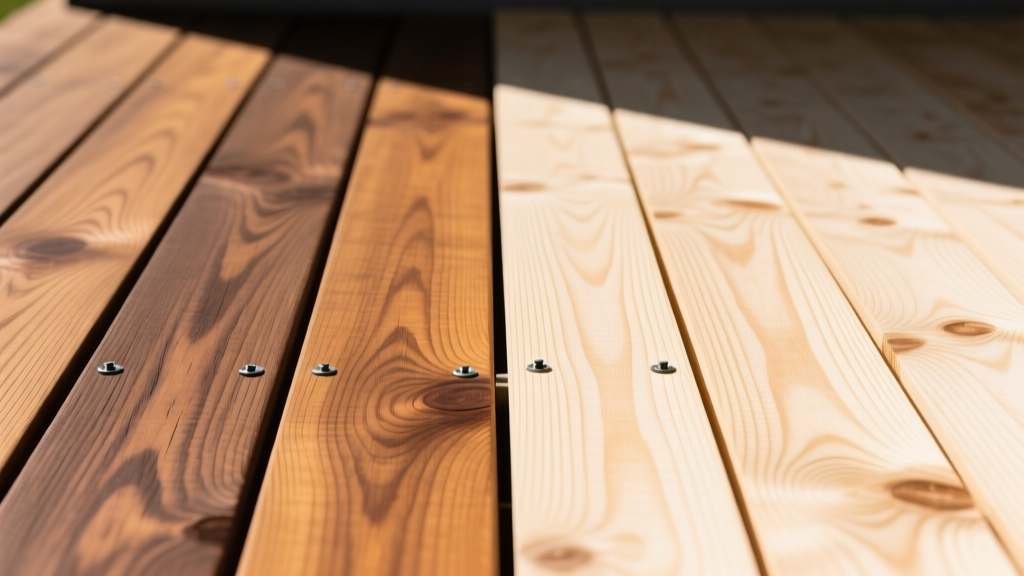
Pressure-Treated Southern Yellow Pine: The Baseline Standard
Pressure-treated (PT) Southern Yellow Pine (SYP) commands roughly 70% of the residential decking market due to its structural strength and low initial cost. However, not all PT lumber is interchangeable. The American Wood Protection Association (AWPA) categorizes treated wood by Use Categories (UC), which dictate the chemical retention levels required for specific applications.
Grade Selection and AWPA Use Categories
- UC4A (Above Ground): Treated to a minimum retention of 0.15 pcf (pounds per cubic foot) for micronized copper azole (MCA). Use this for deck boards, joists, and railings where the wood will not contact the ground and has adequate ventilation.
- UC4B (Ground Contact): Treated to 0.31 pcf. Mandatory for structural posts embedded in concrete, stair stringers touching soil, and joists less than 6 inches above grade.
- UC4C (Heavy Duty Ground Contact): Treated to 0.46 pcf. Reserved for critical structural members, permanent wood foundations, and areas with severe decay hazards.
Older CCA (chromated copper arsenate) treatments were phased out years ago. Modern MCA and ACQ (alkaline copper quaternary) treatments are highly corrosive to standard galvanized steel. You must use hot-dipped galvanized (ASTM A153 Class D) or stainless steel (Type 305 or 316) fasteners. Using electroplated zinc nails will result in structural failure within 3 to 5 years.
2026 Pricing & Value: Standard 5/4x6 PT SYP decking ranges from $3.20 to $4.80 per linear foot. While the initial cost is unbeatable, SYP requires aggressive maintenance. To prevent checking, warping, and UV degradation, it must be cleaned and sealed with a penetrating semi-transparent alkyd stain every 18 to 24 months.
Cedar and Redwood: The Extractive-Rich Tier
Western Red Cedar and California Redwood rely on natural chemical compounds—thujaplicins in cedar and tannins in redwood—to resist fungal decay and insect attack without chemical impregnation. The value proposition of these species hinges entirely on the specific grade purchased.
Cedar vs. Redwood: Grade Matrix
| Species / Grade | Heartwood Content | Decay Resistance | 2026 Cost (5/4x6) |
|---|---|---|---|
| Cedar: Select Tight Knot (STK) | Mixed (Sapwood & Heartwood) | Moderate (Sapwood decays) | $6.50 - $8.00 / lf |
| Cedar: Clear All Heart | 100% Heartwood | High | $11.00 - $14.50 / lf |
| Redwood: Construction Common | Mixed | Moderate | $8.50 - $10.50 / lf |
| Redwood: Clear All Heart | 100% Heartwood | Exceptional | $16.00 - $22.00 / lf |
The Value Trap: Buying "Construction Common" or STK grades to save money is a false economy. The sapwood in these grades contains no natural rot-resistant extractives. If sapwood is left exposed to moisture, it will rot within 5 to 7 years, regardless of the species. For long-term value, Clear All Heart grades are mandatory, pushing the price into the hardwood territory.
Tropical Hardwoods: Ipe and Cumaru
Tropical hardwoods represent the premium tier of wood decking. Ipe (Handroanthus spp.) and Cumaru (Dipteryx odorata) are exceptionally dense, offering lifespans that rival or exceed composite materials. According to the Wood Database, Ipe boasts a Janka hardness rating of 3,510 lbf, making it highly resistant to physical wear, scratching, and denting.
Installation Realities and Hidden Costs
The material cost for 5/4x6 Ipe ranges from $13.00 to $18.00 per linear foot, but the installation economics are drastically different from softwoods. The high density (up to 69 lbs/ft³ for Ipe) and interlocking grain require specific fabrication techniques:
- Pre-drilling: Every single hole must be pre-drilled with a carbide-tipped bit to prevent bit breakage and board splitting.
- Sealing End Cuts: Ipe is prone to end-checking (splitting at the board ends). All field cuts must be immediately sealed with a specialized end-grain sealer like Anchorseal.
- Fastening Systems: Face-screwing requires counter-boring and plugging, which is labor-intensive. Most professionals use hidden clip systems (e.g., Eb-Ty or Camo) routed into the board edges, adding $1.50 to $2.50 per square foot in hardware costs.
Because tropical hardwoods are harvested from sensitive biomes, verifying legal and sustainable sourcing is non-negotiable. Always demand lumber certified by the Forest Stewardship Council (FSC). Uncertified Ipe carries a high risk of being illegally logged, which not only harms the environment but can expose contractors and homeowners to Lacey Act violations.
Modified Woods: The Engineered Alternative
Thermally modified ash (e.g., Thermory) and chemically modified pine (e.g., Kebony) bridge the gap between softwood pricing and hardwood performance. These processes alter the cellular structure of the wood, permanently reducing its moisture absorption rate and increasing dimensional stability.
- Kebony: Radiata pine is infused with furfuryl alcohol, a bio-based liquid derived from agricultural waste. The wood polymerizes, achieving a Janka hardness and durability class (Class 1) comparable to teak. Cost: $9.00 - $12.00 / lf.
- Thermally Modified Ash: Wood is baked in a low-oxygen environment at temperatures exceeding 400°F (200°C). This caramelizes the sugars, removing the food source for fungi and insects. Cost: $10.00 - $14.00 / lf.
Value Insight: Modified woods offer the rich, dark aesthetic of tropical hardwoods without the extreme density. They can be cut and fastened like standard cedar, significantly reducing labor costs compared to Ipe, while still offering a 25- to 30-year lifespan without chemical preservatives.
2026 Deck Wood Decision Framework
Use this conditional logic to select the optimal wood species based on your specific project constraints and long-term expectations.
If/Then Material Selection
- IF your primary constraint is strict upfront budget and you do not mind annual weekend staining THEN choose UC4A Pressure-Treated Southern Yellow Pine.
- IF you want a natural, chemical-free material, live in a dry climate, and accept a 15-year lifespan THEN choose Western Red Cedar (Select Tight Knot), ensuring sapwood faces down.
- IF you are building a ground-level or floating deck with poor ventilation THEN avoid Cedar and PT Pine entirely; choose Ipe, Cumaru, or Kebony to prevent rapid moisture trapping and rot.
- IF you want a 40+ year lifespan, hate the idea of staining, and have a high budget for both material and specialized labor THEN choose FSC-Certified Ipe with a hidden fastener system.
Lifecycle Cost Analysis: 20-Year Projection
The following table models the true cost of a 400-square-foot deck over a 20-year period. Maintenance costs assume professional cleaning and staining for softwoods at $3.50 per square foot every three years (six cycles total), and zero maintenance for hardwoods/modified woods beyond occasional sweeping.
| Material | Initial Material Cost | 20-Yr Maintenance | Total 20-Yr Cost | Expected Lifespan |
|---|---|---|---|---|
| PT Pine (UC4A) | $2,800 | $8,400 | $11,200 | 15 - 20 Years |
| Cedar (Clear Heart) | $6,800 | $8,400 | $15,200 | 20 - 25 Years |
| Kebony (Modified) | $5,600 | $0 | $5,600 | 25 - 30 Years |
| Ipe (Hardwood) | $9,200 | $0 | $9,200 | 40 - 50+ Years |
Final Value Synthesis
When analyzing the types of wood for deck building, pressure-treated pine is only the cheapest option if you plan to sell the home or demolish the deck within a decade. For long-term ownership, modified woods like Kebony and tropical hardwoods like Ipe actually yield a lower cost-per-year of service life. The critical error most builders and homeowners make is underestimating the compounding cost of softwood maintenance. By selecting a wood species that aligns with your willingness to perform annual maintenance, you secure both the structural integrity and the financial value of your exterior living space.
Written by
David NakamuraDavid Nakamura is a licensed architect (AIA) and construction technology writer focused on sustainable building methods, mass timber engineering, and high-performance building envelopes. He holds a Master of Architecture from the University of Washington and is a certified Passive House Consultant (CPHC). David spent eight years at the Seattle firm Mithun, where he led the design of three LEED Platinum projects, before founding his own practice specializing in net-zero residential design. He serves on the editorial advisory board of GreenBuilder Magazine and has authored peer-reviewed papers on cross-laminated timber (CLT) connections for the Journal of Structural Engineering. In his spare time, David teaches woodworking at Pratt Fine Arts Center and kayaks the Puget Sound.
More from David Nakamura
View all
Construction Cost
Labor Cost to Build a Deck Per Sq Ft: 2026 Installation Guide
Discover the exact labor cost to build a deck per sq ft in 2026. This installation guide breaks down contractor rates, complexity factors, and hidden fees.
Aug 4, 2026

Construction Cost
How Much Does It Cost to Build a 3 Bedroom House? Financing Guide
Learn exactly how much it costs to build a 3 bedroom house and explore 2026 financing options, construction loan types, and budget frameworks for your build.
Aug 4, 2026

Construction Cost
Cost to Build a Tennis Court: 2026 Guide
How much does it cost to build a tennis court in 2026? Breakdowns for asphalt, concrete, and synthetic surfaces plus fencing and lighting.
Jul 30, 2026