What Type of Wood for a Deck? Species & Grade Comparison
Discover what type of wood for a deck suits your project. Compare pressure-treated pine, cedar, redwood, and hardwoods by cost, lifespan, and durability.
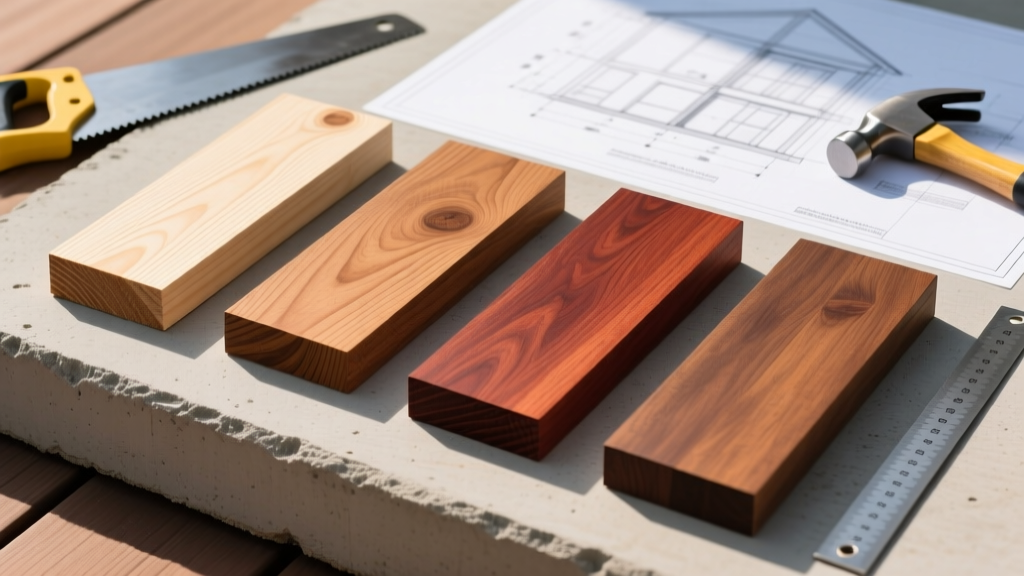
The Core Question: What Type of Wood for a Deck Actually Lasts?
Choosing the right decking material is a balance of upfront budget, long-term maintenance, and structural longevity. When builders and homeowners ask what type of wood for a deck will perform best in their specific climate, the answer requires looking past generic species names and examining lumber grades, treatment levels, and heartwood-to-sapwood ratios. A deck built with the wrong grade of cedar will rot just as quickly as untreated pine, while premium tropical hardwoods demand specialized installation techniques that can double labor costs.
Quick Decision Matrix: Match Your Profile to the Wood
- Budget under $5/sq ft & high moisture: KDAT (Kiln-Dried After Treatment) Pressure-Treated Southern Yellow Pine.
- Budget $6-$9/sq ft & desire natural decay resistance: Western Red Cedar (Select Heart grade) or California Redwood.
- Budget $10+/sq ft & zero-rot lifetime expectation: Ipe, Cumaru, or Tigerwood (Tropical Hardwoods).
Pressure-Treated Southern Yellow Pine (SYP): The Budget Workhorse
Southern Yellow Pine dominates the North American decking market due to its structural strength and affordability. However, not all pressure-treated lumber is created equal. The American Wood Protection Association (AWPA) classifies treated wood into specific Use Categories. For deck framing and joists, you must specify UC3B (Above Ground) or UC4A (Ground Contact) if the joists are within 6 inches of the ground or in poor drainage areas.
The KDAT Advantage
Standard pressure-treated pine is injected with preservatives (like micronized copper azole) and shipped wet. As it dries on your deck, it shrinks, twists, and cups. To mitigate this, specify KDAT (Kiln-Dried After Treatment) lumber. KDAT boards have already undergone the shrinking process in a controlled kiln, resulting in significantly less warping and allowing you to seal or stain the wood immediately upon installation rather than waiting 3 to 6 months for it to dry out.
- Material Cost: $2.50 – $4.00 per linear foot (5/4x6 profile).
- Lifespan: 15–20 years (framing), 10–15 years (decking boards).
- Primary Failure Mode: Checking (surface cracking) and cupping if fastened improperly.
Western Red Cedar & Redwood: The Natural Decay Resistors
Cedar and redwood contain natural tannins and extractives that resist fungal decay and insect attacks without chemical treatments. However, the most critical mistake buyers make is ignoring the lumber grade. Only the heartwood (the dark, inner rings of the tree) contains these protective extractives. The sapwood (the lighter, outer rings) is highly susceptible to rot.
When ordering cedar or redwood, you must explicitly request "Select Heart" or "Construction Heart" grades. According to the USDA Forest Products Laboratory, heartwood of western red cedar has a natural decay resistance rating that can exceed 20 years in above-ground applications. If you buy "Select Tight Knot" or standard "Construction" grades, you are likely getting a mix of heartwood and sapwood, and the sapwood boards will begin to rot within 3 to 5 years.
Tropical Hardwoods (Ipe, Cumaru, Tigerwood): The 50-Year Investment
Tropical hardwoods offer unmatched density and longevity. Ipe (Handroanthus spp.) boasts a Janka hardness rating of 3,680 lbf—roughly six times harder than SYP. This density makes it virtually impervious to rot, termites, and surface scratching. However, sourcing these materials requires strict adherence to sustainability standards. Always verify that your supplier provides Forest Stewardship Council (FSC) certification to ensure the wood was legally and sustainably harvested.
Installation Realities for Hardwoods
Because Ipe and Cumaru are so dense, they cannot be nailed, and driving a screw directly into the board will snap the screw head. Installation requires specific protocols:
- Pre-drilling: Every single screw hole must be pre-drilled using a carbide-tipped drill bit slightly larger than the screw shank.
- End-Grain Sealing: Tropical hardwoods dry unevenly, leading to severe end-grain checking (splitting). Every cut end must be immediately coated with a wax-based end-sealer like Anchorseal.
- Hidden Fasteners: Because face-screwing requires plugging (drilling a larger hole, inserting the screw, and gluing in a wood dowel), most professionals use hidden clip systems (e.g., Ipe Clip Extreme) routed into the grooved edges of the boards.
- Material Cost: $9.00 – $14.00 per linear foot.
- Lifespan: 40–75+ years.
- Maintenance: Annual application of UV-inhibiting penetrating oil (e.g., Ipe Oil) to maintain the brown color; otherwise, it weathers to a silver-gray patina.
Head-to-Head Decking Wood Comparison Matrix
| Wood Species | Janka Hardness (lbf) | Est. Lifespan | Cost / Sq Ft (Material) | Maintenance Cycle |
|---|---|---|---|---|
| PT SYP (KDAT) | 870 | 15 Years | $2.50 - $4.00 | Every 1-2 Years |
| Western Red Cedar (Heart) | 350 | 20 Years | $5.50 - $8.00 | Every 2-3 Years |
| Cumaru | 3,540 | 40+ Years | $7.50 - $9.50 | Annual (for color) |
| Ipe | 3,680 | 50+ Years | $10.00 - $14.00 | Annual (for color) |
Structural Framing vs. Decking Boards: Don't Mix Them Up
A common error in residential construction is using expensive decking woods for the structural subframe. The joists, beams, and posts beneath your deck bear the structural load and are highly exposed to trapped moisture. Never use cedar or redwood for structural framing. Their bending strength (Modulus of Rupture) and stiffness (Modulus of Elasticity) are significantly lower than Douglas Fir or Southern Yellow Pine. Always build the subframe using #1 or Select Structural grade Pressure-Treated SYP or Douglas Fir, ensuring the framing lumber meets the AWPA UC4A standard if it is close to the soil.
Real-World Failure Modes & How to Prevent Them
Even the best wood species will fail if installed incorrectly. The two most common catastrophic failures in wood decking are cupping and end-splitting.
1. Board Cupping (The Bark-Side Rule)
Wood expands and contracts tangentially (parallel to the growth rings) roughly twice as much as it does radially. When installing flat-sawn boards, always place them "bark-side up" (growth rings curving downward like a smile). If installed bark-side down, the edges will curl upward as the wood weathers, creating a cupped profile that holds water and accelerates rot.
2. End-Grain Checking
Moisture escapes from the end-grain of a board 10 to 15 times faster than from the face. When the ends dry too quickly, the differential shrinkage causes deep splits. For cedar, redwood, and tropical hardwoods, applying a specialized wax emulsion end-sealer immediately after every cross-cut is non-negotiable. Standard paint or stain will not penetrate deeply enough to prevent this structural failure.
"The lifespan of a wood deck is rarely determined by the wood species alone; it is dictated by the fastening schedule, the ventilation gap beneath the joists, and the immediate sealing of end-grains during construction."
Final Verdict: Matching Wood to Your Specific Build
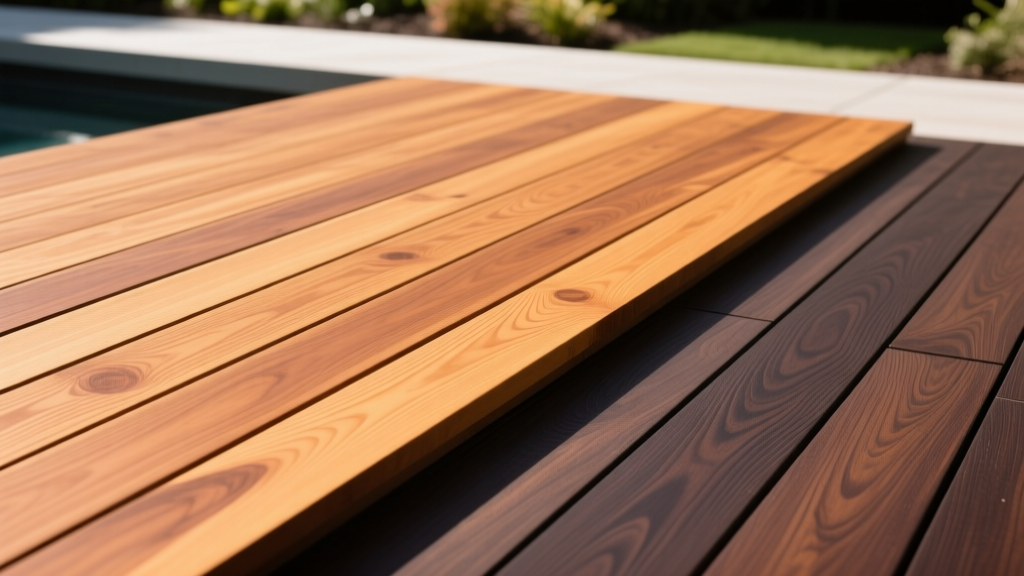
If your priority is minimizing upfront costs and you are willing to perform annual power-washing and sealing, KDAT Pressure-Treated Pine remains the most structurally sound and economical choice. If you want a premium, natural aesthetic with moderate maintenance, invest the extra capital into Western Red Cedar (Select Heart grade), ensuring you reject any boards with wide sapwood margins. Finally, if you are building a forever-home and want a deck surface that will outlive the roof on your house, the high material and labor costs of Ipe or Cumaru are justified by their multi-generational durability and unmatched resistance to the elements.
Written by
Marcus ChenMarcus Chen is a licensed structural engineer (PE) and building materials analyst with over 12 years of experience across residential, commercial, and industrial construction. He holds a Master of Science in Civil Engineering from UC Berkeley and spent six years at Thornton Tomasetti before transitioning to independent consulting and technical writing. Marcus specializes in material selection for seismic-prone regions, concrete reinforcement strategies, and lifecycle cost analysis. His work has been cited by the American Concrete Institute (ACI) and the Structural Engineers Association of California (SEAOC). When he is not on a job site or at his desk, you will find him hiking the Sierra Nevada or restoring a 1920s craftsman bungalow in Oakland, CA.
More from Marcus Chen
View all
Construction Cost
How Much Did the Eiffel Tower Cost to Build?
How much did the Eiffel Tower cost to build in 1889? We adjust for inflation and compare its budget to modern skyscraper construction.
Aug 4, 2026

Fire Resistance
What Is a Fire Resistant Material? Testing & Certification Guide
Discover what is a fire resistant material through ASTM and UL testing. Learn how fire ratings, certifications, and assemblies work in construction.
Aug 4, 2026

Construction Cost
How Much Did the Burj Khalifa Cost to Build?
How much did the Burj Khalifa cost to build? We break down the $1.5B project and extract 5 money-saving strategies for your next build.
Jul 30, 2026