Types of Wood Joinery Compared: Strength, Cost, and Best Uses
Compare the top types of wood joinery for structural and fine woodworking. Evaluate mortise, dovetail, pocket hole, and domino joints by strength and cost.

The Physics and Mechanics of Wood Joinery
Selecting the correct wood joint is an exercise in managing mechanical stress, wood movement, and adhesive chemistry. A joint that excels in tensile pull-apart resistance may fail catastrophically under racking (shear) forces. According to data from the USDA Forest Products Laboratory Wood Handbook, the structural integrity of a wood assembly relies less on the fastener and more on the long-grain to long-grain glue surface area. End-grain glue-ups provide virtually zero structural adhesion because the wood's cellular structure acts like a bundle of straws, wicking adhesive away from the joint line and causing glue starvation.
When evaluating different types of wood joinery, professionals must balance three core variables: shear strength, production speed, and equipment capital expenditure. A custom furniture maker building a $4,000 white oak dining table requires different joinery than a production cabinet shop assembling 50 face frames per day. Below is a comprehensive comparison of the primary joinery methods used in modern woodworking and construction.
Quick Decision Matrix: Joint Selection
- Highest Racking/Shear Strength: Mortise and Tenon, Dovetail
- Fastest Production Speed: Pocket Hole, Biscuit
- Best for Concealed/Invisible Joinery: Domino, Dowel, Sliding Dovetail
- Best for Solid Wood Panel Expansion: Haunched Mortise and Tenon, Frame and Panel
Traditional High-Strength Joinery
Mortise and Tenon (M&T)
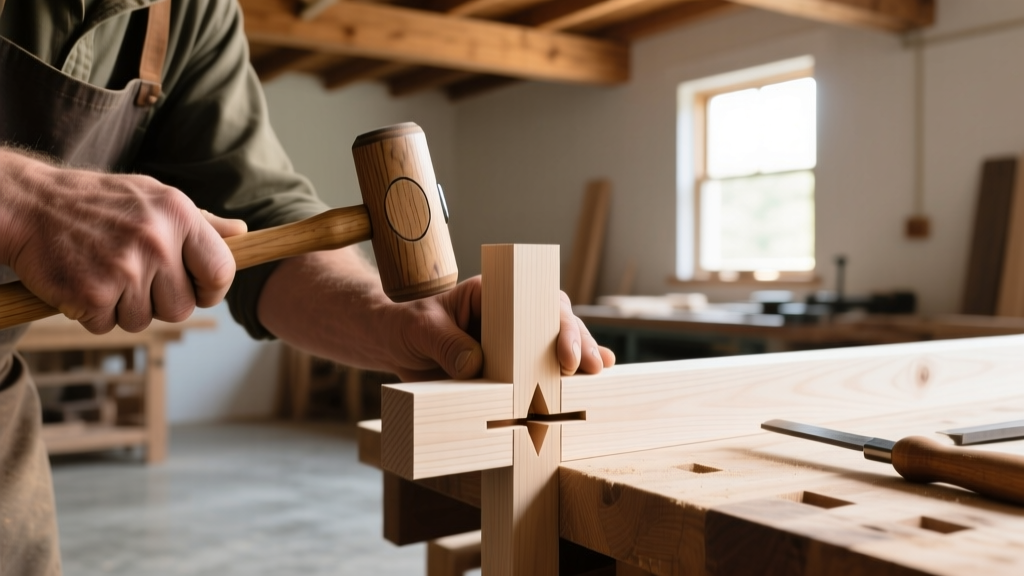
The mortise and tenon remains the undisputed standard for structural frame construction, including chair legs, table aprons, and timber framing. The joint works by inserting a protruding tongue (tenon) into a corresponding cavity (mortise). For optimal strength, the tenon thickness should be exactly one-third the thickness of the stock. A tenon that is too thick weakens the mortise walls, leading to splitting; one that is too thin reduces the glue surface area and risks snapping under leverage.
In structural applications, a properly fitted M&T joint in hard maple or white oak can withstand over 1,500 lbs of shear force. For frame-and-panel doors, woodworkers utilize a haunched tenon. The haunch fills the groove cut for the door panel, preventing the stile from twisting while allowing the floating panel to expand and contract seasonally.
Dovetail Joints
Dovetails provide supreme tensile strength, mechanically locking two boards together at a 90-degree angle. They are the premier choice for drawer boxes and casework. The angle of the dovetail pins and tails is critical: a 1:8 ratio (approx. 7 to 9 degrees) is standard for hardwoods to prevent the brittle pins from snapping, while a 1:6 ratio (approx. 14 degrees) is used for softer woods like pine to provide adequate mechanical bite. Hand-cut dovetails require precise baselining with a cutting gauge set to the exact thickness of the mating board, not the nominal thickness, to ensure a flush fit without excessive planing.
Modern Concealed and Mechanical Joinery
Floating Tenon (Domino) Joinery
Festool’s Domino joiner revolutionized production woodworking by combining the speed of a biscuit joiner with the structural strength of a traditional mortise and tenon. The tool uses a carbide spiral bit that oscillates laterally while plunging, creating a perfect, elongated mortise in both mating pieces. A pre-milled, fluted beech tenon (the "Domino") is then glued into both slots.
Because the beech dominos are compressed during manufacturing, they swell rapidly when exposed to the moisture in PVA wood glues, creating a permanent, mechanical lock inside the mortise. The DF 500 model handles tenons from 4mm to 10mm, ideal for standard furniture and cabinet face frames. For heavy exterior doors, structural gates, and timber work, the DF 700 XL accepts 8mm to 14mm tenons, providing structural parity with traditional M&T joints.
Dowel Joinery
Dowel joinery uses cylindrical wooden pins to align and reinforce edge, butt, and miter joints. While older, mass-produced furniture often used undersized, smooth dowels that failed over time, modern precision jigs (like those from JessEm or Jessem) utilize fluted, compressed hardwood dowels that offer exceptional holding power. Doweling requires absolute precision in hole alignment; a deviation of just 1/32 of an inch will result in a misaligned panel or a joint that refuses to close under clamping pressure. Dowels are highly effective for reinforcing long-grain edge joints in panel glue-ups and for concealing joinery in mitered casework.
Rapid Assembly and Production Joinery
Pocket Hole Joinery
Pocket hole joinery involves drilling an angled, stepped hole into one board and driving a self-tapping screw into the mating board. It is the fastest method for assembling face frames, cabinet carcasses, and basic utility furniture. However, pocket holes rely almost entirely on the mechanical grip of the screw rather than glue surface area. While they offer excellent tensile strength (resisting pull-apart), they perform poorly under racking (side-to-side shear) forces. A pocket-screwed chair leg will eventually wobble and fail unless reinforced with corner brackets or secondary glue blocks.
Crucially, screw thread selection must match the material. Coarse-thread screws are required for softwoods and sheet goods to prevent stripping, while fine-thread screws must be used in hardwoods to prevent the wood from splitting or the screw heads from snapping under torque.
Biscuit (Plate) Joinery
Biscuit joinery uses a small, angled slot cutter to create crescent-shaped grooves in two mating boards, into which a compressed beech "biscuit" is glued. Biscuits are primarily an alignment tool rather than a structural reinforcement. They are invaluable for keeping long panel glue-ups perfectly flush during clamping and for registering miter joints. They do not provide significant structural strength for load-bearing joints like chair rails or table aprons.
2026 Equipment Cost and ROI Matrix
Investing in joinery tooling requires analyzing the cost per joint and the time saved in a production environment. Below is a breakdown of current market pricing for professional-grade equipment.
| Joinery Method | Primary Tooling (Pro Grade) | Approx. 2026 Cost | Time Per Joint |
|---|---|---|---|
| Mortise & Tenon | Hollow Chisel Mortiser + Table Saw Tenon Jig | $850 - $1,400 | 8 - 15 mins |
| Domino (Floating Tenon) | Festool DF 500 Q Set | $1,200 | 1 - 2 mins |
| Pocket Hole | Kreg K5 Master System / Foreman | $160 - $450 | 30 - 60 secs |
| Dowel | JessEm Doweling Jig / Mafell DuoDoweler | $350 - $1,100 | 2 - 4 mins |
| Biscuit | Makita PJ7000 / Porter-Cable 557 | $220 - $280 | 1 - 2 mins |
Critical Failure Modes and Edge Cases
Warning: Cross-Grain Glue-Ups and Wood Movement
As detailed by the experts at The Wood Database, wood expands and contracts significantly across the grain (tangentially and radially) but barely at all along the grain (longitudinally). Rigidly gluing a long-grain board to an end-grain or cross-grain board—such as screwing a solid wood tabletop directly to a cross-grain apron without elongated figure-8 fasteners or Z-clips—will result in the panel splitting as it attempts to shrink in the winter. Never use rigid joinery like dowels or dominos to lock cross-grain assemblies without accommodating for seasonal movement.
Glue Starvation in Deep Mortises
When cutting deep mortises for heavy timber or thick table legs, applying glue only to the tenon often results in the adhesive being scraped off the end grain as the joint is driven home. This leaves the deepest part of the joint completely dry. The correct protocol is to apply a thin, even layer of PVA glue to the mortise walls using a flux brush or a small roller, and a slightly thicker coat on the tenon cheeks.
Shoulder Gaps in Tenons
A common failure in mortise and tenon joinery is a visible gap at the shoulder line after clamping. This is rarely caused by the tenon being too long; it is almost always caused by end-grain tear-out at the base of the tenon cheek, or a mortise that was not squared perfectly with a chisel. Always undercut the tenon shoulder slightly with a shoulder plane or a rabbeting block plane to ensure the outermost edge of the shoulder pulls tight against the mating piece.
Adhesive Selection for Joinery
The type of glue used dictates the open time and final rigidity of the joint. Standard aliphatic resin (yellow glue, like Titebond II) sets in 5 to 10 minutes, which can induce panic during complex casework glue-ups involving multiple dominos or dowels. For complex assemblies, woodworkers should switch to Titebond Extend or a slow-set epoxy, which provides 20 to 30 minutes of open time. For exterior structural joinery, such as exterior timber doors or garden gates, Titebond III or a resorcinol-formaldehyde resin is mandatory to prevent moisture-induced delamination.
Final Verdict: Matching the Joint to the Application
There is no single "best" type of wood joinery; there is only the correct joint for the specific mechanical and economic constraints of the project. For heirloom furniture, chairs, and structural timber framing, the traditional mortise and tenon is non-negotiable due to its unmatched shear strength and longevity. For high-volume cabinet shops and modern furniture makers who require invisible, high-strength joints without the setup time of a hollow chisel mortiser, the Domino floating tenon system offers the highest return on investment. Finally, for face frames, utility shelving, and rapid DIY construction, pocket hole joinery remains the undisputed champion of speed and accessibility.
Written by
Priya KapoorPriya Kapoor is a real estate market analyst and construction economics researcher with expertise in housing affordability, development feasibility, and infrastructure investment. She holds a Master of Regional Planning from Cornell University and previously worked as a senior analyst at CBRE's Investment Properties group, where she modeled returns for $4B in mixed-use development pipelines. Priya now runs an independent research practice advising developers, municipalities, and REITs on construction cost forecasting and market timing. She publishes the quarterly "BuildMat Market Pulse" report tracking material price indices across 12 commodity categories. Based in Austin, TX, Priya serves on the board of Habitat for Humanity Austin and is a marathon runner.
More from Priya Kapoor
View all
Construction Cost
Cost to Build a 1600 Sq Ft Home in 2026: Full Breakdown
Accurate 2026 cost to build a 1600 sq ft home—material, labor, and regional pricing breakdowns included. Plan your budget with real-time estimates.
Aug 11, 2026

Wood & Lumber
Name the Types of Wood for Pressure Treatment and Preservation
Learn how to name the types of wood best suited for pressure treatment. Compare species treatability, chemical retention levels, and 2026 preservation costs.
Aug 4, 2026

Stone & Masonry
Stone Veneer Suppliers Lindenhurst: 2026 Cost Analysis
Analyze 2026 stone veneer costs in Lindenhurst, NY. Compare local supplier pricing, delivery fees, and Suffolk County installation labor rates.
Aug 4, 2026