What Type of Wood for Pizza Oven: Cost & BTU Value Guide
Discover what type of wood for pizza oven delivers the best BTU value. Compare costs, moisture levels, and flavor profiles of top hardwoods.
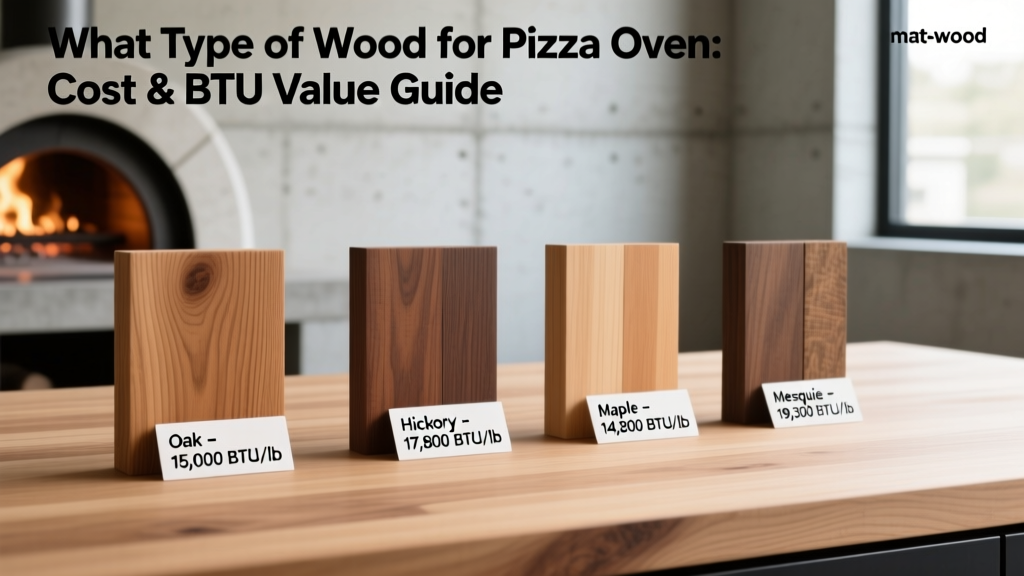
Choosing the right fuel for high-heat outdoor cooking is not just about flavor; it is a thermodynamic necessity. When asking what type of wood for pizza oven setups yields the best results, the answer hinges on the intersection of BTU output, moisture content, and cost-efficiency. Unlike a home fireplace designed for slow, sustained radiant heat, a pizza oven requires rapid, high-BTU combustion to push dome temperatures to 800°F–900°F (425°C–480°C) in under 45 minutes. Using the wrong wood species or improperly dried timber will result in excessive smoke, creosote buildup, and a soggy, undercooked crust.
The Hardwood Hierarchy: Cost vs. BTU Output
Hardwoods are denser than softwoods, packing more cellulose and lignin into the same physical volume. This density translates directly to higher British Thermal Units (BTUs) per cord. Below is a comparative analysis of the most popular pizza oven woods, factoring in average regional bulk pricing, heat output, and culinary flavor profiles.
| Wood Species | BTU per Cord (Millions) | Avg Cost per Cord | Flavor Profile | Cost Per Cook |
|---|---|---|---|---|
| White Oak | 29.1 | $450 - $600 | Neutral, clean, traditional | $0.45 - $0.60 |
| Hickory | 30.6 | $500 - $700 | Strong, smoky, bacon-like | $0.50 - $0.70 |
| Apple | 27.0 | $600 - $850 | Mild, sweet, fruity | $0.60 - $0.85 |
| Cherry | 23.5 | $550 - $750 | Mild, slightly tart, aromatic | $0.55 - $0.75 |
| Mesquite | 28.0 | $700 - $900 | Intense, earthy, sharp | $0.70 - $0.90 |
According to data from the USDA Forest Products Laboratory, dense hardwoods like hickory and oak provide the highest energy density per cubic foot. For pure cost-efficiency and reliable high-heat performance, White Oak remains the undisputed champion. It burns hot, produces a stable coal bed, and imparts a neutral smoke that enhances rather than overpowers the ingredients.
Kiln-Dried vs. Air-Seasoned: Analyzing the Price Premium
When sourcing wood, you will encounter two primary drying methods: air-seasoned and kiln-dried. Understanding the economic and performance differences is critical for maintaining consistent oven temperatures.
The Case for Kiln-Dried Wood
- Moisture Content: Guaranteed to be between 10% and 15%.
- Ignition Speed: Lights in under 3 minutes with minimal kindling.
- Pest Control: The kiln process (heating to 140°F+ for several hours) kills all insects, larvae, and mold spores.
- Cost Premium: Typically costs 20% to 30% more per cord than air-seasoned wood.
The Reality of Air-Seasoned Wood
- Moisture Content: Highly variable. Even after 12 months of stacking, wood in humid climates rarely drops below 20% to 25% moisture.
- Performance Hit: Wet wood wastes up to 30% of its potential BTU output simply boiling off internal water, resulting in a smoky, low-temperature fire.
- Hidden Costs: Requires a 6-to-12-month storage commitment, proper stacking infrastructure, and tarps to protect against rain.
Sizing for High-Heat Combustion
The physical dimensions of your firewood dictate the burn rate. Pizza ovens require fast, aggressive burns to maintain dome temperatures during the 60-to-90-second bake window of a Neapolitan pizza. Do not use full-sized 16-inch fireplace logs.
Optimal Pizza Oven Wood Dimensions:
- Length: 10 to 12 inches (allows for proper airflow and fits easily through standard oven doors).
- Diameter: 3 to 4 inches (thin enough to catch quickly and burn hot, thick enough to sustain a 15-minute coal bed).
Using oversized logs will smolder and drop the dome temperature, while using exclusively thin kindling will cause rapid temperature spikes and crashes, leading to unevenly cooked crusts.
Woods to Avoid: The Hidden Costs of Softwoods and Scraps
Never compromise on wood quality to save a few dollars. The EPA's BurnWise program explicitly warns against burning softwoods and treated materials due to excessive particulate emissions and toxic off-gassing.
- Pine, Fir, Spruce, and Cedar: High sap and resin content cause aggressive creosote buildup on the oven dome, which will eventually flake off onto your food as bitter, black soot.
- Pallet Wood and Construction Scraps: Often treated with methyl bromide or heat-treated (HT) with chemical accelerants. Burning these introduces toxic compounds directly into your food.
- Painted or Stained Wood: Releases volatile organic compounds (VOCs) and heavy metals like lead when subjected to 800°F+ temperatures.
Bulk Cords vs. Retail Bags: A Purchasing Framework
How you buy your wood drastically impacts your cost-per-cook. Here is a mathematical breakdown to help you decide between bulk delivery and retail convenience.
The Retail Bag Route
Hardware stores and supermarkets sell 'pizza oven wood' in small, branded boxes or shrink-wrapped bundles. These typically contain 0.5 to 1.0 cubic feet of kiln-dried wood and cost between $8.00 and $15.00. While highly convenient and guaranteed to be dry, the cost per pound is exorbitant—often exceeding $1.50 per pound. This route is only viable for occasional users baking 2 to 3 pizzas a month.
The Bulk Cord Route
A full cord measures 128 cubic feet (4x4x8 feet) and weighs roughly 2,000 to 2,500 lbs depending on the species. At $500 per cord for White Oak, your cost drops to roughly $0.25 per pound. For a standard 4-hour pizza party baking 20 pizzas, you will consume approximately 15 to 20 lbs of wood. Buying in bulk drops your fuel cost from $12.00 per party (retail) to roughly $4.50 per party (bulk).
The Hybrid Strategy
If you lack the space to store a full cord, seek out local specialty firewood dealers who sell 'half-cords' or 'pizza oven specific splits' in 50 lb or 100 lb burlap sacks. This bridges the gap between bulk pricing and manageable storage, typically costing $0.40 to $0.60 per pound.
Frequently Asked Questions
Can I mix wood and charcoal in a pizza oven?
Yes. Many pitmasters use a base bed of high-quality lump charcoal (like Fogo or Jealous Devil) to establish a long-lasting, high-BTU coal bed, and then add 2 to 3 splits of hardwood (like cherry or apple) purely for flavor and the aesthetic rolling flame. This is highly effective for lower-temperature New York style pizzas (650°F–700°F) that require longer 5-to-7-minute bakes.
Does the wood species really affect the taste of a 90-second pizza?
Yes, but subtly. In a 90-second Neapolitan bake, the food is exposed to smoke for a very short duration. Strong woods like mesquite or hickory can easily overpower delicate toppings like fresh mozzarella and basil. For ultra-fast bakes, stick to mild, sweet fruit woods like apple or cherry, or use neutral white oak to let the ingredients shine.
How long does a cord of pizza oven wood last?
If you host a pizza party twice a month, baking roughly 15 pizzas per session, you will consume about 40 lbs of wood per month. A standard 2,000 lb cord will last approximately 4 to 5 years. For most residential users, a half-cord is the most economically sound purchase to prevent the wood from degrading or absorbing ambient moisture over multiple seasons.
Written by
Priya KapoorPriya Kapoor is a real estate market analyst and construction economics researcher with expertise in housing affordability, development feasibility, and infrastructure investment. She holds a Master of Regional Planning from Cornell University and previously worked as a senior analyst at CBRE's Investment Properties group, where she modeled returns for $4B in mixed-use development pipelines. Priya now runs an independent research practice advising developers, municipalities, and REITs on construction cost forecasting and market timing. She publishes the quarterly "BuildMat Market Pulse" report tracking material price indices across 12 commodity categories. Based in Austin, TX, Priya serves on the board of Habitat for Humanity Austin and is a marathon runner.
More from Priya Kapoor
View all
Construction Cost
Cost to Build a 1600 Sq Ft Home in 2026: Full Breakdown
Accurate 2026 cost to build a 1600 sq ft home—material, labor, and regional pricing breakdowns included. Plan your budget with real-time estimates.
Aug 11, 2026

Wood & Lumber
Name the Types of Wood for Pressure Treatment and Preservation
Learn how to name the types of wood best suited for pressure treatment. Compare species treatability, chemical retention levels, and 2026 preservation costs.
Aug 4, 2026

Stone & Masonry
Stone Veneer Suppliers Lindenhurst: 2026 Cost Analysis
Analyze 2026 stone veneer costs in Lindenhurst, NY. Compare local supplier pricing, delivery fees, and Suffolk County installation labor rates.
Aug 4, 2026