Wood Preservative Performance Ratings and AWPA Specifications
Master wood preservative performance ratings. Compare AWPA Use Categories, chemical retention rates (pcf), and fastener compatibility specs.
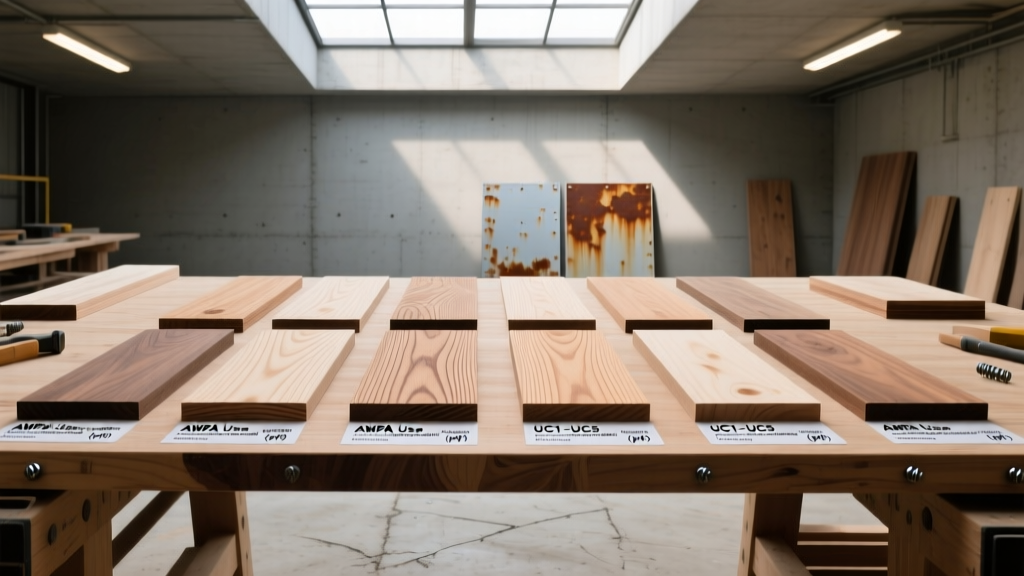
Decoding the AWPA Use Category (UC) System
Specifying the correct wood preservative requires moving beyond generic terms like 'pressure-treated' and understanding the precise environmental exposure the lumber will face. The American Wood Protection Association (AWPA) establishes the definitive performance ratings through its Use Category (UC) system. This framework dictates the minimum chemical retention levels required to prevent fungal decay and termite infestation over a 50-year structural lifespan.
For architects, structural engineers, and procurement managers, matching the lumber's UC rating to the specific microclimate of the build site is the single most critical factor in preventing premature structural failure.
| AWPA Category | Exposure Condition | Typical Application |
|---|---|---|
| UC1 | Interior, dry, above ground | Interior framing, flooring joists |
| UC2 | Interior, dampness possible | Bathroom subfloors, unvented crawl spaces |
| UC3A | Exterior, above ground, coated | Painted siding, protected fascia |
| UC3B | Exterior, above ground, uncoated | Decking, fence boards, railings |
| UC4A | Ground contact, general | Deck posts, fence posts, landscaping timbers |
| UC4B | Ground contact, heavy duty | Permanent wood foundations, critical structural posts |
| UC4C | Ground contact, extreme duty | Piling, highway guardrail posts |
| UC5A-C | Marine / Saltwater environments | Docks, bulkheads, seawalls |
Modern Chemical Formulations and Minimum Retention Rates
Following the 2004 voluntary phase-out of Chromated Copper Arsenate (CCA) for residential use, the industry shifted toward copper-based and organic biocide systems. In 2026, the market is dominated by Alkaline Copper Quaternary (ACQ), Copper Azole (CA-C), Micronized Copper Azole (MCA), and Propiconazole-Tebuconazole-Imidacloprid (PTI). The USDA Forest Products Laboratory emphasizes that efficacy is not just about the chemical used, but the net retention rate measured in pounds per cubic foot (pcf).
Comparative Retention Data for Ground Contact (UC4A)
The table below outlines the minimum AWPA-specified retention rates for Southern Pine in ground contact (UC4A). Note that formulations with lower copper content require highly specific co-biocides to maintain efficacy against copper-tolerant fungi.
| Preservative Type | AWPA Designation | Min. Retention (pcf) | Primary Mechanism |
|---|---|---|---|
| Copper Azole, Type C | CA-C | 0.15 | Copper (fungicide) + Tebuconazole (co-biocide) |
| Micronized Copper Azole | MCA | 0.15 | Suspended micronized copper + Tebuconazole |
| Alkaline Copper Quat, Type D | ACQ-D | 0.40 | Copper + Didecyldimethylammonium chloride (quat) |
| Organic Biocide Blend | PTI | 0.09 (total actives) | Propiconazole + Tebuconazole + Imidacloprid |
Fastener Corrosion: The Hidden Cost of Copper-Based Preservatives
The shift to ACQ and CA formulations introduced a massive secondary cost to construction projects: fastener corrosion. Because these modern preservatives contain high levels of alkaline copper, they act as a galvanic catalyst when in contact with reactive metals. Standard electroplated galvanized fasteners will corrode and fail within 3 to 5 years when used with ACQ or CA-C treated lumber.
Mandatory Hardware Specifications
- Hot-Dip Galvanized (HDG): Must meet ASTM A153 standards with a minimum zinc coating thickness of 1.0 mil (0.001 inches). This is the absolute minimum for UC3B and UC4A applications.
- Zinc Flake Coatings: Must meet ASTM F2329. While aesthetically pleasing and offering good corrosion resistance, verify the manufacturer's specific warranty for use with copper-based preservatives.
- Stainless Steel: Type 304 (ASTM A276) is required for UC4A and above. Type 316 marine-grade stainless is mandatory for UC5 (marine) applications or when treating lumber exposed to de-icing salts.
- Aluminum Flashing: Never allow bare aluminum to contact CA-C or ACQ treated wood. Use a physical barrier (e.g., butyl rubber tape or PVC membrane) to prevent galvanic pitting.
Penetration Depth and Reading the Quality Stamp
Retention rate (pcf) is meaningless if the preservative does not penetrate deeply enough into the wood matrix. The AWPA E1 standard governs inspection and mandates specific penetration depths based on the wood species and the presence of heartwood.
When inspecting a load of treated lumber on-site, verify the end tag or incised stamp. A compliant AWPA stamp will display:
- The Quality Mark: An ALSC (Accredited Laboratories Services Council) logo indicating third-party inspection.
- Standard Compliance: 'AWPA U1' confirming the chemical and retention specs.
- Use Category: e.g., 'UC4A' for ground contact.
- Preservative Code: e.g., 'CA-C' or 'MCA'.
- Drying Status: 'KDAT' (Kiln Dried After Treatment) is highly recommended for framing lumber to minimize warping and twisting, though it commands a 15-20% price premium in the 2026 lumber market.
For Southern Pine (which is nearly 100% treatable sapwood), AWPA requires a minimum penetration of 2.5 inches or 90% of the sapwood depth for UC4A. However, for species like Douglas Fir, which possess highly impermeable heartwood, the standard requires 100% penetration of the available sapwood, and the heartwood must be physically excluded or incised to allow chemical uptake. Always specify 'Inced' lumber when ordering Douglas Fir or Hem-Fir for ground contact.
Decision Matrix: Selecting the Right Preservative Specification
Use the following framework to specify the correct wood preservative for your project documentation and procurement orders:
Scenario 1: Above-Ground Residential Decking (UC3B)
- Specification: MCA or PTI.
- Rationale: MCA offers excellent color retention and paintability. PTI is ideal if the builder wants to use standard aluminum flashing and standard fasteners without corrosion concerns. Estimated material cost: $2.80 - $3.50 per linear foot (5/4x6).
Scenario 2: Structural Deck Posts in Soil (UC4A)
- Specification: CA-C or MCA (0.15 pcf minimum).
- Rationale: Copper is necessary to resist soil-borne fungi and subterranean termites. Must pair with ASTM A153 hot-dip galvanized post bases and 304 stainless steel structural screws.
Scenario 3: Permanent Wood Foundation / Retaining Wall (UC4B)
- Specification: CA-C (0.31 pcf) or ACQ-D (0.60 pcf).
- Rationale: High moisture, continuous soil contact, and critical structural load demand maximum biocide loading. Do not use PTI or standard MCA in this scenario.
Environmental Regulations and 2026 Market Trends
The regulatory landscape for wood preservatives continues to tighten. The Environmental Protection Agency (EPA) maintains strict oversight on pesticide registration, heavily scrutinizing the leaching potential of heavy metals into groundwater. In 2026, the market is seeing a definitive shift toward micronized copper systems (like MCA) and advanced organic biocides (like PTI) due to their lower environmental impact during the manufacturing and disposal phases.
Furthermore, specifiers are increasingly demanding 'Eco-Certified' labels from treaters, which verify that the preservative chemicals were applied using closed-loop vacuum systems that capture and recycle leaching chemicals, preventing soil contamination at the treatment facility. When drafting project specifications, explicitly requiring ALSC-certified, AWPA U1-compliant lumber with KDAT processing ensures structural longevity, minimizes contractor callbacks, and aligns with modern environmental building standards.