Prefinished Hardwood Flooring Cost Estimator & 2026 Pricing Guide
Calculate your prefinished hardwood flooring costs with our 2026 estimator. Get exact material, labor, and waste factor pricing for top brands.
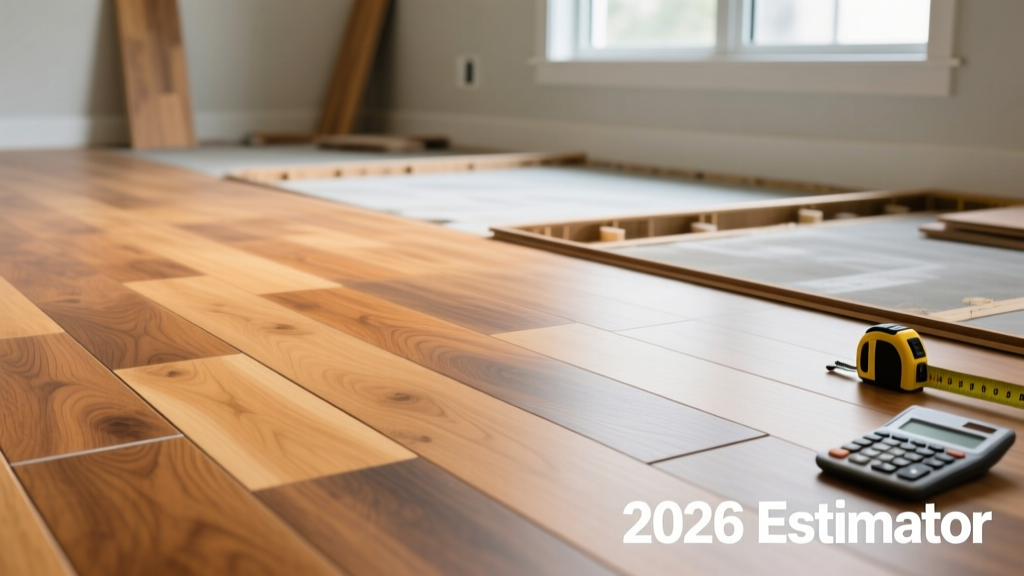
The True Cost of Prefinished Hardwood in 2026
Budgeting for prefinished hardwood flooring requires moving beyond the advertised price-per-square-foot on the showroom tag. Factory-finished planks eliminate the $3 to $6 per square foot cost of on-site sanding and finishing, but they introduce strict requirements for subfloor flatness, precise waste calculations, and specialized transition moldings. In 2026, the national average for a complete prefinished hardwood installation (materials, labor, and waste) ranges from $9.50 to $18.00 per square foot, depending heavily on wood species, plank width, and installation method.
Quick 2026 Cost Summary (Per Square Foot)
- Material (Domestic Solid): $6.00 - $11.50
- Material (Engineered Wide-Plank): $7.50 - $14.00
- Labor (Nail-Down/Staple): $4.50 - $7.50
- Labor (Glue-Down/Floating): $3.50 - $6.00
- Waste Factor (Standard Layout): 7% - 10%
Material Cost Breakdown by Wood Species & Grade
The price of prefinished hardwood is dictated by the species' scarcity, the thickness of the wear layer (for engineered products), and the grading. A common misconception is that lower grades are always cheaper. In 2026, character grades (like #2 Common or Rustic) with heavy mineral streaks and knots often carry a premium over Select grades due to high designer demand for organic, lived-in aesthetics.
| Wood Species | Format | Grade / Style | 2026 Cost / Sq Ft |
|---|---|---|---|
| Red Oak | 3/4" Solid (3.25" wide) | Select | $6.50 - $8.50 |
| White Oak | 1/2" Engineered (7" wide) | Character / Wire-Brushed | $9.00 - $13.50 |
| Hickory | 3/4" Solid (5" wide) | #1 Common | $8.00 - $11.00 |
| Brazilian Cherry | 3/4" Solid (3.25" wide) | Select | $14.00 - $19.00 |
| European Oak | 5/8" Engineered (9.5" wide) | Premium / Fumed | $16.00 - $24.00 |
The Quantity Calculator: Factoring in Waste and Cuts
Prefinished hardwood is sold in cartons, typically covering 18 to 24 square feet for solid 3/4-inch planks, and 25 to 32 square feet for wider engineered planks. Because you cannot buy partial boxes, and because every row requires staggered end-joints (usually a minimum 6-inch stagger), material waste is inevitable. Buying too little results in dye-lot mismatches if you need to order more; buying too much leaves you with expensive, unreturnable leftovers.
Calculating Your Exact Waste Factor
The National Wood Flooring Association (NWFA) recommends specific waste allowances based on room geometry and installation pattern. Use this framework to determine your multiplier:
- Standard Rectangular Rooms (Parallel Install): Add 7% to 10%. This covers end-cuts and rip-cutting the final row against the wall.
- Complex Layouts (Hallways, Closets, Doorways): Add 12% to 15%. Every doorway threshold and closet return requires precision cuts that generate offcuts too small to reuse.
- Diagonal Installations (45-degree angle): Add 15%. Both the starting and ending edges require continuous angled rip-cuts.
- Herringbone or Chevron Patterns: Add 18% to 22%. The geometric interlocking of prefinished engineered blocks or planks creates maximum waste at the room's perimeter.
Hidden Costs: Subfloor Prep, Underlayment, and Trim
The most frequent cause of budget overruns in prefinished hardwood projects is subfloor remediation. Factory-finished planks have zero tolerance for uneven subfloors. If the subfloor deviates by more than 3/16-inch over a 10-foot radius, the tongue-and-groove joints will fail, and the floor will squeak or splinter.
Essential Ancillary Materials
- Self-Leveling Compound: $35 - $55 per 50lb bag. Covers roughly 40-50 sq ft at a 1/4-inch depth. Essential for concrete slabs before gluing down engineered wood.
- Moisture Barriers: For nail-down over wood subfloors, 15lb asphalt-saturated felt paper costs $0.15 per sq ft. For engineered glue-down over concrete, a urethane moisture-mitigation adhesive (like Bostik Ultra-Set) costs $0.80 - $1.20 per sq ft, acting as both glue and vapor barrier.
- Transition Moldings: Prefinished floors require color-matched T-moldings, reducers, and stair noses. These cost $35 to $85 per 78-inch piece. Do not skip stair noses; attempting to bullnose a standard plank on a stair tread voids the manufacturer's warranty.
- Baseboard Removal & Reinstall: If you are not using quarter-round shoe molding to cover the 1/2-inch expansion gap, you must pay a carpenter $2.50 to $4.50 per linear foot to carefully remove, number, and reinstall existing baseboards.
Labor Rates and the Janka Hardness Factor
According to 2026 industry data compiled by Angi home improvement experts, standard labor for prefinished nail-down installation averages $5.50 per square foot. However, labor rates scale with the Janka hardness rating of the wood species you select.
Woods with a Janka rating over 1800 (such as Hickory at 1820, or Brazilian Cherry at 2350) are notoriously difficult to blind-nail. The pneumatic flooring stapler can split the tongues of ultra-hard woods if the air compressor PSI is not perfectly calibrated, or the installer may need to pre-drill holes near the ends of the boards. Expect a 15% to 20% labor surcharge for exotic or ultra-hard domestic species. Conversely, softer woods like American Cherry (950 Janka) install quickly but require careful handling to avoid denting the prefinished surface during the tapping process.
Top Brand Pricing & Product Line Comparison
When estimating costs, it helps to benchmark against major manufacturers. Here is how three dominant brands position their prefinished lines in 2026:
| Brand | Flagship Line | Key Specification | Est. Price Range |
|---|---|---|---|
| Shaw Floors | EpicPlus Engineered | 5/8" thick, up to 9" wide, Stabilitek core | $8.50 - $13.00 / sq ft |
| Bruce | Dundee Plank Solid | 3/4" solid, 5" wide, urethane finish | $7.00 - $10.50 / sq ft |
| Mullican | St. Andrews Engineered | 1/2" thick, 7.5" wide, 4mm sawn wear layer | $10.00 - $15.50 / sq ft |
Step-by-Step Estimation Framework
To finalize your budget, follow this exact sequence before signing a contractor's proposal or placing a retail order:
- Measure Gross Square Footage: Measure length x width of all rooms. Do not deduct for kitchen islands or small closets (this naturally builds in a base waste buffer).
- Apply the Layout Multiplier: Multiply gross square footage by 1.10 (for standard 10% waste).
- Calculate Carton Count: Divide the multiplied square footage by the carton coverage. Round up to the nearest whole number.
- Add Ancillary Materials: Calculate linear footage for transitions and baseboards. Calculate square footage for underlayment or moisture-mitigation adhesives.
- Factor in Tool Rental (If DIY): A pneumatic flooring nailer/stapler rental costs roughly $45 to $65 per day. You will also need a miter saw and a table saw for rip cuts.
- Verify Dye-Lot Availability: Ensure the retailer has 100% of your required cartons from the exact same production run. Prefinished hardwood varies slightly in gloss and stain depth between manufacturing batches.
Always acclimate prefinished solid hardwood in the installation rooms for a minimum of 3 to 7 days with HVAC running at normal living temperatures (60-80°F). While some engineered products claim 'no acclimation required,' allowing the wood to adjust to the home's specific relative humidity (ideally 35% to 55%) prevents post-installation cupping and gapping.
By utilizing precise waste calculations and accounting for the hidden costs of subfloor prep and moldings, you can accurately predict the final investment of your prefinished hardwood project and avoid the mid-project budget shocks that plague poorly planned renovations.