How to Determine Type of Wood: A Builder's Selection Framework
Learn how to determine type of wood for construction using our selection framework. Compare grain, Janka hardness, and structural grades.

The Core Challenge in Wood Identification and Selection
Specifying the correct timber is not merely an aesthetic choice; it is a structural and environmental imperative. Misidentifying a species or misunderstanding its grade can lead to catastrophic fastener withdrawal failures, severe dimensional shifting, or premature biological decay. When professionals need to know how to determine type of wood on a job site or in a lumber yard, visual guesswork is insufficient. A rigorous, multi-pillar selection framework is required to match the material's cellular properties to the project's structural and environmental demands.
- Visual/Tactile Grain Analysis: End-grain cellular mapping and pore structure.
- Density Profiling: Janka hardness and specific gravity correlations.
- Moisture Dynamics: Equilibrium Moisture Content (EMC) and dimensional stability.
- Structural Decoding: Translating agency stamps and grading rules.
Pillar 1: Visual and Tactile Grain Analysis
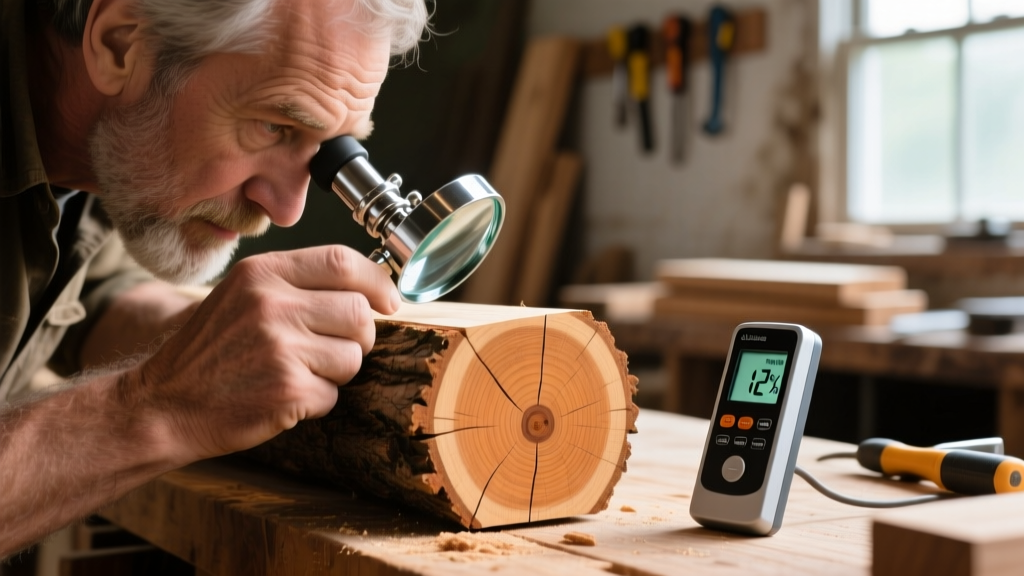
The most definitive way to identify solid lumber without laboratory testing is end-grain analysis. While face-grain patterns can be obscured by saw marks, stains, or weathering, the end-grain reveals the tree's cellular architecture. Using a 10x or 20x jeweler's loupe, examine a freshly sanded cross-section of the board.
Hardwood vs. Softwood Cellular Structure
Hardwoods (angiosperms) possess specialized water-conducting cells called vessels or pores. Softwoods (gymnosperms) lack these pores, relying instead on uniform tracheids for both water transport and structural support. This distinction immediately halves the field of potential species.
| Cellular Feature | Hardwoods (e.g., Oak, Maple, Walnut) | Softwoods (e.g., Pine, Fir, Spruce) |
|---|---|---|
| Pores/Vessels | Visible on end-grain as small holes or lines | Absent; end-grain appears as uniform, closed cells |
| Earlywood/Latewood Transition | Variable (abrupt in ring-porous, gradual in diffuse) | Often abrupt (e.g., Southern Yellow Pine) or gradual (e.g., Spruce) |
| Ray Fleck Visibility | Prominent in species like White Oak and Sycamore | Generally microscopic, rarely visible without high magnification |
Sub-Categorizing Hardwoods: Pore Arrangement
Once confirmed as a hardwood, analyze the pore arrangement on the earlywood (the lighter, faster-growing spring wood). Ring-porous species like Red Oak and Ash have massive earlywood pores that form distinct concentric rings. Diffuse-porous species like Hard Maple and Birch feature uniformly sized pores scattered evenly across the growth ring. This distinction is critical because ring-porous woods tend to have higher permeability, making them easier to treat with preservatives but more susceptible to rapid moisture uptake if left unfinished.
Pillar 2: Density and Janka Hardness Profiling
Once the visual profile narrows the species down, density testing confirms the hypothesis and dictates the fastening strategy. The Janka hardness test measures the force (in pounds-force, lbf) required to embed a 0.444-inch steel ball halfway into the wood. This metric directly correlates with fastener withdrawal strength and wear resistance.
Janka Thresholds for Application Selection
- < 600 lbf (e.g., Eastern White Pine - 380 lbf): Suitable for interior trim, non-structural framing, and temporary scaffolding. Pre-drilling is rarely required for nails, but screw withdrawal strength is low.
- 600 - 1,200 lbf (e.g., Douglas Fir - 660 lbf, Black Walnut - 1,010 lbf): The sweet spot for structural framing, decking, and heavy cabinetry. Excellent nail-holding capacity.
- 1,200 - 2,000 lbf (e.g., Hard Maple - 1,450 lbf, White Oak - 1,360 lbf): Mandatory for high-traffic commercial flooring, workbench tops, and heavy timber joinery. Pre-drilling is strictly required to prevent fastener shearing and wood splitting.
- > 2,500 lbf (e.g., Ipe - 3,510 lbf, Cumaru - 3,540 lbf): Specialized exterior decking and marine applications. Requires carbide-tipped tooling and specialized hidden fastener systems; traditional nailing is virtually impossible.
Pillar 3: Moisture Content and Dimensional Stability
Wood is hygroscopic; it constantly exchanges moisture with the surrounding environment until it reaches Equilibrium Moisture Content (EMC). Determining the wood type is only half the battle; verifying its current moisture state relative to its destination environment prevents catastrophic post-installation movement. According to the American Wood Council, structural lumber must be graded and stamped based on specific moisture conditions at the time of surfacing.
Target Moisture Content (MC) by Application
- Structural Framing (S-DRY or MC-15): Surfaced Dry (max 19% MC) or Moisture Content 15% (max 15% MC). Acceptable for enclosed, climate-controlled building envelopes.
- Interior Millwork and Flooring (KD - Kiln Dried): Target 6% to 8% MC. Installing 12% MC flooring in a winter-heated home (where indoor EMC can drop to 4%) will result in severe gapping and cupping.
- Exterior Decking and Siding: Target 12% to 15% MC, allowing the wood to acclimate to the local outdoor EMC before final fastening.
Field Testing Protocol: Use a pinless electromagnetic moisture meter (like the Wagner Meters Orion 910) for rapid, non-destructive scanning of finish materials. For rough-sawn structural timbers where surface moisture may differ from the core, use a pin-type meter with insulated probes driven at least 1 inch into the board to measure the deep-core moisture gradient.
Pillar 4: Structural Grading and Stamp Decoding
For engineered and structural solid sawn lumber, visual species identification is superseded by the grading stamp. The stamp provides the legally binding structural properties verified by an accredited agency. Understanding how to read these stamps is non-negotiable for structural integrity.
Decoding a Standard Dimensional Lumber Stamp:
A stamp reading 'S-DRY SPF #2 24 o.c. HUD-UM-40' translates to:
• S-DRY: Surfaced Dry (maximum 19% moisture content at time of planing).
• SPF: Spruce-Pine-Fir (a specific species grouping with shared structural values).
• #2: The structural grade, dictating the allowable bending stress (Fb) and modulus of elasticity (E).
• 24 o.c.: Approved for joist/rafter spacing up to 24 inches on center under standard code loads.
When evaluating plywood or oriented strand board (OSB), refer to the APA - The Engineered Wood Association grading standards. An APA stamp reading 48/24 indicates the panel is rated for 48 psf total load (roof) and 24 psf live load (subfloor), dictating exactly where the panel can be legally installed in the structural envelope.
Decision Matrix: Matching Wood Type to Application
Use this matrix to cross-reference your identified wood species and grade against the specific demands of your build phase.
| Application Scenario | Required Wood Traits | Optimal Species / Grade Selection | Critical Failure Mode to Avoid |
|---|---|---|---|
| Load-Bearing Wall Framing | High nail withdrawal, straight grain, predictable shrinkage | Douglas Fir-Larch or Southern Yellow Pine, Stud Grade or #2 | Using flat-grain boards that twist and bow as they dry, causing drywall pops. |
| Exterior Ground-Contact Posts | High natural decay resistance, dense heartwood | Western Red Cedar (Heartwood) or Pressure-Treated Southern Pine (UC4B) | Using sapwood or non-treated diffuse-porous hardwoods, leading to subterranean rot within 3 years. |
| Heavy-Duty Shop Workbench | Extreme Janka hardness, high mass, shock resistance | Hard Maple or Beech, FAS (First and Second) Grade, Kiln-Dried to 8% | Using ring-porous woods like Ash that can splinter heavily under repeated impact. |
| Interior Painted Cabinetry | Uniform texture, closed grain, minimal resin bleed | Soft Maple or Poplar, Select Grade, KD | Using resinous softwoods like Pine, where knots and sap streaks bleed through primer over time. |
Advanced Field Testing: Chemical and Olfactory Identification
When visual and density tests yield ambiguous results between two closely related species, advanced field techniques provide the final confirmation. These methods are particularly useful when distinguishing between species that look identical but have vastly different structural or exterior performance profiles.
The Sodium Nitrite Test: White Oak vs. Red Oak
White Oak is highly rot-resistant due to tyloses (cellular plugs) in its pores, making it ideal for exterior applications and boatbuilding. Red Oak lacks tyloses and will rot rapidly outdoors. Because they look nearly identical when milled, apply a 10% solution of sodium nitrite to the raw wood. Red Oak will turn a slight yellowish-brown. White Oak will undergo a dramatic color shift, turning dark brown, then grey, and finally a deep purplish-black within minutes.
The Ammonia Test: Black Walnut Identification
Genuine Black Walnut (Juglans nigra) is highly prized and expensive, leading to frequent substitution with cheaper, stained woods. Swabbing a hidden area of true Black Walnut with standard household ammonia will cause the wood to darken significantly, often taking on a rich, greenish-brown hue due to the chemical reaction with the wood's natural juglone compounds. Stained imitations will not react.
Olfactory Profiling
Many species retain distinct volatile organic compounds (VOCs) long after being felled, especially when freshly machined or lightly sanded.
- Spanish Cedar: Emits a strong, classic cigar-box aroma (due to thujaplicins), confirming its natural insect-repelling properties.
- Eastern Red Cedar: Smells sharply of camphor and pine, indicating high rot resistance suitable for closet linings and fence posts.
- Catalpa: Produces a distinct, somewhat foul, earthy odor when cut, distinguishing it from similar-looking ash species.
Final Selection Protocol
Mastering how to determine type of wood requires moving beyond simple visual matching. By systematically applying the 4-Pillar Framework—verifying cellular structure under magnification, confirming density thresholds, measuring deep-core moisture, and decoding agency stamps—builders eliminate the guesswork that leads to costly material failures. Always cross-reference your field findings with authoritative grading manuals and species databases before committing to large-scale procurement.
Written by
Elena RodriguezElena Rodriguez is a civil engineer and technical writer specializing in concrete technology, masonry systems, and ASTM/ACI compliance. She earned her B.S. in Civil Engineering from Texas A&M University and spent a decade at a materials testing laboratory, performing over 2,000 concrete compressive strength tests and masonry prism evaluations. Elena is an ACI-certified Field Testing Technician (Grade I) and a member of ASTM Committee C12 on Natural Building Stone. She currently consults on forensic engineering cases involving concrete failures and moisture intrusion. Based in San Antonio, TX, Elena is a proud member of the Society of Women Engineers (SWE) and coaches her daughter's FIRST Robotics team.
More from Elena Rodriguez
View all
Walls & Panels
Cost Analysis: Light Gauge Steel Framing Advantages and Disadvantages
Evaluate light gauge steel framing advantages and disadvantages through a strict cost analysis lens, comparing material, labor, and lifecycle expenses.
Aug 4, 2026

Walls & Panels
Gypsum Board Types: Exact Specifications, Thickness & Dimensions
Compare standard, Type X, and moisture-resistant gypsum board types. Get exact specifications, thicknesses, dimensions, and ASTM standards for your project.
Aug 4, 2026

Fire Resistance
Best Fire-Resistant Outdoor Decking Materials: 2026 Buyer Guide
Discover the best fire-resistant outdoor decking materials for 2026. Compare Class A PVC, aluminum, and hardwood options for WUI compliance and safety.
Aug 4, 2026