How to Treat and Preserve Different Types of Wood Deck Materials
Learn how to seal, stain, and maintain different types of wood deck materials. Expert preservation guide for pine, cedar, and tropical hardwoods.

The Science of Wood Porosity and Preservative Penetration
Treating a wooden deck is not a uniform process. The cellular structure, density, and natural extractive content of the lumber dictate exactly which chemical preservatives will penetrate the surface and which will fail. When evaluating different types of wood deck materials, the primary metric governing treatment is the Janka hardness rating, which correlates directly with cellular porosity. A highly porous softwood will absorb deep-penetrating water-repellent preservatives, while an ultra-dense tropical hardwood will reject standard stains, causing film-forming products to peel within months.
According to the USDA Forest Products Laboratory, the longevity of any exterior wood finish depends heavily on the substrate's moisture content at the time of application and the finish's ability to flex with the wood's seasonal dimensional changes. Selecting the wrong chemistry for your specific wood species is the leading cause of premature coating failure, cupping, and fungal decay.
Treatment Protocols by Wood Species
Pressure-Treated Southern Yellow Pine (SYP)
Southern Yellow Pine is the most common decking material in North America due to its affordability and structural strength. With a Janka hardness of roughly 690 lbf, SYP is highly porous and accepts preservatives deeply. However, it is notoriously prone to shrinking, warping, and cupping as it dries.
- The Mill Glaze Problem: New SYP boards often suffer from "planer's glaze" or mill glaze—a compressed, polished surface layer created by the heat of the milling blades. This glaze blocks stain penetration. You must remove it using a sodium percarbonate deck cleaner and a light scuff-sanding with 60-grit aluminum oxide sandpaper before applying any finish.
- Recommended Coatings: Use semi-transparent, oil-based penetrating stains. Products like TWP 1500 Series or Defy Extreme contain mildewcides and water repellents that soak into the porous SYP cells without forming a surface film.
- Timing: Never stain brand-new pressure-treated wood immediately. It is typically saturated with liquid copper-based preservatives (like ACQ or Micronized Copper Azole) and requires 3 to 6 months of weathering to drop below a 15% moisture content.
Western Red Cedar and Redwood
Cedar (Janka ~350 lbf) and Redwood (Janka ~420 lbf) are prized for their natural rot resistance, derived from high concentrations of tannins and extractives. While they resist decay naturally, they are highly susceptible to ultraviolet (UV) degradation, which breaks down the surface lignin and turns the wood a silvery-gray.
- Tannin Bleed: The same tannins that protect the wood can ruin your finish. If you apply a water-based acrylic or a light-colored solid stain, moisture will draw the tannins to the surface, causing severe brown discoloration known as tannin bleed.
- Recommended Coatings: The Western Red Cedar Lumber Association (WRCLA) strongly recommends penetrating oil-based or alkyd-resin stains. Armstrong Clark wood stains utilize a two-oil system (a drying oil and a non-drying conditioning oil) that binds with the cedar's natural oils and blocks tannin bleed without forming a peelable film.
Tropical Hardwoods (Ipe, Cumaru, Tigerwood)
Tropical hardwoods boast extreme density (Ipe measures over 3,600 lbf on the Janka scale). Their cellular structure is so tightly packed that standard wood stains simply sit on the surface. Furthermore, these woods contain natural oils that actively repel water-based finishes.
- The Peeling Failure Mode: Applying a film-forming stain (like a solid acrylic or polyurethane) to Ipe is a catastrophic mistake. As moisture inevitably gets trapped beneath the dense surface, the sun heats the board, creating vapor pressure that blisters and peels the film. Stripping this failed coating from hardwood is nearly impossible without aggressive chemical strippers and heavy mechanical sanding.
- Recommended Coatings: You must use specialized, highly refined penetrating oils designed specifically for dense hardwoods. Messmer's UV Plus for Hardwoods and Ipe Oil are formulated with smaller molecular resins that can penetrate the tight grain. Expect to re-coat horizontal hardwood surfaces every 12 to 18 months, as UV radiation rapidly depletes the surface oils.
Thermally Modified Timber (Ash, Pine)
Thermal modification bakes wood at temperatures exceeding 400°F in an oxygen-depleted environment, altering its cellular structure to reduce moisture absorption and eliminate sugars that attract fungi. While highly stable and rot-resistant, the process makes the wood brittle and strips its natural UV resistance.
- Recommended Coatings: Thermally modified wood requires finishes with high UV blockers and extreme flexibility. Because the wood absorbs very little moisture, deep-penetrating water repellents are unnecessary. Instead, focus on pigmented UV-blocking oils, such as Penofin Architectural Grade, to prevent the wood from silvering and surface-checking.
Wood Deck Preservation Matrix
| Wood Species | Janka Hardness | Primary Vulnerability | Recommended Coating Chemistry | Re-coat Interval |
|---|---|---|---|---|
| Pressure-Treated SYP | ~690 lbf | Cupping, Mill Glaze | Semi-Transparent Penetrating Oil | 2–3 Years |
| Western Red Cedar | ~350 lbf | Tannin Bleed, UV Graying | Alkyd-Resin / Conditioning Oil | 2–4 Years |
| Ipe / Cumaru | >3,000 lbf | Surface Film Peeling | Refined Hardwood Penetrating Oil | 1–1.5 Years |
| Thermo-Modified Ash | ~1,300 lbf | Surface Checking, UV Damage | Pigmented UV-Blocking Oil | 2–3 Years |
Critical Preparation: Moisture and Surface Profiling
The most expensive preservative will fail if applied to improperly prepared wood. The American Wood Protection Association (AWPA) standards emphasize that substrate moisture content (MC) and surface profiling are the primary determinants of coating adhesion.
Never apply a finish based on a visual assessment of dryness. You must use a calibrated moisture meter. For softwoods (SYP, Cedar), use a pin-type meter and ensure the core moisture content is below 15%. For dense hardwoods, use a pinless (electromagnetic) meter to avoid marring the surface, targeting an MC below 12%. Applying oil to wood exceeding these thresholds traps moisture inside, leading to internal rot and black mildew growth beneath the stain.
The Cleaning and Brightening Protocol
Before treating any existing deck, the surface must be stripped of oxidized wood fibers, dirt, and previous failing coatings.
- Alkaline Cleaning: Apply a sodium percarbonate-based cleaner (avoid chlorine bleach, which destroys the wood's lignin and weakens the surface fibers). Scrub with a stiff synthetic bristle brush.
- Acid Brightening: After rinsing, apply an oxalic acid-based wood brightener. This neutralizes the alkaline cleaner, restores the wood's natural pH, and opens the cellular pores to accept the new preservative.
- Drying Period: Allow the deck to dry for a minimum of 48 to 72 hours in direct sunlight before checking the moisture content with your meter.
Application Framework for Maximum Longevity
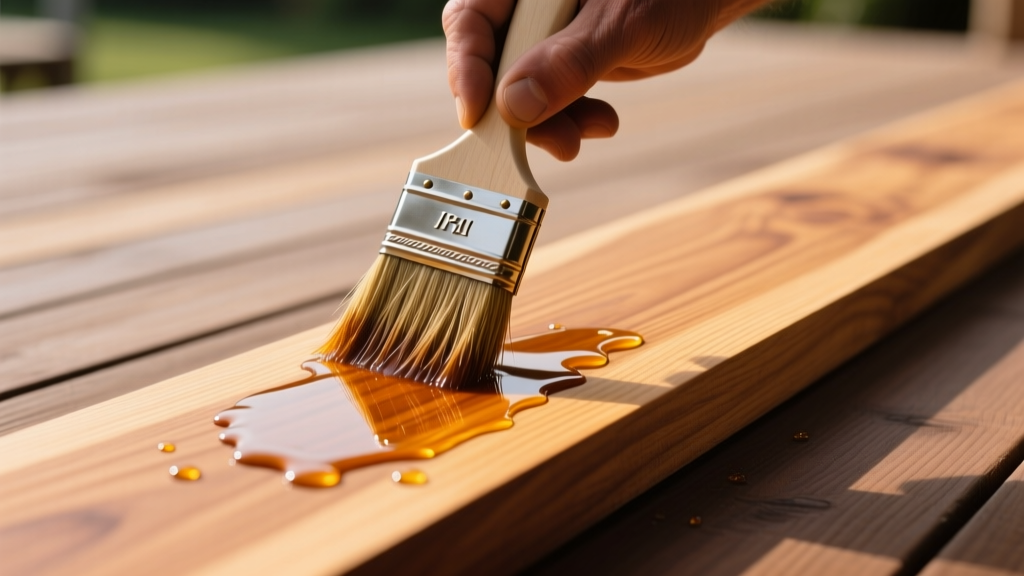
When applying penetrating oils to any of these types of wood deck boards, the application method drastically affects penetration depth. Avoid pump sprayers for the primary application; they atomize the product and leave an uneven, milky surface film if not back-brushed immediately.
Use a high-quality natural bristle brush or a specialized deck stain pad to force the oil into the wood grain. Apply the preservative to only two or three boards at a time, working the full length of the boards to prevent lap marks. For tropical hardwoods, the "wet-on-wet" technique is mandatory: apply a liberal coat of oil, allow it to penetrate for 15 to 30 minutes, and then aggressively wipe up all excess pooling with clean, lint-free cotton rags. Any oil left on the surface of Ipe or Cumaru will oxidize into a sticky, tacky residue that attracts dirt and pollen.
By matching the specific chemical formulation of your preservative to the exact cellular density and extractive profile of your wood species, you can extend the functional lifespan of your deck surface by decades, preventing the costly cycle of annual stripping and refinishing.
Written by
Priya KapoorPriya Kapoor is a real estate market analyst and construction economics researcher with expertise in housing affordability, development feasibility, and infrastructure investment. She holds a Master of Regional Planning from Cornell University and previously worked as a senior analyst at CBRE's Investment Properties group, where she modeled returns for $4B in mixed-use development pipelines. Priya now runs an independent research practice advising developers, municipalities, and REITs on construction cost forecasting and market timing. She publishes the quarterly "BuildMat Market Pulse" report tracking material price indices across 12 commodity categories. Based in Austin, TX, Priya serves on the board of Habitat for Humanity Austin and is a marathon runner.
More from Priya Kapoor
View all
Construction Cost
Cost to Build a 1600 Sq Ft Home in 2026: Full Breakdown
Accurate 2026 cost to build a 1600 sq ft home—material, labor, and regional pricing breakdowns included. Plan your budget with real-time estimates.
Aug 11, 2026

Wood & Lumber
Name the Types of Wood for Pressure Treatment and Preservation
Learn how to name the types of wood best suited for pressure treatment. Compare species treatability, chemical retention levels, and 2026 preservation costs.
Aug 4, 2026

Stone & Masonry
Stone Veneer Suppliers Lindenhurst: 2026 Cost Analysis
Analyze 2026 stone veneer costs in Lindenhurst, NY. Compare local supplier pricing, delivery fees, and Suffolk County installation labor rates.
Aug 4, 2026