Matching Pressure Treated Wood Deck Boards to Your Build Scenario
Match the right pressure treated wood deck boards to your project. Learn AWPA retention levels, KDAT benefits, and grade selection for lasting results.
The Science of Scenario Matching: Why One Board Doesn't Fit All
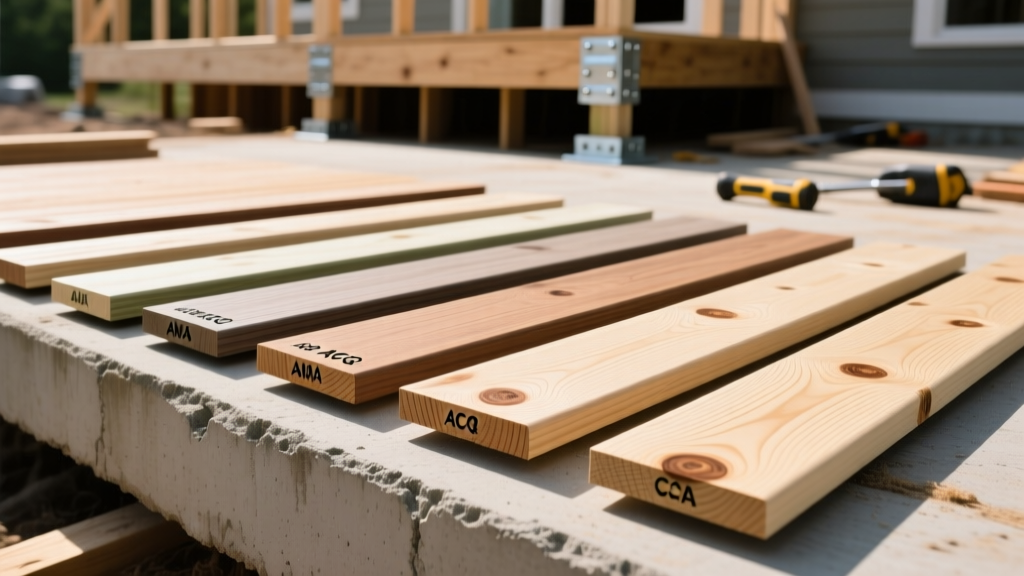
Selecting pressure treated wood deck boards is rarely a one-size-fits-all decision. A board that performs flawlessly on a shaded, suburban second-story balcony will rapidly fail when used for a ground-level boardwalk in a coastal environment. The longevity of a timber deck hinges on aligning the wood's preservative retention level, species, grade, and moisture content with the specific microclimate and structural demands of the build. This guide breaks down the exact specifications required to match pressure treated lumber to real-world decking scenarios, eliminating guesswork and preventing premature rot, cupping, and hardware corrosion.
Decoding AWPA Use Categories for Decking Scenarios
The American Wood Protection Association (AWPA) classifies treated lumber into Use Categories (UC) based on biological hazard exposure. Misunderstanding these categories is the leading cause of premature deck failure. While most decking surfaces require above-ground protection, specific components demand higher retention levels.
| AWPA Category | Retention Level (pcf) | Exposure Scenario | Deck Application |
|---|---|---|---|
| UC3B | 0.25 - 0.40 | Above ground, coated/uncoated, rapid water runoff | Standard deck boards, railings, top caps, stairs |
| UC4A | 0.40 - 0.60 | Ground contact, general use, poor drainage | Posts, fascia boards near soil, joists under low-clearance decks |
| UC4B | 0.60+ | Ground contact, high decay hazard, critical structures | Permanent wood foundations, structural posts in saturated soil |
For the actual walking surface, UC3B is the standard. However, if your deck boards will serve as a skirt board or fascia that touches the ground, you must upgrade those specific boards to UC4A. According to the AWPA standards, using UC3B lumber in ground-contact scenarios voids most manufacturer warranties and invites subterranean termite and fungal degradation within 3 to 5 years.
Species and Grade Selection: Beyond the Treatment
Preservative treatment protects against biological decay, but it does not alter the structural mechanics or dimensional stability of the wood species itself. Matching the species and grade to your load and climate requirements is critical.
Southern Yellow Pine (SYP) vs. Douglas Fir / Hem-Fir
Southern Yellow Pine is the dominant species for pressure treated wood deck boards in the eastern and central United States. It is dense, highly receptive to preservative penetration, and boasts high bending strength. However, SYP is prone to severe checking and twisting if not properly dried. In the Pacific Northwest and Mountain regions, Douglas Fir and Hem-Fir are more common. These species are more dimensionally stable and resist warping better than SYP, but they require incising (micro-slashes in the wood) to achieve adequate preservative penetration.
Navigating Lumber Grades for Decking
Do not default to #2 grade for deck boards. While #2 is perfectly adequate for hidden structural framing (joists and beams), deck boards require higher grades to minimize defects that trap water.
- Select / Premium: Tight knots, minimal wane (bark edges), straight grain. Best for high-visibility areas and hidden fastener systems.
- #1 Grade: Small, tight knots. Excellent balance of cost and aesthetics for standard face-screwed decks.
- #2 Grade: Larger knots, frequent wane. Avoid for decking; wane creates water pockets that accelerate localized decay.
Expert Insight: When ordering pressure treated wood deck boards, specify 'Select' or 'Premium' grade and explicitly request boards with less than 5% wane. Wane compromises the holding power of edge-driven hidden fasteners and creates uneven gaps that violate most building codes for stair treads.
The KDAT Factor: Solving the Shrinkage Problem
Standard pressure treated lumber is sold 'wet' (often at 35-45% moisture content). As it acclimates to ambient humidity, it shrinks, leading to cupped boards, popped screws, and widened gaps. Kiln-Dried After Treatment (KDAT) lumber solves this by drying the wood in a controlled environment after the preservatives are infused.
KDAT vs. Standard Wet Treated Lumber
KDAT Advantages: Pre-shrunk (will not cup or gap post-installation), lighter weight (easier handling), accepts stain and sealant immediately upon installation.
KDAT Disadvantages: 15-25% price premium, limited availability in big-box stores (often requires specialty lumber yards).
Verdict: Mandatory for high-end builds, composite-picture-frame borders, and any application where tight, consistent 1/8-inch gapping is required.
Scenario Matrix: Matching Board Specs to Real-World Builds
Use this decision matrix to specify the exact pressure treated wood deck boards for your specific project environment.
Scenario 1: High-Humidity Coastal Environment
- Climate Profile: High salt spray, constant moisture, intense UV.
- Board Spec: UC3B KDAT Southern Yellow Pine, Select Grade.
- Fastener Requirement: 316 Marine-Grade Stainless Steel. (Standard galvanized will corrode from the combination of salt and the copper in the wood treatment).
- Installation Note: Use a 1/4-inch gap rather than 1/8-inch to allow for rapid debris washout and prevent moisture trapping between boards.
Scenario 2: Arid Climate with Heavy Winter Snow Loads
- Climate Profile: Extreme dry heat in summer, heavy wet snow and freeze-thaw cycles in winter.
- Board Spec: UC3B Standard Treated Douglas Fir, #1 Grade. (Fir's superior dimensional stability prevents severe cupping in dry heat).
- Fastener Requirement: G185 Hot-Dipped Galvanized structural screws.
- Installation Note: Face-screw with two screws per joist. Avoid hidden fasteners in extreme freeze-thaw zones; the lateral expansion of wet, freezing wood can snap plastic hidden clips.
Scenario 3: Standard Suburban Above-Ground Deck
- Climate Profile: Moderate seasonal changes, standard rainfall.
- Board Spec: UC3B Standard Treated SYP, #1 or #2 Grade (if budget-constrained).
- Fastener Requirement: Polymer-coated deck screws or G90/G185 galvanized.
- Installation Note: Install boards tight against each other if they are wet from the treatment plant; they will shrink to the ideal 1/8-inch gap as they dry over the first 60 days.
Fastener Compatibility: Avoiding Galvanic Corrosion
Modern preservative treatments rely heavily on copper (either dissolved Alkaline Copper Quaternary [ACQ] or Copper Azole [CA-C], or suspended Micronized Copper [MCA]). Copper is highly corrosive to standard steel and aluminum. The USDA Forest Products Laboratory Wood Handbook explicitly warns against using uncoated or lightly coated fasteners with copper-based treatments.
| Treatment Chemistry | Minimum Fastener Coating | Acceptable Hardware Brands |
|---|---|---|
| CA-C / ACQ (Dissolved Copper) | G185 Hot-Dipped Galvanized or 304 Stainless | Simpson Strong-Tie ZMAX, FastenMaster Lokring |
| MCA / MCQ (Micronized Copper) | G90 Hot-Dipped Galvanized (G185 preferred) | National Nail, Grip-Rite (Polymer-coated) |
| Borate / Non-Copper (Rare for exterior) | Standard Zinc-Plated | Standard hardware store fasteners |
Critical Warning: Never use aluminum flashing or aluminum joist tape in direct contact with ACQ or CA-C treated deck boards. The galvanic reaction between the copper preservative and the aluminum will cause the flashing to disintegrate within a single season, leading to joist rot. Always use butyl-based joist tape or heavy-duty PVC flashing.
Sourcing, Pricing, and Procurement Realities
As of 2026, the cost of pressure treated wood deck boards reflects both raw timber markets and the energy costs associated with the treatment and kiln-drying processes. Standard 5/4x6 #2 SYP deck boards typically range from $2.50 to $3.50 per linear foot at regional lumberyards. Upgrading to KDAT or Select grade pushes the cost to $4.00 to $5.50 per linear foot.
When procuring materials, inspect the end-tags on the boards. The tag must explicitly state the AWPA Use Category (e.g., UC3B or UC4A) and the treatment standard. If the tag is missing or only lists a proprietary brand name without AWPA certification, reject the bundle. Furthermore, always store pressure treated wood deck boards flat, supported evenly every 4 feet, and covered with a breathable tarp if they will sit on-site for more than 48 hours before installation to prevent solar-induced warping.