Types of Wood Panelling: The Complete Species & Profile Guide
Discover the best types of wood panelling for your project. Compare species, Janka hardness, moisture stability, profiles, and installation costs.

Beyond the Profile: Why Wood Species Dictates Panelling Performance
When selecting interior or exterior wall cladding, most designers and homeowners fixate on the profile—shiplap, beadboard, or board-and-batten. However, the underlying wood species is the primary determinant of dimensional stability, impact resistance, and long-term finish integrity. A poorly chosen species will cup, gap, or bleed tannins regardless of how perfectly it was milled. This guide breaks down the top species used for wood panelling, analyzing their structural properties, ideal environments, and specific milling requirements.
The Species Matrix: Hardness, Stability, and Cost
Not all woods react to interior humidity fluctuations equally. Tangential shrinkage—the percentage a board shrinks parallel to the growth rings when drying from green to oven-dry—is the most critical metric for wall panelling. High tangential shrinkage leads to cupping and edge-gapping. Below is a comparative matrix of the most specified panelling species.
| Species | Janka Hardness (lbf) | Tangential Shrinkage | Best Environment | Avg. Cost (per sq. ft.) |
|---|---|---|---|---|
| White Oak | 1,360 | 10.5% | High-traffic, moisture-prone (Kitchens/Baths) | $8.00 - $14.00 |
| Black Walnut | 1,010 | 7.8% | Low-impact luxury interiors, accent walls | $14.00 - $22.00 |
| Western Red Cedar | 350 | 7.8% | Saunas, humid climates, exterior soffits | $6.00 - $10.00 |
| Eastern White Pine | 380 | 6.8% | Low-traffic rustic interiors, painted finishes | $3.00 - $6.00 |
| Hard Maple | 1,450 | 9.9% | Modern commercial spaces, high-impact zones | $9.00 - $15.00 |
| Teak (Plantation) | 1,000 | 5.2% | Wet rooms, luxury yachts, spa environments | $24.00 - $38.00 |
Deep Dive: Top Species for Wood Panelling
White Oak (Quercus alba): The Moisture-Resistant Hardwood
White oak is the gold standard for high-end, durable panelling, particularly in environments with fluctuating humidity. Unlike red oak, white oak contains tyloses—cellular structures that plug the xylem vessels, rendering the heartwood highly impermeable to water. This makes it an exceptional choice for bathroom accent walls or kitchen range hoods where steam is prevalent. Because of its 10.5% tangential shrinkage, white oak must be quarter-sawn for panelling to convert that movement into radial shrinkage (which is only 5.6%), virtually eliminating cupping.
Black Walnut (Juglans nigra): Dimensional Stability and Aesthetics
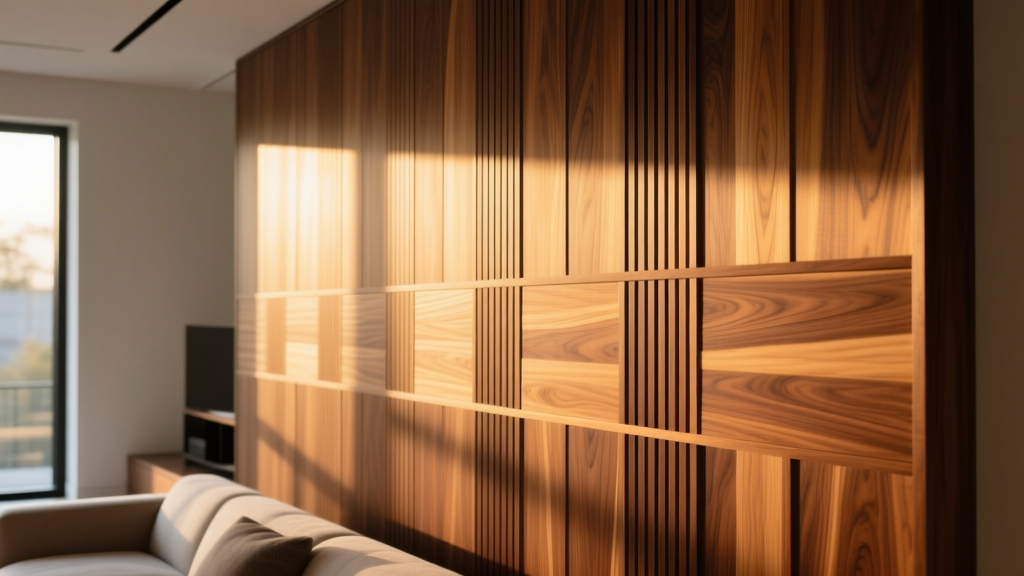
Walnut is prized for its rich, chocolate-brown heartwood and straight grain. With a tangential shrinkage of just 7.8%, it is remarkably stable for a hardwood, making it highly forgiving during seasonal humidity swings. Walnut is softer than oak (1,010 lbf on the Janka scale), meaning it will dent if struck by heavy furniture, but it mills beautifully, holding crisp edges for complex profiles like French shiplap or micro-bevelled tongue-and-groove (T&G). According to the Wood Database, walnut's natural oils also allow it to accept hardwax oil finishes exceptionally well without requiring chemical grain fillers.
Western Red Cedar (Thuja plicata): The Softwood Specialist
For saunas, sunrooms, or exterior transitions, Western Red Cedar is unmatched. It contains natural thujaplicins, which act as powerful fungicides and decay inhibitors. Its low density (350 lbf) makes it an excellent thermal insulator, which is why it remains cool to the touch in high-heat environments like saunas. The trade-off is its softness; cedar will scratch and dent easily, so it should be avoided in high-traffic corridors or mudrooms.
Matching Species to Milling Profiles
The physical hardness and grain structure of a species dictate which milling profiles it can successfully hold. Attempting to mill a delicate profile into a soft, brittle wood will result in high factory waste and fragile installation edges.
- Tongue and Groove (T&G): Requires hardwoods like White Oak, Ash, or Maple. The tongue must be thin enough to hide the fastener but thick enough to resist snapping during blind-nailing. Softwoods like pine often suffer from "tongue blowout" during installation.
- Shiplap (Rabbeted Edge): Highly versatile, but excels in Eastern White Pine and Cedar. The overlapping rabbet joint hides the seasonal gaps that naturally occur in softwoods as they expand and contract.
- Beadboard (V-Groove with Bead): Best milled in Poplar or Pine if destined for paint. If left natural, Hard Maple provides the sharpest, most durable bead that won't crush when bumped by chairs or luggage.
Many contractors substitute solid wood with Medium Density Fiberboard (MDF) panelling to save 40-50% on material costs. While MDF paints beautifully and never warps in a climate-controlled living room, it is catastrophic in moisture-prone areas. If a pipe leaks or condensation builds up behind the wall, MDF acts like a sponge, swelling irreversibly and crumbling at the fastener points. For bathrooms, kitchens, or exterior-adjacent walls, always specify solid wood or marine-grade plywood substrates.
Acclimatization and Installation Protocols
Even the most stable wood species will fail if installed at the wrong moisture content (MC). The USDA Forest Products Laboratory mandates that interior wood products must reach Equilibrium Moisture Content (EMC) with their environment before fastening. Follow this strict protocol to prevent post-installation gapping:
- Site Conditioning: The building must be fully enclosed, and the HVAC system must be operational, maintaining a temperature of 65°F–75°F and a relative humidity (RH) of 35%–45% for at least 14 days prior to wood delivery.
- Sticker the Bundles: Do not leave panelling stacked flat on the floor. Unbundle the boards and "sticker" them (place 1/2-inch scrap wood spacers between every 10-15 layers) to allow air circulation on all faces.
- Acclimation Window: Leave the stickered wood in the installation room for a minimum of 7 to 10 days.
- Moisture Testing: Use a pin-type moisture meter. For most North American interiors, the target MC for solid wood panelling is between 6% and 9%. The subfloor or wall framing should be within 2% MC of the panelling.
Fastening Specifications
For T&G and shiplap profiles, blind-nailing through the tongue at a 45-degree angle is standard. Use 15-gauge or 16-gauge galvanized or stainless steel cleats. For hardwoods like White Oak or Hard Maple, the density of the wood can cause the fastener to deflect or snap. You must use specialized flooring cleats with a wider head and reinforced shank, or pre-drill the tongue using a V-groove drill bit to prevent splitting the wood fibers during pneumatic driving.
Finishing: Film-Forming vs. Penetrating Oils
The finish applied to wood panelling dictates how it handles seasonal movement. Traditional polyurethane creates a surface film. When the wood expands in high summer humidity and contracts in dry winter months, this rigid film can micro-crack, allowing moisture ingress and leading to localized peeling.
"For large-scale interior wall cladding, penetrating hardwax oils (such as Osmo Polyx or Rubio Monocoat) are superior to film-forming polyurethanes. They bond with the wood fibers at a molecular level, allowing the wood to breathe and move dimensionally without cracking the finish." — Architectural Woodwork Institute (AWI) Finishing Guidelines
Furthermore, hardwax oils are significantly easier to maintain. A scuffed or stained section of oiled walnut panelling can be spot-repaired with a Scotch-Brite pad and a fresh coat of oil in 15 minutes. Repairing a polyurethane finish requires sanding and re-coating the entire wall from corner to corner to avoid visible lap marks.
Summary Decision Framework
Select your wood species based on the specific mechanical and environmental demands of the room. Choose White Oak for wet areas and high-traffic durability; specify Black Walnut for stable, luxury accent walls; utilize Western Red Cedar for thermal insulation and high-humidity saunas; and reserve Eastern White Pine for budget-conscious, painted, low-impact applications. Always prioritize quarter-sawn material for wide hardwood boards, acclimatize rigorously to 6-9% MC, and finish with penetrating oils to accommodate natural seasonal movement.
Written by
David NakamuraDavid Nakamura is a licensed architect (AIA) and construction technology writer focused on sustainable building methods, mass timber engineering, and high-performance building envelopes. He holds a Master of Architecture from the University of Washington and is a certified Passive House Consultant (CPHC). David spent eight years at the Seattle firm Mithun, where he led the design of three LEED Platinum projects, before founding his own practice specializing in net-zero residential design. He serves on the editorial advisory board of GreenBuilder Magazine and has authored peer-reviewed papers on cross-laminated timber (CLT) connections for the Journal of Structural Engineering. In his spare time, David teaches woodworking at Pratt Fine Arts Center and kayaks the Puget Sound.
More from David Nakamura
View all
Construction Cost
Labor Cost to Build a Deck Per Sq Ft: 2026 Installation Guide
Discover the exact labor cost to build a deck per sq ft in 2026. This installation guide breaks down contractor rates, complexity factors, and hidden fees.
Aug 4, 2026

Construction Cost
How Much Does It Cost to Build a 3 Bedroom House? Financing Guide
Learn exactly how much it costs to build a 3 bedroom house and explore 2026 financing options, construction loan types, and budget frameworks for your build.
Aug 4, 2026

Construction Cost
Cost to Build a Tennis Court: 2026 Guide
How much does it cost to build a tennis court in 2026? Breakdowns for asphalt, concrete, and synthetic surfaces plus fencing and lighting.
Jul 30, 2026