Cost and Value Analysis of Rare Types of Petrified Wood
Analyze the market value, fabrication costs, and architectural applications of rare types of petrified wood for luxury building and design projects.

The Economics of Fossilized Timber in Luxury Architecture
In the upper echelons of architectural surfacing and luxury interior design, standard lumber and conventional stone often yield to exotic, hybrid materials. Among the most coveted are rare types of petrified wood. Unlike traditional timber, petrified wood is a fossilized stone—primarily composed of microcrystalline quartz and chalcedony—boasting a Mohs hardness of 6.5 to 7.0. This unique mineralogical profile allows it to be polished to a glass-like finish while retaining the intricate, organic cellular structures of ancient trees.
For contractors, fabricators, and high-end designers, integrating these rare materials requires a deep understanding of their geological origins, structural limitations, and volatile market pricing. The cost of rare petrified wood is not dictated by board-feet, but by weight, translucency, mineral inclusions, and the sheer logistical difficulty of extraction and fabrication.
Valuation Matrix: Pricing the Rarest Petrified Species
The market for fossilized timber is highly fragmented. Pricing fluctuates based on the specimen's origin, the quality of the lapidary polish, and the presence of rare mineral oxides. Below is a current valuation breakdown for architectural-grade materials.
| Material Variety | Primary Origin | Mineral Composition | Avg. Cost (Polished Slab) | Best Architectural Use |
|---|---|---|---|---|
| Rainbow Petrified Wood | Arizona, USA (Chinle Fm.) | Chalcedony, Quartz, Iron Oxides | $90 - $280 / sq. ft. | Kitchen islands, luxury vanities |
| Opalized Wood | Nevada, USA / Australia | Precious/Common Opal (Hydrated Silica) | $400 - $1,200+ / lb. | Display inlays, backlit feature walls |
| Petrified Teak | Myanmar (Burma) | Massive Quartz, Silica | $25 - $75 / lb. (Rough/Honed) | Large-scale landscaping, structural pillars |
| Agatized Palmwood | Indonesia (Java/Sumatra) | Agate, Chalcedony | $50 - $140 / sq. ft. | Backsplashes, accent wall cladding |
Regional Varieties and Their Market Premiums
Arizona Rainbow Wood (The Chinle Formation)
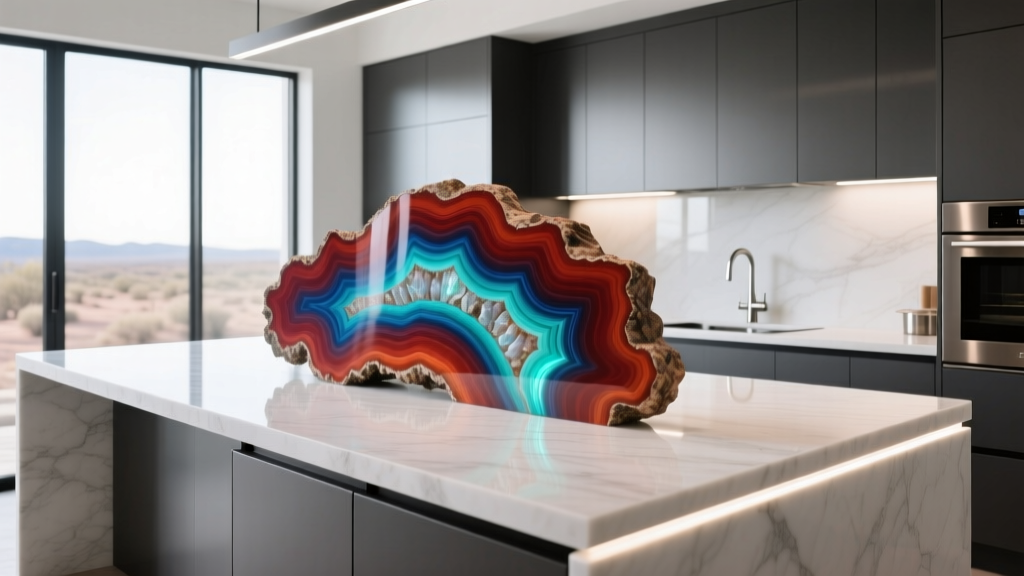
Arguably the most famous and architecturally utilized rare type is the Rainbow wood from the Triassic-era Chinle Formation. The vibrant spectrum of colors—ranging from deep crimsons and mustard yellows to rare blues and purples—is caused by trace minerals. According to the National Park Service geological records, iron oxides produce the reds and yellows, while manganese and copper create the highly prized black, blue, and green hues. Slabs featuring high concentrations of blue and green command a 200% to 300% premium over predominantly red/brown specimens due to the rarity of those specific mineral deposits.
Burmese Petrified Teak
Sourced primarily from the Sagaing and Mandalay regions of Myanmar, petrified teak is valued for its massive scale. Unlike the smaller, fragmented logs found in Arizona, Burmese specimens can yield continuous slabs exceeding 10 feet in length. However, geopolitical instability and strict export tariffs on Myanmar's natural resources have severely constrained the supply chain, driving wholesale prices up by nearly 40% over the last three years. It remains the premier choice for exterior luxury landscaping and heavy-duty commercial flooring where massive, unbroken fossilized grain patterns are required.
Nevada and Australian Opalized Wood
True opalized wood is exceptionally rare. Instead of the quartz replacement seen in most petrified wood, the organic material is replaced by hydrated silica (opal). Precious opalized wood, which exhibits 'play-of-color' (fire), is almost exclusively reserved for jewelry or micro-inlays. For architectural applications, 'common' opalized wood is used. It lacks the fiery flash but offers a stunning, waxy translucency. When backlit with LED channel lighting, opalized wood slabs create a breathtaking, glowing feature wall, though the material is significantly more fragile than quartz-based petrified wood and requires extensive epoxy stabilization.
Fabrication and Structural Integration Costs
Designing with rare petrified wood requires specialized stoneworking infrastructure. Because the material is essentially solid quartz, standard woodworking or masonry tools will fail catastrophically.
Cutting dense chalcedony requires continuous-rim diamond blades specifically designed for hard agates (e.g., MK Diamond Premium Agate blades). Dry cutting or insufficient water cooling will cause thermal shock, resulting in micro-fractures that compromise the slab's structural integrity. Furthermore, the high silica content will rapidly glaze standard diamond segments, leading to blade burnout and thousands of dollars in replacement costs.
- Substrate Reinforcement: Petrified wood weighs approximately 165 lbs per cubic foot. Cantilevered countertops (like a kitchen island overhang) cannot rely on the stone's tensile strength. Fabricators must rout the back of the slab and embed structural aluminum honeycomb or carbon-fiber mesh using high-modulus epoxy.
- Void Filling and Stabilization: Fossilization is rarely perfect. Voids, fractures, and soft spots are common. High-end fabricators use UV-stable, low-viscosity epoxies (such as System Three MirrorCoat) to penetrate and stabilize micro-fissures before the final polishing stages.
- Polishing Costs: Achieving a 3,000-grit optical polish on a quartz-based fossil requires a multi-step diamond abrasive process. Expect fabrication labor to add $45 to $85 per square foot on top of the raw material cost.
Authentication: Navigating Market Pitfalls
As the demand for rare types of petrified wood in luxury real estate has surged, so has the prevalence of counterfeit and artificially enhanced materials. Buyers and procurement officers must be vigilant.
The Dye and Acetone Test
Lower-grade, pale agatized wood is frequently pressure-dyed to mimic the rare blue and green hues of Arizona Rainbow wood. To test for artificial dyes, apply a small amount of pure acetone to an inconspicuous edge or the unpolished back of the slab using a cotton swab. If the swab picks up color, the stone has been artificially enhanced, which drastically reduces its long-term architectural value and can lead to UV-fading when exposed to direct sunlight in solariums or atriums.
Glass and Resin Composites
Some unscrupulous suppliers sell 'reconstituted' petrified wood, which is essentially crushed low-grade fossil dust mixed with colored polyester resins and poured into molds. According to mineralogical databases like Mindat's chalcedony records, natural microcrystalline quartz has a specific gravity of 2.58 to 2.64. Resin composites will feel noticeably lighter and will emit a dull, plastic-like sound when tapped with a metal tool, whereas genuine petrified wood produces a high-pitched, glassy ring.
Pros and Cons of Petrified Wood in High-Traffic Architecture
Architectural Advantages
- Extreme Durability: Mohs hardness of 7 makes it highly resistant to scratching from everyday kitchen use.
- Zero Porosity: Once properly polished and sealed, it is entirely impervious to water, wine, and acidic spills, outperforming marble and limestone.
- Unmatched Aesthetics: No two slabs are identical; the preservation of ancient tree rings provides a biophilic design element that stone cannot replicate.
Design and Structural Limitations
- Extreme Weight: Requires heavy-duty, steel-reinforced cabinetry and specialized structural engineering for upper-floor installations.
- Brittleness: Despite its hardness, it lacks tensile flexibility and is prone to snapping during transport if not properly crated and supported.
- High Cost: Material and specialized fabrication costs easily exceed $350 per square foot for premium, gem-grade slabs.
Final Valuation and ROI Considerations
Integrating rare types of petrified wood into a luxury build is less about standard material budgeting and more about commissioning functional art. For high-net-worth residential projects and boutique commercial spaces, the ROI is realized in the property's unique market positioning and appraisal value. Procurement teams should always allocate a 20% contingency for material waste and unforeseen stabilization requirements, ensuring that the final installation is both structurally sound and visually flawless.
Written by
Priya KapoorPriya Kapoor is a real estate market analyst and construction economics researcher with expertise in housing affordability, development feasibility, and infrastructure investment. She holds a Master of Regional Planning from Cornell University and previously worked as a senior analyst at CBRE's Investment Properties group, where she modeled returns for $4B in mixed-use development pipelines. Priya now runs an independent research practice advising developers, municipalities, and REITs on construction cost forecasting and market timing. She publishes the quarterly "BuildMat Market Pulse" report tracking material price indices across 12 commodity categories. Based in Austin, TX, Priya serves on the board of Habitat for Humanity Austin and is a marathon runner.
More from Priya Kapoor
View all
Construction Cost
Cost to Build a 1600 Sq Ft Home in 2026: Full Breakdown
Accurate 2026 cost to build a 1600 sq ft home—material, labor, and regional pricing breakdowns included. Plan your budget with real-time estimates.
Aug 11, 2026

Wood & Lumber
Name the Types of Wood for Pressure Treatment and Preservation
Learn how to name the types of wood best suited for pressure treatment. Compare species treatability, chemical retention levels, and 2026 preservation costs.
Aug 4, 2026

Stone & Masonry
Stone Veneer Suppliers Lindenhurst: 2026 Cost Analysis
Analyze 2026 stone veneer costs in Lindenhurst, NY. Compare local supplier pricing, delivery fees, and Suffolk County installation labor rates.
Aug 4, 2026