The Best Type of Wood for Cooking Utensils: A Cost & Value Guide
Discover the best type of wood for cooking utensils through a detailed cost and value analysis, comparing longevity, Janka hardness, and price.

The True Metric of Culinary Timber: Cost-Per-Year of Use
When evaluating the best type of wood for cooking utensils, most buyers focus exclusively on aesthetics or initial price. However, a $12 beech spatula that splinters and warps after eight months of use represents a significantly worse financial value than a $45 olive wood turner that remains structurally sound for fifteen years. To accurately assess culinary timber, we must shift from evaluating initial purchase price to calculating the Annualized Cost of Ownership (ACO).
The ACO formula for wooden kitchen tools accounts for the initial retail cost, the cumulative cost of required maintenance (food-grade mineral oil and beeswax conditioners), and the expected functional lifespan before structural failure, excessive checking, or bacterial saturation occurs.
(Initial Purchase Price + (Annual Maintenance Cost × Lifespan in Years)) / Lifespan in Years = ACO
By applying this framework, we can objectively compare budget-friendly domestic hardwoods against premium imported exotics, revealing which species actually deliver the highest long-term value for both commercial kitchens and home cooks.
Grain Structure: The Hidden Determinant of Value
Before analyzing specific species, it is critical to understand how wood anatomy dictates food safety and longevity. The USDA Forest Service Wood Handbook categorizes hardwoods into two primary structural types: diffuse-porous and ring-porous. This distinction is the single most important factor in determining a wood's viability for food contact.
Diffuse-Porous Woods (High Value)
Species like Hard Maple, Beech, and Cherry feature small, evenly distributed pores. This tight, closed-grain structure prevents moisture ingress, limits bacterial harborage, and stops food particles from embedding in the wood fibers. These woods maintain a sanitary surface longer and require less frequent oiling, directly lowering their maintenance costs.
Ring-Porous Woods (Low Value / Unsuitable)
Species like Red Oak, White Oak, Ash, and Hickory possess large earlywood pores designed to transport sap rapidly in living trees. When machined into utensils, these open pores act as microscopic traps for food juices, oils, and bacteria. Despite often being cheaper at the lumberyard, ring-porous woods are fundamentally unsuited for cooking utensils, rendering their initial cost a sunk loss due to premature hygienic failure.
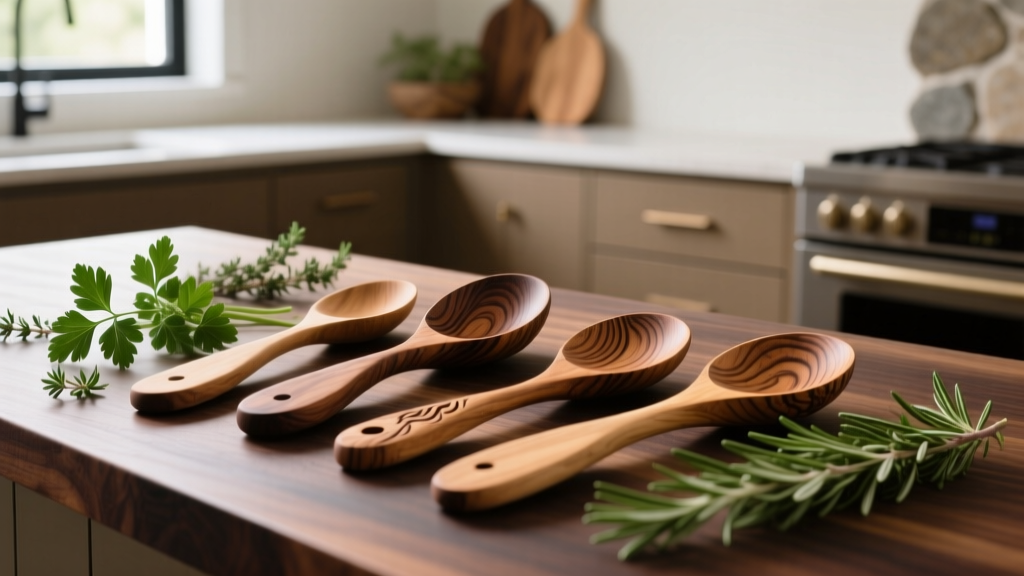
Wood Species Comparison Matrix
The following matrix evaluates the top diffuse-porous candidates based on Janka hardness (resistance to denting and knife scarring), average retail cost for a standard 12-inch spatula or spoon, and projected lifespan under normal maintenance.
| Wood Species | Janka Hardness (lbf) | Avg. Retail Cost | Est. Lifespan | Annualized Cost |
|---|---|---|---|---|
| Hard Maple (Acer saccharum) | 1,450 | $18 - $28 | 5 - 8 Years | $3.50 - $5.60 |
| European Beech (Fagus sylvatica) | 1,300 | $10 - $16 | 3 - 5 Years | $3.33 - $5.33 |
| Olive Wood (Olea europaea) | 2,710 | $40 - $75 | 15+ Years | $2.66 - $5.00 |
| Teak (Tectona grandis) | 1,070 | $25 - $40 | 10 - 12 Years | $2.50 - $4.00 |
Deep Dive: Top Contenders by Value Tier
Hard Maple: The Commercial Workhorse
Hard Maple remains the undisputed standard for commercial kitchens and high-volume production. Its exceptionally tight diffuse-porous grain resists scarring from sharp edges, and its light color makes it easy to visually verify cleanliness. While the initial cost is moderate, its predictable wear pattern and widespread availability keep replacement costs low. For buyers prioritizing utilitarian function over aesthetic flair, Hard Maple offers the most reliable baseline value.
European Beech: The Budget Champion
Beech is frequently used in mass-produced, budget-friendly kitchenware. It shares a similar cellular structure to maple but is slightly softer and more prone to warping if subjected to rapid temperature fluctuations. Beech represents the highest value for users who tend to lose or accidentally destroy utensils (e.g., leaving them in hot pans or running them through dishwashers). The low initial capital outlay minimizes financial friction when replacement is necessary.
Olive Wood: The Heirloom Investment
Olive wood commands a premium price due to its slow growth rate, high natural oil content, and striking, high-contrast grain patterns. With a Janka hardness of 2,710 lbf, it is nearly twice as hard as maple, making it virtually impervious to denting and knife scarring. The natural oils within the wood act as an internal moisture barrier, drastically reducing the frequency of required external oiling. When evaluated over a 15-year lifespan, olive wood's annualized cost drops to match or beat much cheaper domestic woods, making it the ultimate long-term value proposition for careful home cooks.
Teak: The High-Moisture Specialist
Teak contains high levels of natural silica and rubber, which provide unparalleled resistance to water absorption and rot. While its Janka hardness is lower than maple (making it slightly more susceptible to deep gouges), its dimensional stability in high-humidity environments is superior. Teak is the highest-value choice for utensils that will frequently remain in liquid-heavy environments, such as stirring spoons for soups, stews, and sauces, where lesser woods would quickly succumb to checking and splitting.
Hidden Costs: Maintenance and Premature Failure
The financial analysis of wooden utensils must account for the 'dishwasher tax.' Exposing wooden tools to the prolonged heat, aggressive water pressure, and alkaline detergents of a dishwasher strips the wood's cellular moisture and degrades food-safe finishes. This causes rapid checking (micro-cracks) that harbor bacteria, instantly reducing the utensil's functional lifespan to near zero.
Proper maintenance requires periodic application of food-grade mineral oil and a beeswax-based board cream. A 16-ounce bottle of USP-grade mineral oil costs approximately $12 and will maintain a dozen utensils for several years, adding less than $0.50 per year to the ACO of any given tool. Neglecting this minor maintenance cost accelerates wood desiccation, forcing premature replacement and destroying the value proposition of premium woods like Teak or Olive.
Toxicity and Food Safety Parameters
Not all hardwoods are safe for culinary use. When sourcing custom or artisan utensils, buyers must verify the toxicity profile of the timber. The Wood Database maintains comprehensive records of wood sensitization and toxicity. Exotic woods such as Cocobolo, Rosewood, and Wenge contain natural compounds that can cause severe allergic reactions, respiratory issues, or systemic toxicity when ingested via food contact. Furthermore, while Black Walnut is a popular domestic hardwood, it contains juglone, which can cause mild reactions in highly sensitive individuals, making diffuse-porous, non-toxic species like Maple, Cherry, and Beech the safest universal choices. Always verify compliance with USDA food safety guidelines regarding porous materials in food preparation environments.
Final Procurement Framework
Selecting the best type of wood for cooking utensils requires aligning the material properties with your specific operational habits. Use the following decision framework to optimize your purchase:
- For Commercial Kitchens & High Turnover: Procure Hard Maple. The balance of high Janka hardness, strict food safety compliance, and moderate replacement costs minimizes operational downtime and expense.
- For Budget-Conscious or High-Loss Environments: Choose European Beech. The low initial cost absorbs the financial impact of accidental damage or loss without sacrificing basic food-safe grain structures.
- For Liquid-Heavy Cooking (Soups, Stews, Syrups): Invest in Teak. The natural silica and rubber content prevent the wood swelling and checking that destroys standard hardwoods in boiling liquids.
- For Heirloom Quality & Lowest Long-Term ACO: Purchase Olive Wood. The extreme density and natural oils provide a multi-decade lifespan that amortizes the high initial purchase price into pennies per year.
Written by
Marcus ChenMarcus Chen is a licensed structural engineer (PE) and building materials analyst with over 12 years of experience across residential, commercial, and industrial construction. He holds a Master of Science in Civil Engineering from UC Berkeley and spent six years at Thornton Tomasetti before transitioning to independent consulting and technical writing. Marcus specializes in material selection for seismic-prone regions, concrete reinforcement strategies, and lifecycle cost analysis. His work has been cited by the American Concrete Institute (ACI) and the Structural Engineers Association of California (SEAOC). When he is not on a job site or at his desk, you will find him hiking the Sierra Nevada or restoring a 1920s craftsman bungalow in Oakland, CA.
More from Marcus Chen
View all
Construction Cost
How Much Did the Eiffel Tower Cost to Build?
How much did the Eiffel Tower cost to build in 1889? We adjust for inflation and compare its budget to modern skyscraper construction.
Aug 4, 2026

Fire Resistance
What Is a Fire Resistant Material? Testing & Certification Guide
Discover what is a fire resistant material through ASTM and UL testing. Learn how fire ratings, certifications, and assemblies work in construction.
Aug 4, 2026

Construction Cost
How Much Did the Burj Khalifa Cost to Build?
How much did the Burj Khalifa cost to build? We break down the $1.5B project and extract 5 money-saving strategies for your next build.
Jul 30, 2026