What Type of Saw to Cut Wood: Pro Comparison Guide
Decide what type of saw to cut wood with our pro comparison matrix. We review circular, miter, table, and track saws for framing, trim, and cabinetry.
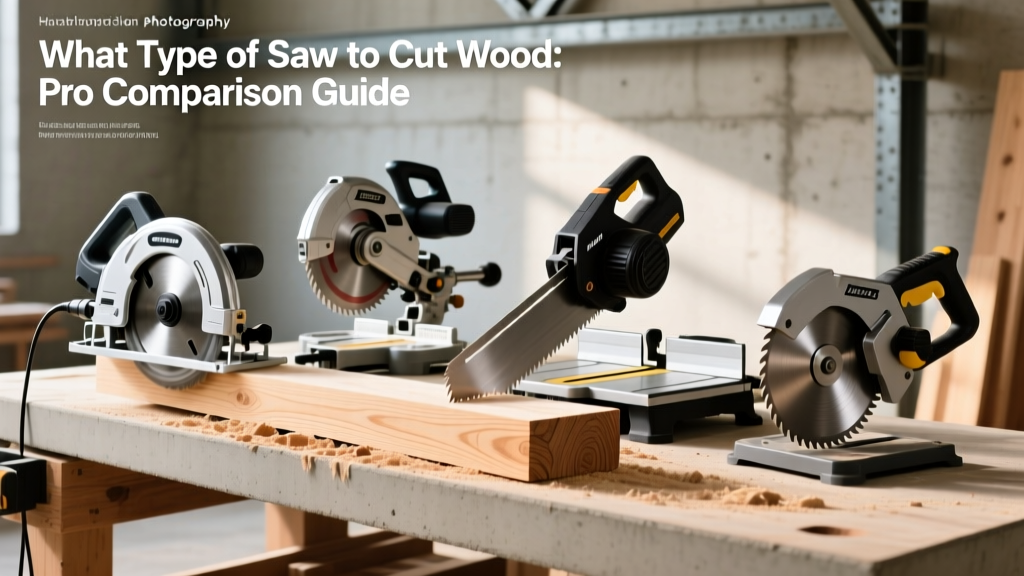
The Core Decision Framework: Rip vs. Crosscut
Determining what type of saw to cut wood depends entirely on the cut vector, required tolerance, and material dimensions. In woodworking and construction, cuts are categorized into two primary vectors: ripping (cutting parallel to the wood grain) and crosscutting (cutting perpendicular to the grain). A saw optimized for ripping will tear and splinter wood if used for crosscutting, and vice versa. Furthermore, the required tolerance dictates the tool class; rough framing allows for 1/8-inch variances, while custom cabinetry demands 1/64-inch precision.
The Quick-Reference Saw Selection Matrix
Use the matrix below to identify the correct saw category based on your specific project parameters. Pricing reflects 2026 professional-grade cordless and stationary models.
| Saw Type | Primary Cut Vector | Max Cut Depth | Best Application | Avg Pro Cost |
|---|---|---|---|---|
| Circular Saw (7-1/4") | Rip & Crosscut | 2.5" | Framing, sheathing, rough dimensioning | $150 - $250 |
| Track Saw | Rip & Plunge | 2.125" | Sheet goods, splinter-free cabinetry | $450 - $700 |
| Miter Saw (12") | Crosscut & Miter | 4" x 14" | Trim, crown molding, decking | $350 - $650 |
| Table Saw (10") | Rip & Dado | 3.125" | Dimensioning lumber, joinery, ripping | $800 - $2,500 |
| Reciprocating Saw | Demolition | Blade Length | Tear-out, pruning, nail-embedded wood | $120 - $220 |
Portable Power Saws: Circular vs. Track Saws
The Circular Saw: The Framing Workhorse
For structural framing and rough carpentry, the 7-1/4-inch circular saw is the undisputed standard. Models like the DeWalt DCS570B or Milwaukee M18 Fuel Gen 4 deliver over 5,800 RPM, providing enough torque to rip through wet pressure-treated 2x10s without bogging down. Circular saws are inherently freehand tools; while you can attach an edge guide, they are not designed for the microscopic tolerances required in finish carpentry.
The Track Saw: The Cabinetmaker's Secret
If your project involves breaking down 4x8 sheets of plywood or melamine for cabinetry, a track saw is mandatory. Tools like the Makita XPS01PTJ ride along an extruded aluminum guide rail with a zero-clearance splinter guard. This guard physically holds the wood veneer down directly adjacent to the blade, eliminating the tear-out that plagues standard circular saws. Track saws also feature plunge-cut capabilities, allowing you to start a cut in the middle of a panel for sink cutouts without needing a starter hole.
Stationary Precision: Table Saw vs. Miter Saw
The Table Saw: The Shop Centerpiece
When deciding what type of saw to cut wood for dimensional milling, the table saw is the only viable option for repetitive, perfectly parallel rip cuts. The workpiece moves past a stationary blade. For professional shops, the SawStop PCS-175 remains the industry benchmark due to its flesh-sensing safety technology, which stops the blade in 3 milliseconds upon skin contact. When ripping hardwoods like oak or maple, the table saw's cast-iron table and heavy-duty fence system (like the Biesemeyer style) prevent the wood from twisting, which is the primary cause of kickback.
The Miter Saw: The Crosscutting Specialist
Miter saws pull a spinning blade down through a stationary workpiece. They are strictly for crosscutting and should never be used for ripping. The Bosch GCM12SD utilizes an axial-glide arm system rather than traditional sliding rails, saving up to 12 inches of bench space while providing incredibly smooth articulation. A 12-inch sliding miter saw can crosscut a 2x12 or slice 45-degree miters on 5-inch crown molding nested against the fence.

The Hidden Variable: Blade Geometry and TPI
Selecting the right saw is only half the equation; the blade dictates the actual cut quality. The USDA Forest Products Laboratory Wood Handbook notes that wood fiber shear strength varies wildly by species, requiring specific tooth geometries to prevent cellular crushing.
- Flat Top Grind (FTG): Teeth are ground flat across the top. Acts like a chisel. Use for: Ripping solid lumber. Fast material removal, but leaves a rough crosscut.
- Alternate Top Bevel (ATB): Teeth are beveled left and right alternately. Acts like a knife. Use for: Crosscutting solid wood and plywood. Slices fibers cleanly to prevent tear-out.
- High Alternate Top Bevel (Hi-ATB): Steeper bevel angle (usually 30-40 degrees). Use for: Melamine, veneered plywood, and MDF where micro-chipping is a major risk.
TPI (Teeth Per Inch) Quick Guide:
Use 24T for rough framing (fast, aggressive, messy). Use 40T to 50T for general-purpose combination cuts. Use 80T to 90T for finish trim, hardwood flooring, and cabinetry.
Troubleshooting Common Cut Failures
Even with the correct saw, operators frequently encounter specific failure modes. Here is how to diagnose and fix them:
1. Burn Marks on the Cut Edge
Cause: Friction buildup. This happens when the feed rate is too slow, the blade is dull, or the blade is pitched slightly out of parallel with the fence (creating a rubbing action on the back of the kerf).
Fix: Check blade-to-fence parallelism with a dial indicator. Clean pitch buildup off the blade using a dedicated resin solvent, and maintain a steady, continuous feed rate.
2. Bottom-Side Tear-Out on Plywood
Cause: The blade teeth exit the wood on the bottom, tearing the unsupported veneer fibers upward.
Fix: If using a table saw, install a zero-clearance throat plate and lower the blade height so it only protrudes 1/4-inch above the material. If using a circular saw, cut with the "good" face up, as the blade cuts on the upstroke.
3. Blade Binding and Kickback
Cause: Internal tension in the wood. As you rip a board, the kerf can pinch shut behind the blade, grabbing the teeth and throwing the wood backward.
Fix: Always use a riving knife or splitter directly behind the blade to hold the kerf open. Never rip bowed lumber with the concave side facing down against the table.
Frequently Asked Questions
Can I use a jigsaw to cut thick dimensional lumber?
While a jigsaw can physically cut through a 2x4, it is not recommended for structural framing. Jigsaw blades deflect (bend) under the lateral pressure of thick, dense wood, resulting in cuts that are out of square by several degrees. Reserve jigsaws for curved cuts in material under 1.5 inches thick.
What is the best saw for cutting reclaimed wood with hidden nails?
Use a reciprocating saw equipped with a carbide-tipped demolition blade (such as the Milwaukee AX series). Standard bi-metal blades will dull instantly upon hitting embedded masonry nails, while carbide teeth can sheer through nail heads without catastrophic tooth loss.
Written by
Elena RodriguezElena Rodriguez is a civil engineer and technical writer specializing in concrete technology, masonry systems, and ASTM/ACI compliance. She earned her B.S. in Civil Engineering from Texas A&M University and spent a decade at a materials testing laboratory, performing over 2,000 concrete compressive strength tests and masonry prism evaluations. Elena is an ACI-certified Field Testing Technician (Grade I) and a member of ASTM Committee C12 on Natural Building Stone. She currently consults on forensic engineering cases involving concrete failures and moisture intrusion. Based in San Antonio, TX, Elena is a proud member of the Society of Women Engineers (SWE) and coaches her daughter's FIRST Robotics team.
More from Elena Rodriguez
View all
Walls & Panels
Cost Analysis: Light Gauge Steel Framing Advantages and Disadvantages
Evaluate light gauge steel framing advantages and disadvantages through a strict cost analysis lens, comparing material, labor, and lifecycle expenses.
Aug 4, 2026

Walls & Panels
Gypsum Board Types: Exact Specifications, Thickness & Dimensions
Compare standard, Type X, and moisture-resistant gypsum board types. Get exact specifications, thicknesses, dimensions, and ASTM standards for your project.
Aug 4, 2026

Fire Resistance
Best Fire-Resistant Outdoor Decking Materials: 2026 Buyer Guide
Discover the best fire-resistant outdoor decking materials for 2026. Compare Class A PVC, aluminum, and hardwood options for WUI compliance and safety.
Aug 4, 2026