Structural Composite Lumber: Performance Ratings & Span Specs
Compare LVL, PSL, LSL, and OSL structural composite lumber. Explore Fb/E ratings, load specs, and manufacturer grades for modern framing.
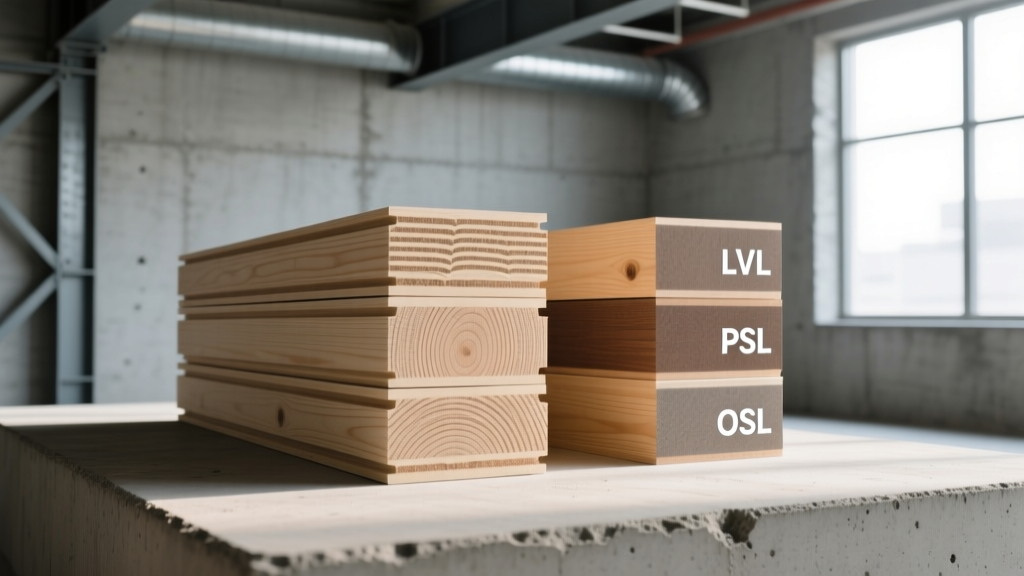
The SCL Matrix: LVL vs. PSL vs. LSL vs. OSL
Structural composite lumber (SCL) has fundamentally altered load-bearing framing, offering predictable engineering values that traditional sawn lumber cannot match. Under the 2024 International Building Code (IBC), which governs most 2026 construction, SCL is mandated for high-load transfer beams, long-span headers, and critical rim board applications. To specify the right product, engineers and builders must distinguish between the four primary SCL categories.
| SCL Type | Manufacturing Process | Typical Modulus of Elasticity (E) | Primary Structural Application | Relative Cost Index |
|---|---|---|---|---|
| LVL (Laminated Veneer Lumber) | Peeling logs into thin veneers, laminating with parallel grain orientation. | 1.9E to 2.6E | Long-span beams, headers, rafters, and I-joist flanges. | 1.0x (Baseline) |
| PSL (Parallel Strand Lumber) | Clipping veneers into long strands, bonding under high pressure. | 2.0E to 2.4E | Heavy columns, high-shear transfer beams, and point-load bearing. | 1.3x |
| LSL (Laminated Strand Lumber) | Flaking logs into short strands, pressing with resin. | 1.3E to 1.5E | Short-span headers, rim boards, and window/door framing. | 0.75x |
| OSL (Oriented Strand Lumber) | Similar to LSL but with specific strand alignment for directional strength. | 1.3E to 1.5E | Rim boards, I-joist flanges, and specialized blocking. | 0.80x |
Decoding Performance Ratings: Fb, E, and Fv Explained
When reading an SCL manufacturer’s span table or an architect’s blueprint, you will encounter designations like 2800Fb-2.0E. These alphanumeric codes are the lifeblood of structural specifications, defined by standards from APA - The Engineered Wood Association.
The Rating Nomenclature
- Fb (Bending Stress): The first number (e.g., 2800) represents the allowable bending stress in pounds per square inch (psi). A 3100Fb beam can resist roughly 10% more bending moment than a 2800Fb beam of the exact same dimension.
- E (Modulus of Elasticity): The second number (e.g., 2.0E) indicates stiffness, measured in millions of psi. A 2.0E beam has an MOE of 2,000,000 psi. Higher E values mean less deflection under live loads, which is critical for preventing drywall cracking and floor bounce.
- Fv (Shear Stress): Often listed separately in technical guides, Fv dictates how well the beam resists sliding forces along its grain. PSL typically boasts the highest Fv values, making it superior for short beams carrying massive point loads.
For context, a standard #2 grade Douglas Fir-Larch 2x12 sawn lumber beam has an allowable Fb of roughly 1,000 psi and an E of 1,600,000 psi (1.6E). Upgrading to a 2800Fb-2.0E LVL nearly triples the bending capacity and increases stiffness by 25%, allowing for significantly longer spans without intermediate support columns.
Manufacturer Specifications & Grade Stamps
Not all SCL is created equal. While the raw materials are similar, proprietary adhesives and pressing techniques result in distinct product lines. When sourcing materials for a 2026 build, ensure the lumber bears a valid grade stamp from an accredited agency like PFS TECO or APA.
Industry-Leading Product Lines
- Weyerhaeuser Trus Joist Microllam® LVL: Available in 2.0E and 2.2E grades. Known for tight dimensional tolerances and excellent screw-holding capabilities for joist hangers.
- Boise Cascade Versa-Lam® LVL: Offers a 3100Fb-2.0E grade, specifically engineered for high-load residential and light commercial transfer beams.
- Weyerhaeuser Parallam® PSL: The industry standard for heavy timber columns and beams. Recognizable by its distinct, rough-textured strand surface. It requires specific sealants if left exposed in architectural applications.
- Boise Cascade All-Joist® LSL: Highly cost-effective for rim boards and short headers, typically graded at 1.3E or 1.5E.
Job-Site Moisture Tolerances and Storage Protocols
SCL is manufactured at a strict moisture content (MC) of 12% or less. Because the wood strands and veneers are dried before gluing, SCL is highly stable. However, job-site abuse can compromise this stability.
While LVL and PSL are highly resistant to moisture absorption, LSL (Laminated Strand Lumber) is susceptible to edge swelling if exposed to standing water. If an LSL rim board is left uncovered in a rainstorm, the edges can swell up to 10%, compromising the nailing surface for I-joists. Always store LSL flat, elevated off the ground, and covered with breathable tarps until the structure is dried in.
According to the American Wood Council (AWC), SCL can be used in conditions where the equilibrium moisture content does not exceed 19%. If the SCL will be exposed to the elements during a prolonged construction phase, specify products treated with borate-based preservatives or apply a field-applied water repellent coating to the end grains, which are the most porous areas for moisture ingress.
Fastener and Hardware Compatibility
A common failure mode in SCL framing is the use of standard smooth-shank nails or drywall screws in structural connectors. SCL is significantly denser than traditional sawn lumber, which alters fastener withdrawal and lateral resistance.
| Fastener Type | SCL Compatibility Rule | Application Example |
|---|---|---|
| Smooth-Shank Nails | Prohibited for most joist hangers. Lack of withdrawal resistance in dense LVL/PSL. | N/A |
| Ring-Shank / Deformed Nails | Required for standard joist hangers (e.g., Simpson Strong-Tie LUS series). | Attaching I-joists to LVL rim boards. |
| Structural Screws (SD/SDS) | Highly Recommended. Provide superior lateral load values and reduce splitting. | Ledger board attachment, heavy shear walls. |
| Through-Bolts & Lag Screws | Pre-drilling Mandatory for holes exceeding 1/2-inch diameter to prevent internal checking. | Column caps, heavy beam splices. |
Sizing Framework: When to Upgrade from Sawn to SCL
Determining when to transition from dimensional sawn lumber to SCL requires a balance of material cost, labor efficiency, and architectural constraints. Use this decision framework during the preliminary design phase:
- Check the Span: If a clear span exceeds 14 feet for a floor beam or 8 feet for a header supporting a roof load, sawn lumber will likely require built-up members (e.g., four 2x12s nailed together). Decision: Upgrade to a single-ply or double-ply LVL to save labor and eliminate the risk of nail-pop shrinkage gaps.
- Evaluate Depth Restrictions: If mechanical ducting or plumbing limits beam depth to 11.25 inches or less, sawn lumber will deflect excessively over long spans. Decision: Specify a 2800Fb-2.0E LVL to maintain the required stiffness (E) within the restricted depth envelope.
- Analyze Point Loads: If a beam supports a concentrated load from a steel column or a heavy masonry fireplace exceeding 10,000 lbs. Decision: Utilize PSL (Parallel Strand Lumber). Its superior compression perpendicular to grain (Fc⊥) prevents the beam from crushing at the bearing points without requiring steel bearing plates.
Frequently Asked Technical Questions
Can SCL be ripped or cross-cut in the field?
Cross-cutting to length is perfectly acceptable and does not affect the structural grade. However, ripping SCL (cutting it along its length to reduce depth) is strictly prohibited by manufacturers. Ripping severs the continuous veneers or strands, destroying the engineered tension zone and voiding the warranty. If a shallower beam is needed, order the correct depth from the mill.
How does fire resistance compare between SCL and solid timber?
SCL chars at a predictable rate of approximately 1.5 inches per hour when exposed to standard ASTM E119 fire tests. Because SCL members are typically thicker (3.5" to 7"), they inherently provide excellent fire resistance for Type III and Type IV (Mass Timber) construction, often eliminating the need for intumescent paints or gypsum encapsulation in commercial builds.
What is the required bearing length for SCL beams?
Minimum bearing length is dictated by the reaction force and the beam’s Fc&perp (compression perpendicular to grain) rating. As a baseline rule, LVL requires a minimum of 3 inches of bearing on wood or steel for standard residential loads, while heavy commercial PSL transfer beams may require 5.5 to 8 inches of bearing to prevent localized crushing at the supports.