Hardwood Flooring Options: The Complete Wood Species Guide
Compare top hardwood flooring options with our complete species guide. Analyze Janka hardness, moisture stability, and 2026 material costs.
Strategic Species Selection: Beyond Aesthetics
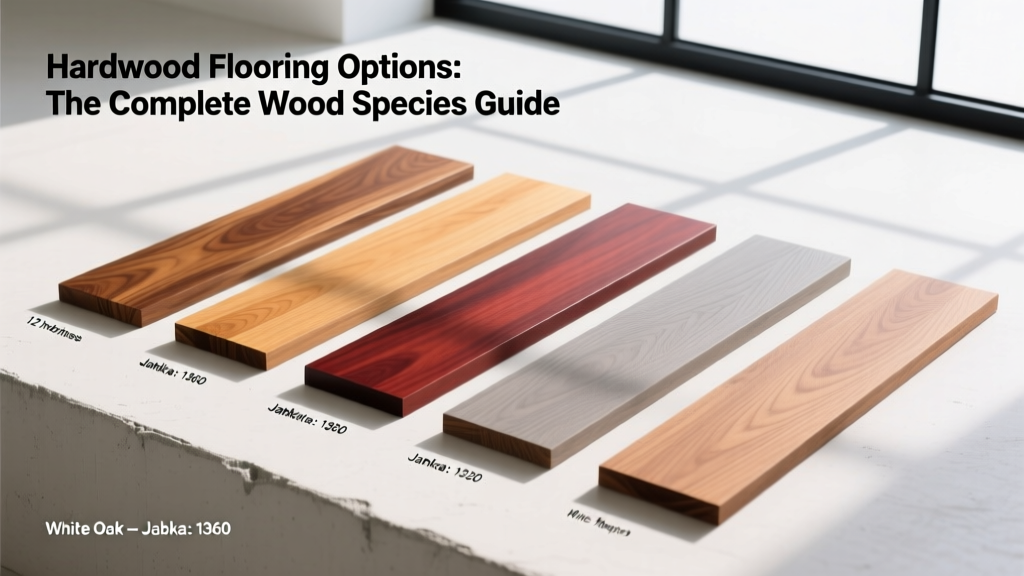
Selecting from the vast array of hardwood flooring options requires looking past surface color and grain. The long-term performance of a wood floor is dictated by its cellular structure, Janka hardness rating, and dimensional stability. While trends shift toward specific tones, the underlying species determines how the floor will handle point loads, moisture fluctuations, and UV exposure over decades of use.
Decision Matrix: Match Species to Environment
- High Moisture / Basements: Engineered White Oak (tyloses block moisture penetration).
- Commercial / High Traffic: Hickory or Hard Maple (Janka > 1400 lbf).
- Radiant Heat Systems: Quarter-sawn White Oak or American Cherry (low tangential shrinkage).
- Budget / DIY Installation: Red Oak (forgiving milling, easy to sand, accepts stain uniformly).
Top Domestic Hardwood Flooring Options
Red Oak (Quercus rubra): The Industry Benchmark
Red oak has historically been the baseline for North American hardwood flooring. With a Janka hardness of 1,290 lbf, it offers a reliable balance of dent resistance and workability. Its open-pore grain structure makes it exceptionally receptive to traditional oil-based penetrating stains, allowing for deep, uniform color saturation.
Technical Consideration: Red oak contains high levels of tannins and an open cellular structure. If exposed to standing water or chronic high humidity, it will wick moisture rapidly, leading to black tannin stains and cupping. It is strictly recommended for above-grade, climate-controlled environments (35%-55% relative humidity).
White Oak (Quercus alba): The Modern Standard
White oak (Janka: 1,360 lbf) has overtaken red oak in contemporary specifications due to its tighter grain and superior moisture resistance. The defining anatomical feature of white oak is the presence of tyloses—membranous growths that plug the xylem vessels, rendering the wood nearly impervious to liquid water. This makes white oak the only solid domestic hardwood viable for areas with occasional moisture exposure, such as powder rooms or kitchens.
Finishing Gotcha: White oak's tannins react aggressively with the water and alkaline solvents found in many water-based polyurethanes, often resulting in a green or brownish chemical bleed. Installers must apply a dedicated tannin-blocking sealer (such as a two-part epoxy sealer or specific shellac-based primers) before applying water-based topcoats.
Hard Maple (Acer saccharum): The High-Traffic Workhorse
Hard maple (Janka: 1,450 lbf) is the standard for gymnasiums and bowling alleys due to its exceptional shock resistance and tight, closed-grain appearance. In residential settings, it provides a clean, minimalist aesthetic with minimal grain distraction.
Staining Limitations: Maple's dense, closed-pore structure resists traditional liquid stains, leading to severe blotching. To achieve darker tones on maple, specify dye stains or gel stains, which sit on the surface rather than attempting to penetrate the dense wood fibers.
Hickory (Carya spp.): The Rustic Heavyweight
Hickory is the hardest commercially available domestic species, boasting a Janka rating of 1,820 lbf. It features extreme color variation between its pale sapwood and dark brown heartwood, making it the premier choice for rustic, character-grade designs.
Installation Reality: Hickory's density is notorious for dulling carbide-tipped saw blades up to 30% faster than oak. Installers must use fresh, high-tooth-count blades for crosscuts to prevent tear-out and burning, and pre-drilling is mandatory for face-nailing near board ends to prevent splitting.
Premium Exotic Hardwood Flooring Options
Brazilian Cherry / Jatoba (Hymenaea courbaril)
For specifications demanding extreme durability, Brazilian Cherry offers a Janka hardness of 2,350 lbf. Its interlocked grain and high density provide unparalleled resistance to denting from heavy furniture or pet claws. However, Jatoba is highly photosensitive. Freshly milled boards exhibit a tan-to-salmon color that rapidly oxidizes and deepens into a rich, dark reddish-brown within six months of UV exposure. Area rugs placed immediately after installation will result in permanent, uneven color silhouettes.
Comprehensive Species Comparison Data
The following matrix synthesizes critical performance metrics for specifying hardwood flooring options in 2026. Material costs reflect unfinished, 3/4-inch thick, 5-inch wide plank averages.
| Wood Species | Janka Hardness (lbf) | Volumetric Shrinkage | Avg. Material Cost (2026) | Best Application |
|---|---|---|---|---|
| American Cherry | 950 | 11.5% | $6.00 - $9.00 / sq ft | Low-traffic formal rooms, radiant heat |
| Red Oak | 1,290 | 12.6% | $4.50 - $7.00 / sq ft | Standard residential, heavy staining |
| White Oak | 1,360 | 16.5% | $5.50 - $9.50 / sq ft | Kitchens, modern aesthetics, engineered |
| Hard Maple | 1,450 | 14.7% | $5.00 - $8.00 / sq ft | Contemporary homes, light natural tones |
| Hickory | 1,820 | 17.9% | $6.50 - $10.00 / sq ft | Rustic designs, high-impact zones |
| Brazilian Cherry | 2,350 | 12.0% | $9.00 - $14.00 / sq ft | Luxury residential, commercial lobbies |
Data sourced from the USDA Forest Products Laboratory Wood Handbook and industry pricing aggregates.
Dimensional Stability and Moisture Tolerance
Hardness does not equate to stability. A wood's dimensional stability is measured by its volumetric shrinkage from green to oven-dry conditions. According to the Wood Database, species with lower shrinkage percentages experience less seasonal gapping and cupping.
For installations over concrete slabs or in environments with wide humidity swings, specify quarter-sawn or rift-sawn lumber. Quarter-sawing aligns the growth rings perpendicular to the face of the board, reducing tangential shrinkage (the primary cause of cupping) by up to 50% compared to plain-sawn boards. While quarter-sawn white oak commands a 20% to 30% price premium, it is virtually mandatory for wide-plank installations (7 inches and wider) to prevent structural failure.
Navigating NWFA Lumber Grades
The National Wood Flooring Association (NWFA) standardizes grading based on visual characteristics and allowable defects, not structural integrity.
- Clear Grade: Heartwood only, minimal color variation, no open knots or character marks. Yields a highly uniform, formal appearance.
- Select Grade: Slight color variation between heartwood and sapwood, small tight knots permitted. The most common choice for modern residential builds.
- #1 Common (Character Grade): Pronounced color variation, open knots, wormholes, and mineral streaks. Requires epoxy filling during the finishing process but provides high visual texture.
- #2 Common (Rustic Grade): Maximum allowable defects, heavy sapwood inclusion, large knots. Best suited for distressed or hand-scraped flooring profiles where defects are masked by intentional tooling marks.
Technical FAQ: Hardwood Flooring Options
Can solid hardwood be installed over radiant heating systems?
Solid hardwood is generally discouraged over radiant heat due to the extreme localized drying, which causes severe gapping. If solid wood must be used, specify narrow-width (2 1/4-inch to 3-inch), quarter-sawn American Cherry or White Oak, and ensure the subfloor surface temperature never exceeds 80°F (26°C). Engineered hardwood with a thick sawn wear layer is the vastly superior technical choice for radiant applications.
Why is my white oak floor turning green under the finish?
This is a chemical reaction between the natural tannins in white oak and the alkaline components of water-based polyurethane. To prevent this, the raw wood must be sealed with a tannin-blocking primer or a two-component epoxy sealer before applying the water-based topcoat. Alternatively, use a high-quality oil-based finish, which does not trigger this reaction.
What is the maximum recommended width for solid plain-sawn boards?
For plain-sawn domestic species like oak or maple, the maximum recommended width for a glue-and-nail installation in a climate-controlled home is 5 inches. Boards wider than 5 inches possess too much tangential tension and will inevitably cup at the edges during seasonal humidity drops unless they are quarter-sawn or fully glued down with a high-tensile urethane adhesive.
Written by
David NakamuraDavid Nakamura is a licensed architect (AIA) and construction technology writer focused on sustainable building methods, mass timber engineering, and high-performance building envelopes. He holds a Master of Architecture from the University of Washington and is a certified Passive House Consultant (CPHC). David spent eight years at the Seattle firm Mithun, where he led the design of three LEED Platinum projects, before founding his own practice specializing in net-zero residential design. He serves on the editorial advisory board of GreenBuilder Magazine and has authored peer-reviewed papers on cross-laminated timber (CLT) connections for the Journal of Structural Engineering. In his spare time, David teaches woodworking at Pratt Fine Arts Center and kayaks the Puget Sound.
More from David Nakamura
View all
Construction Cost
Labor Cost to Build a Deck Per Sq Ft: 2026 Installation Guide
Discover the exact labor cost to build a deck per sq ft in 2026. This installation guide breaks down contractor rates, complexity factors, and hidden fees.
Aug 4, 2026

Construction Cost
How Much Does It Cost to Build a 3 Bedroom House? Financing Guide
Learn exactly how much it costs to build a 3 bedroom house and explore 2026 financing options, construction loan types, and budget frameworks for your build.
Aug 4, 2026

Construction Cost
Cost to Build a Tennis Court: 2026 Guide
How much does it cost to build a tennis court in 2026? Breakdowns for asphalt, concrete, and synthetic surfaces plus fencing and lighting.
Jul 30, 2026