Types of Wood Working in Construction: A Comparison Review
Compare the four main types of wood working in construction, from rough framing to architectural millwork, with 2026 material costs and labor rates.

The Four Primary Types of Wood Working in Construction
When evaluating the different types of wood working required for a custom build or commercial project, it is a critical mistake to treat carpentry as a single trade. The discipline is strictly divided by structural intent, material tolerances, and installation environments. In modern construction, woodworking is categorized into four distinct specialties: rough carpentry, timber framing, finish carpentry, and architectural millwork. Each requires different lumber grades, moisture content specifications, and labor skill sets.
| Woodworking Type | Primary Function | Standard Materials | Avg. Cost Range (2026) | Moisture Content (MC) |
|---|---|---|---|---|
| Rough Carpentry | Structural framing, sheathing | SPF #2, Douglas Fir | $8 - $14 per sq. ft. | 15% - 19% |
| Timber Framing | Exposed structural joinery | Douglas Fir, White Oak | $150 - $300 per sq. ft. | 12% - 15% |
| Finish Carpentry | Site-built trim, casing, molding | Poplar, MDF, Pine | $12 - $22 per linear ft. | 8% - 12% |
| Architectural Millwork | Custom cabinetry, built-ins, paneling | Maple, Walnut, Oak veneers | $800 - $1,500+ per linear ft. | 6% - 8% |
Structural Woodworking: Rough Carpentry vs. Timber Framing
Structural woodworking forms the skeleton of the building. The choice between conventional rough carpentry and timber framing dictates not only the architectural aesthetic but also the mechanical system integration and insulation strategy.
Rough Carpentry (Stick Framing)
Conventional stick framing utilizes dimension lumber, typically 2x4 or 2x6 SPF (Spruce-Pine-Fir) graded #2 or better. In 2026, framing lumber prices have stabilized, with SPF 2x6 stud packs averaging $650 to $850 per thousand board feet (MBF). The primary advantage of rough carpentry is speed and the ease of routing HVAC and electrical systems through the stud bays. However, the structural connections rely entirely on concealed metal fasteners (joist hangers, hurricane ties) and pneumatic nails.
Timber Framing
Timber framing is a specialized type of wood working that relies on heavy timber members (minimum 5x5 inches) connected via traditional mortise and tenon joinery, secured with hardwood pegs. According to the USDA Forest Products Laboratory Wood Handbook, heavy timber exhibits superior fire resistance compared to dimension lumber due to the predictable charring rate of large cross-sections. Timber framing costs significantly more—often $150 to $300 per square foot of footprint—due to the precision CNC cutting or hand-hewing required off-site, and the crane-assisted raising process.
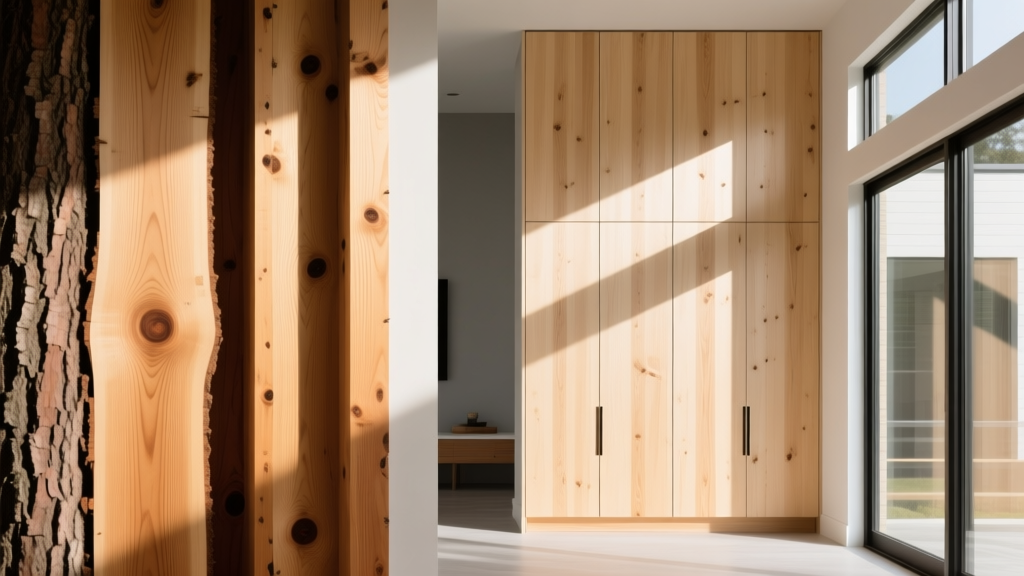
Aesthetic Woodworking: Finish Carpentry vs. Architectural Millwork
While structural woodworking handles the loads, aesthetic woodworking defines the interior visual quality. The boundary between finish carpentry and architectural millwork is defined by where the fabrication takes place.
Finish Carpentry: The Site-Built Approach
Finish carpentry encompasses all trim work installed directly on the job site: baseboards, window and door casing, crown molding, and wainscoting. The finish carpenter must scribe and cope joints to accommodate the inevitable imperfections in drywall and framing.
- Paint-Grade Trim: Poplar and MDF (Medium Density Fiberboard) are the industry standards. MDF provides a perfectly smooth, knot-free surface for painted finishes, while Poplar offers better edge durability for high-impact zones like door casings.
- Stain-Grade Trim: Requires clear, kiln-dried hardwoods like Red Oak, White Oak, or Cherry. Material costs for stain-grade trim run 40% to 60% higher than paint-grade equivalents.
Architectural Millwork: The Shop-Fabricated Approach
Architectural millwork refers to complex, custom wood components fabricated in a controlled shop environment using 5-axis CNC routers and edgebanders. This includes kitchen cabinetry, library built-ins, custom reception desks, and acoustic wood slat wall paneling.
Millwork is governed by the Architectural Woodwork Institute (AWI) Standards, which categorizes construction into three tiers:
- Economy: Basic joinery (dado and rabbet), standard hardware, and laminate or veneer faces. Used in commercial tenant improvements.
- Custom: The baseline for high-end residential. Includes concealed fasteners, premium veneer matching, and soft-close hardware.
- Premium: Reserved for luxury estates and high-profile commercial spaces. Requires specific grain-matching across adjacent panels, blind dovetail joinery, and rigorous tolerance checks (typically +/- 1/64 inch).
Labor Rates and Installation Timelines
Understanding the labor economics of the various types of wood working is essential for accurate project scheduling and budgeting. Labor rates vary by region, but the 2026 national averages for specialized trades highlight the premium placed on precision.
| Trade Specialty | Avg. Hourly Rate (Burdened) | Crew Size | Typical Output per Day |
|---|---|---|---|
| Rough Framer | $30 - $45 | 4 - 6 workers | 1,500 - 2,500 board feet erected |
| Timber Frame Rigger | $55 - $85 | 3 - 5 workers | 10 - 15 bents/joinery connections |
| Finish Carpenter | $45 - $65 | 1 - 2 workers | 80 - 120 linear feet of coping/trim |
| Millwork Installer | $60 - $95 | 2 - 3 workers | 1 - 2 full custom cabinet runs |
Notice the inverse relationship between crew size and hourly rate. Rough carpentry relies on large crews moving heavy materials quickly, whereas millwork installation requires highly paid artisans making micro-adjustments with shims and laser levels to achieve seamless reveals.
Decision Framework: Which Discipline Fits Your Build?
Selecting the right woodworking approach requires aligning the project's architectural intent with the budget and timeline. Use this framework to guide your specifications:
- If maximizing interior square footage and minimizing material costs is the priority: Specify advanced framing techniques (2x6 studs at 24-inch on-center) using SPF #2 lumber. This reduces thermal bridging and lowers rough carpentry labor by up to 15%.
- If the structure is the aesthetic focal point: Invest in a hybrid approach. Use conventional rough carpentry for the concealed exterior walls to maintain budget, and allocate funds for a timber-framed great room or entryway using Douglas Fir beams with a clear, penetrating oil finish.
- If executing a high-end residential interior: Bypass site-built finish carpentry for complex elements. Specify AWI Custom-grade architectural millwork for all cabinetry and built-ins, utilizing site-built finish carpentry only for baseboards and simple crown molding to optimize the budget.
Frequently Asked Questions
Can a rough carpenter install architectural millwork?
Generally, no. Rough carpenters are trained for structural plumb and speed, tolerating 1/4-inch deviations. Architectural millwork requires tolerances of 1/32-inch or less, demanding specialized installers with precision laser levels and micro-adjustment hardware experience.
Is MDF acceptable for exterior trim in finish carpentry?
Never use standard MDF for exterior applications. It acts as a sponge and will swell and degrade within a single season. For exterior finish carpentry, specify cellular PVC trim (like Azek) or finger-jointed, pressure-treated radiata pine, which offers dimensional stability and rot resistance.
How do I verify the moisture content of lumber on delivery?
Require the use of a pin-type moisture meter (such as a Delmhorst or Wagner) on every lumber delivery. For interior millwork, reject any shipment reading above 9% MC in a climate-controlled environment, as it will inevitably shrink and crack the finish after installation.
Written by
Marcus ChenMarcus Chen is a licensed structural engineer (PE) and building materials analyst with over 12 years of experience across residential, commercial, and industrial construction. He holds a Master of Science in Civil Engineering from UC Berkeley and spent six years at Thornton Tomasetti before transitioning to independent consulting and technical writing. Marcus specializes in material selection for seismic-prone regions, concrete reinforcement strategies, and lifecycle cost analysis. His work has been cited by the American Concrete Institute (ACI) and the Structural Engineers Association of California (SEAOC). When he is not on a job site or at his desk, you will find him hiking the Sierra Nevada or restoring a 1920s craftsman bungalow in Oakland, CA.
More from Marcus Chen
View all
Construction Cost
How Much Did the Eiffel Tower Cost to Build?
How much did the Eiffel Tower cost to build in 1889? We adjust for inflation and compare its budget to modern skyscraper construction.
Aug 4, 2026

Fire Resistance
What Is a Fire Resistant Material? Testing & Certification Guide
Discover what is a fire resistant material through ASTM and UL testing. Learn how fire ratings, certifications, and assemblies work in construction.
Aug 4, 2026

Construction Cost
How Much Did the Burj Khalifa Cost to Build?
How much did the Burj Khalifa cost to build? We break down the $1.5B project and extract 5 money-saving strategies for your next build.
Jul 30, 2026