Structural Guide: What Type of Wood Is Best for Hardwood Floors
Discover what type of wood is best for hardwood floors from a structural perspective, analyzing MOE, load distribution, and subfloor requirements.

Beyond Aesthetics: The Structural Role of Hardwood Species
When architects, structural engineers, and advanced builders ask what type of wood is best for hardwood floors, they are rarely concerned with stain absorption or grain aesthetics. Instead, they evaluate flooring as a critical component of the building's structural diaphragm. A properly specified and fastened hardwood floor distributes lateral wind and seismic loads to shear walls, while simultaneously managing gravity loads and dynamic impact forces. Selecting the wrong species for a specific joist spacing or environmental condition can lead to subfloor telegraphing, fastener fatigue, and catastrophic diaphragm failure during lateral events.
To determine the optimal species for structural applications, we must analyze three core mechanical properties: Modulus of Elasticity (MOE), dimensional stability (tangential vs. radial shrinkage), and fastener withdrawal capacity. This guide strips away interior design subjectivity and evaluates hardwood species purely on their structural engineering merits.
The Structural Diaphragm and Load Distribution
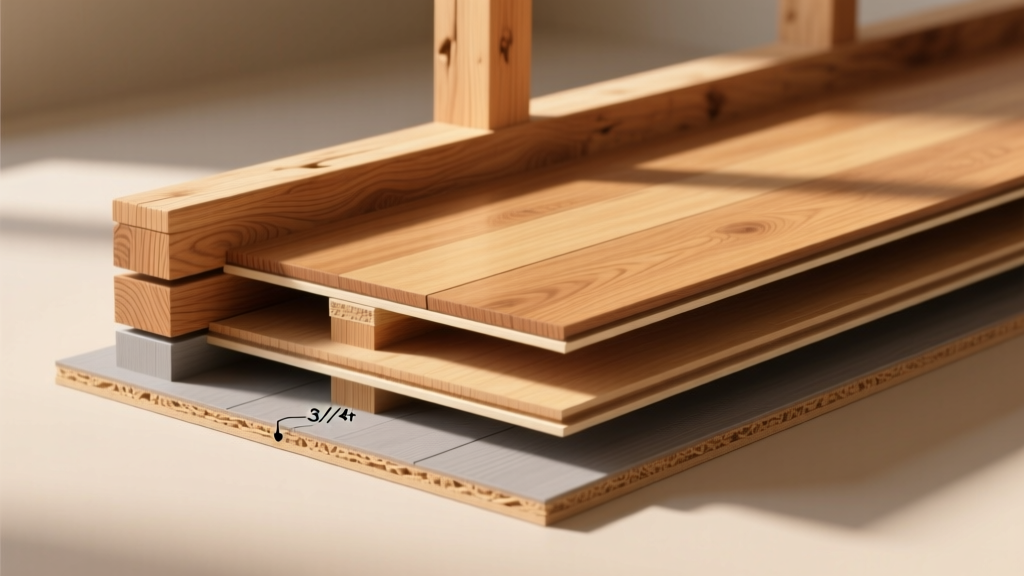
In light-frame construction, the floor assembly acts as a horizontal diaphragm. The hardwood flooring, when blind-nailed or stapled to the subfloor at precise intervals, creates a composite membrane. The stiffness of this membrane is directly tied to the Modulus of Elasticity (MOE) of the chosen wood species. A higher MOE means the wood will deflect less under concentrated point loads (such as heavy commercial equipment or grand pianos), reducing the transfer of localized stress to the underlying engineered wood subfloor.
Engineering Principle: Hardwood flooring does not replace the structural subfloor. According to the National Wood Flooring Association (NWFA), the subfloor must independently meet the deflection criteria of L/360 for live loads. The hardwood layer acts as a secondary load-spreader and diaphragm shear membrane, not a primary structural joist substitute.
Mechanical Properties Matrix: MOE, Hardness, and Shrinkage
The table below contrasts common domestic and imported hardwoods based on structural metrics. Data sourced from the comprehensive Wood Database mechanical testing archives.
| Wood Species | Janka Hardness (lbf) | Modulus of Elasticity (psi) | Tangential Shrinkage (%) | Radial Shrinkage (%) |
|---|---|---|---|---|
| White Oak (Quercus alba) | 1,360 | 1,780,000 | 7.2% | 4.2% |
| Hard Maple (Acer saccharum) | 1,450 | 1,830,000 | 9.9% | 4.8% |
| Hickory (Carya spp.) | 1,820 | 2,160,000 | 7.8% | 4.7% |
| Brazilian Cherry (Jatoba) | 2,350 | 2,690,000 | 7.2% | 4.2% |
Fastener Withdrawal Capacity and Shear Strength
The structural integrity of the floor diaphragm relies entirely on the fastener schedule. The withdrawal capacity of a nail or staple is dictated by the density and interlocking grain structure of the hardwood species. When evaluating what type of wood is best for hardwood floors in high-shear zones (such as coastal hurricane-prone regions), fastener holding power is paramount.
Standard Fastener Schedule for 3/4-Inch Structural Hardwood
- Fastener Type: 16-gauge, 2-inch L-cleats or 15.5-gauge 2-inch flooring staples.
- Spacing: Every 8 to 10 inches along the tongue, and within 3 inches of all board ends.
- Edge Clearance: Minimum 1/2-inch expansion gap at all vertical obstructions to allow for tangential expansion without buckling the diaphragm.
Hickory and Brazilian Cherry exhibit exceptional screw and nail withdrawal resistance due to their dense, interlocking grain. However, their extreme hardness (Janka > 1,800 lbf) requires pre-drilling near board ends to prevent splitting, which can compromise the structural continuity of the tongue-and-groove joint if not executed precisely on-site.
Species Breakdown for Structural Applications
White Oak: The Structural Baseline
White Oak remains the undisputed benchmark for structural hardwood flooring. With an MOE of 1,780,000 psi and excellent dimensional stability, it provides predictable load distribution. Its tyloses-blocked pores make it highly resistant to moisture infiltration, preserving its structural integrity and fastener-holding capacity even if minor subfloor moisture events occur. For commercial applications and heavy residential loads, 3/4-inch quartersawn White Oak offers maximum radial stability, virtually eliminating cupping under structural stress.
Hickory: Maximum Rigidity and Impact Resistance
If the primary structural concern is point-load deflection and impact resistance, Hickory is the optimal domestic choice. Its MOE of 2,160,000 psi makes it significantly stiffer than oak or maple. This stiffness allows Hickory to bridge minor subfloor imperfections without telegraphing deflection to the surface. However, installers must account for its high density by using pneumatic nailers calibrated to higher PSI (90-100 PSI) to ensure the cleat fully seats without fracturing the tongue.
Hard Maple: High Stiffness, High Risk
While Hard Maple boasts a high MOE (1,830,000 psi) and is frequently used in structural gymnasium floors (where it is fastened to specialized sleeper systems), it is a risky choice for direct-to-subfloor residential or commercial applications. Its high tangential shrinkage (9.9%) means that a mere 2% fluctuation in equilibrium moisture content (EMC) can generate enough expansive force to push baseboards off walls or cause the diaphragm to buckle if perimeter expansion gaps are undersized.
Subfloor and Joist Spacing Matrix
The structural performance of the hardwood species is entirely dependent on the underlying substrate. According to guidelines published by the National Wood Flooring Association (NWFA), the subfloor must be matched to the joist spacing to prevent excessive deflection that will fatigue the hardwood fasteners over time.
| Joist Spacing (O.C.) | Minimum Subfloor Requirement | Hardwood Thickness Required | Structural Notes |
|---|---|---|---|
| 16 inches | 5/8' CDX Plywood (3/4' preferred) | 5/8' or 3/4' | Standard residential diaphragm. L-cleats achieve full penetration. |
| 19.2 inches | 3/4' T&G Sturd-I-Floor Plywood | 3/4' only | Requires T&G subfloor edges. Do not use 5/8' hardwood. |
| 24 inches | 1-1/8' T&G Plywood or Double Layer | 3/4' only | High deflection risk. Consider adding a 1/2' plywood underlayment layer to increase fastener bite and shear stiffness. |
Moisture Content (MC) and Structural Acclimation
A hardwood floor cannot perform structurally if it is installed at the wrong moisture content. Wood is hygroscopic; it will absorb or release moisture until it reaches equilibrium with the surrounding environment. If 3/4-inch White Oak is installed at 10% MC in a building that will operate at 4% MC during winter heating seasons, the wood will undergo radial and tangential shrinkage. This shrinkage reduces the clamping force on the subfloor, leading to fastener withdrawal, squeaking, and a compromised shear diaphragm.
Frequently Asked Questions: Structural Hardwood Performance
Can engineered hardwood act as a structural diaphragm?
Generally, no. While engineered hardwood offers superior dimensional stability due to its cross-ply construction, most structural engineering codes and the APA (The Engineered Wood Association) do not recognize floating or glue-down engineered floors as contributing to the lateral load-resisting diaphragm in the same way mechanically fastened 3/4-inch solid hardwood does. For shear-critical assemblies, specify solid, nail-down hardwood.
Does the orientation of the hardwood boards affect structural stiffness?
Yes. For maximum diaphragm shear transfer, hardwood boards should be installed perpendicular to the floor joists. Installing boards parallel to the joists reduces the floor's ability to distribute concentrated point loads across multiple joists, increasing the risk of localized subfloor deflection and fastener fatigue.
What is the maximum allowable deflection for hardwood floors?
The structural subfloor must meet an L/360 deflection limit under a 300-pound concentrated load. If the subfloor exceeds this deflection, the rigid hardwood layer will act as a lever, placing immense shear stress on the 16-gauge cleats, eventually causing the fasteners to yield or the wood tongues to split.
Written by
James ThorntonJames Thornton is a construction industry veteran with 25 years of hands-on experience in wood framing, lumber grading, and residential building codes. He started as a framing carpenter in rural Oregon, earned his ICC Residential Building Inspector certification, and eventually became a senior plan reviewer for the City of Portland Bureau of Development Services. James holds a B.S. in Wood Science & Technology from Oregon State University and is a certified lumber grader through the West Coast Lumber Inspection Bureau (WCLIB). He has inspected over 3,000 residential construction sites and authored the city's internal guide on advanced framing techniques (2x6 at 24" O.C.). James lives in Bend, OR, where he builds custom timber-frame cabins and competes in lumberjack sports.
More from James Thornton
View all
Insulation
Best Home Insulation Materials: Complete 2026 Guide
Compare top home insulation materials for 2026. Find R-values, installed costs per square foot, and best uses for fiberglass, spray foam, and mineral wool.
Aug 4, 2026

Sustainable Building
Certify Your Green Building Material for LEED and WELL
Step-by-step guide to certifying a green building material for LEED v5 and WELL v2. Master EPDs, HPDs, and VOC limits for 2026 project specifications.
Aug 4, 2026

Stone & Masonry
Veneer Stacked Stone Panels: Interior Design & Style Showcase
Discover how veneer stacked stone panels transform interiors. Explore modern design profiles, material pairings, and technical installation specs.
Aug 4, 2026