Types of Wood for Construction: The Complete Species Guide
Discover the best types of wood for construction. This complete species guide covers structural timber, framing lumber, and exterior wood applications.

Decoding Structural Lumber: Softwoods vs. Hardwoods in Building
When selecting materials for a build, the fundamental distinction between botanical classifications and mechanical performance dictates your choices. In construction, 'softwoods' (gymnosperms like pine and fir) are the backbone of structural framing due to their rapid growth, straight grain, and high strength-to-weight ratios. 'Hardwoods' (angiosperms like oak and maple) are denser, slower-growing, and primarily reserved for finish carpentry, flooring, and heavy timber applications where abrasion resistance or specific aesthetic profiles are required.
A common misconception is that softwoods are physically soft. Longleaf Southern Yellow Pine, for example, boasts a Janka hardness rating of 870 lbf, making it significantly harder than many commercial hardwoods like Basswood (410 lbf). Understanding the specific mechanical properties of different types of wood ensures structural integrity and prevents costly material failures.
- Standard Wall Framing: SPF (Spruce-Pine-Fir) or SYP (Southern Yellow Pine)
- Heavy Load-Bearing Beams & Rafters: Douglas Fir-Larch
- Exterior Decking & Siding: Western Red Cedar or Pressure-Treated SYP
- High-Traffic Interior Flooring: Hard Maple or White Oak
Top Framing and Structural Wood Species
Dimensional framing lumber is graded based on visual characteristics that affect structural integrity, such as knot size, slope of grain, and wane. The two critical engineering values stamped on structural wood are Fb (allowable bending stress in psi) and E (Modulus of Elasticity, measuring stiffness). As of 2026, supply chain stabilizations have brought framing lumber prices into a predictable range, though regional availability still dictates the dominant species.
SPF (Spruce-Pine-Fir)
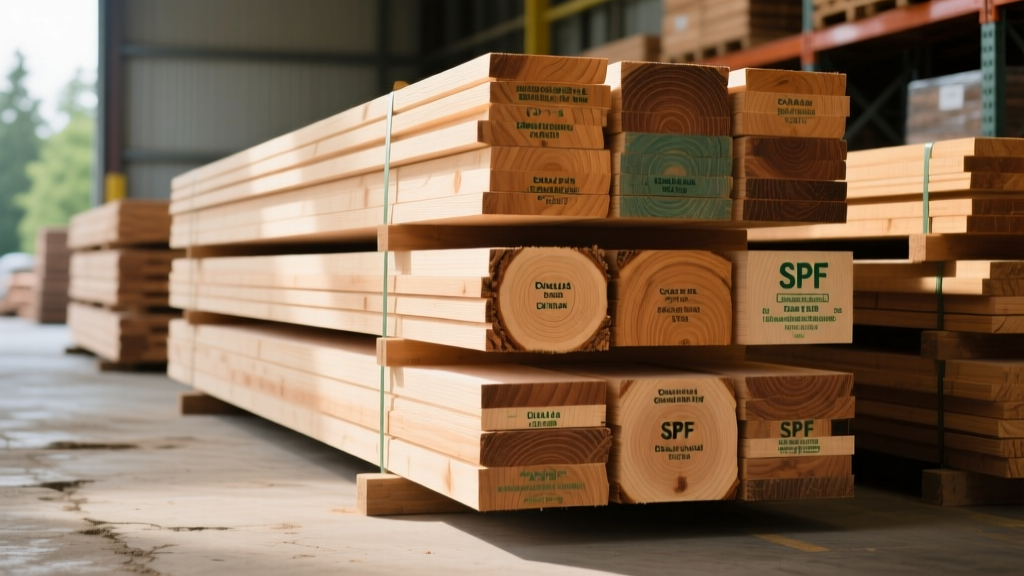
The undisputed workhorse of North American residential construction. SPF is a marketing grouping that includes White Spruce, Lodgepole Pine, and Alpine Fir. It is lightweight, easy to nail, and readily available. A standard No. 2 grade 2x4 SPF offers an Fb of 875 psi and an E of 1,400,000 psi. It is best suited for standard interior wall framing and floor joists where spans do not exceed standard code limits. Expect to pay between $3.85 and $4.20 per 2x4x8 board.
Douglas Fir-Larch (DF-L)
When architectural plans call for long-span rafters, exposed structural beams, or heavy roof loads, DF-L is the premier choice. It possesses exceptional dimensional stability and high shear strength. Select Structural grade DF-L achieves an Fb of 1,500 psi and an E of 1,900,000 psi. Because it holds fasteners exceptionally well and resists warping under heavy loads, it is the preferred species for post-and-beam construction. Pricing typically ranges from $5.50 to $7.00 per 2x4x8, scaling up significantly for large-dimension timbers.
Southern Yellow Pine (SYP)
Grown primarily in the US South, SYP is the densest of the standard framing softwoods. Its high density translates to superior fastener-holding capacity, making it the mandatory choice for engineered wood connectors, hurricane ties, and heavy shear walls. No. 2 grade SYP delivers an Fb of 1,100 psi and an E of 1,600,000 psi. It is also the primary species used for pressure-treated lumber due to its cellular structure, which readily absorbs preservative chemicals. Standard framing SYP costs roughly $4.10 to $4.60 per 2x4x8.
| Species Group | Grade | Fb (psi) | E (psi) | Est. Cost (2x4x8) |
|---|---|---|---|---|
| SPF | No. 2 | 875 | 1,400,000 | $3.85 - $4.20 |
| Southern Yellow Pine | No. 2 | 1,100 | 1,600,000 | $4.10 - $4.60 |
| Douglas Fir-Larch | No. 2 | 900 | 1,600,000 | $5.50 - $7.00 |
Always verify local span requirements. For exact load calculations, consult the American Wood Council span tables before finalizing framing plans.
Exterior, Decking, and High-Moisture Wood Types
Wood exposed to the elements requires either natural biological defenses against decay or chemical alteration. The Janka hardness test and natural extractive content are the primary metrics for evaluating exterior species.
Western Red Cedar
Valued for its natural decay resistance, Western Red Cedar contains thujaplicins—organic compounds that act as natural fungicides. With a Janka hardness of 350 lbf, it is relatively soft and prone to denting, making it better suited for siding, fencing, and low-traffic decking rather than heavy-load structural members. It exhibits exceptional dimensional stability, shrinking and swelling less than most softwoods when exposed to moisture cycles. Untreated, it weathers to a silvery gray; sealed, it retains its warm amber tone. Material costs average $6.50 to $8.50 per linear foot for 5/4x6 decking boards.
Pressure-Treated Southern Yellow Pine
For ground-contact applications like deck posts, retaining walls, and sill plates, pressure-treated SYP is mandatory. Modern treatments utilize Micronized Copper Azole (MCA) or Alkaline Copper Quaternary (ACQ). When purchasing, strictly differentiate between 'Above Ground' (UC3B) and 'Ground Contact' (UC4A) retention levels. Ground contact lumber contains higher chemical concentrations (typically 0.60 pcf for CA-C) to resist subterranean fungal attack. Always use hot-dipped galvanized or stainless steel fasteners with treated wood, as the copper preservatives will rapidly corrode standard zinc-plated hardware.
Ipe (Brazilian Walnut)
For luxury decking where extreme hardness and longevity are required, Ipe (Tabebuia serratifolia) is the industry benchmark. It boasts a staggering Janka hardness of 3,684 lbf and Class A fire rating. Its dense cellular structure makes it virtually impervious to rot and insect damage, with a documented exterior lifespan exceeding 40 years without chemical treatment. However, its density requires pre-drilling for all fasteners and specialized carbide-tipped saw blades. Expect to pay $14.00 to $18.00 per linear foot. Due to historical overharvesting, always demand Chain of Custody documentation to ensure your Ipe is legally and sustainably sourced.
Interior Finish and Flooring Species
Interior finish woods are selected for grain pattern, stain absorption, and abrasion resistance. Moisture content at the time of installation is critical; interior hardwoods should be acclimated to an equilibrium moisture content (EMC) of 6% to 9% before installation to prevent seasonal gapping or cupping.
White Oak (Quercus alba)
White Oak has surged in popularity for both flooring and interior millwork. Unlike Red Oak, which has open, porous end-grain, White Oak features tyloses—membranous growths that plug the xylem vessels, making the wood highly water-resistant. This cellular structure is why White Oak is used for whiskey barrels and boat building. With a Janka rating of 1,360 lbf, it withstands heavy foot traffic while taking modern penetrating oils and reactive stains beautifully. Quarter-sawn White Oak commands a premium ($9 to $14 per square foot) due to its striking ray fleck pattern and superior dimensional stability compared to plain-sawn boards.
Hard Maple (Acer saccharum)
Hard Maple is the standard for high-abuse environments, including gymnasium floors, bowling alleys, and heavy-use kitchen cabinetry. It rates 1,450 lbf on the Janka scale. Its tight, closed grain makes it highly resistant to dirt infiltration and easy to clean, but its density and interlocking grain can cause tear-out during routing or planing if tooling is not kept razor-sharp. It takes light, natural finishes exceptionally well but can blotch with dark penetrating stains; a pre-stain wood conditioner or gel stain is mandatory for dark color applications.
Reading the Lumber Grade Stamp
Every piece of structural lumber bears an ink stamp that serves as its structural passport. Misinterpreting this stamp is a common cause of framing failures and inspection rejections. A standard stamp includes:
- Species: e.g., S-DRY, DF-L, SYP.
- Grade: e.g., SELECT STRUC, NO 1, NO 2, STUD.
- Mill Identification: A number or name identifying the manufacturer.
- Certification Agency: e.g., SPIB (Southern Pine Inspection Bureau), WWPA (Western Wood Products Association).
- Moisture Content: This is the most frequently overlooked metric.
Expert Insight on Moisture Stamps: 'S-GRN' (Surfaced Green) indicates a moisture content above 19% at the time of planing. This lumber will shrink significantly as it dries in the wall cavity, leading to drywall cracks, nail pops, and floor squeaks. Always specify 'S-DRY' (max 19% moisture, typically 15% at surfacing) or 'MC-15' (max 15% moisture) for interior framing to minimize post-construction callbacks.
Sourcing and Sustainability Certifications
Specifying sustainably harvested wood is no longer optional for commercial builds and high-end residential projects; it is often a prerequisite for LEED certification and municipal green building codes. The two primary certification bodies in North America are the Forest Stewardship Council (FSC) and the Sustainable Forestry Initiative (SFI).
FSC certification, governed by the Forest Stewardship Council, is widely considered the most rigorous global standard, requiring strict adherence to indigenous rights, old-growth forest protection, and biodiversity maintenance. When sourcing exotic hardwoods like Ipe, Cumaru, or Mahogany, FSC Chain of Custody certification is the only reliable safeguard against illegal logging. For domestic softwoods like SPF and Douglas Fir, SFI certification is highly prevalent and satisfies most regional green building mandates. Always request the supplier's FSC or SFI certificate number and verify it via the respective organization's online database before finalizing large-scale material procurement.
For advanced mechanical properties, decay resistance data, and detailed engineering values across all North American species, builders should regularly consult the USDA Forest Products Laboratory publications, specifically the Wood Handbook, which remains the definitive scientific reference for wood material science.
Written by
Priya KapoorPriya Kapoor is a real estate market analyst and construction economics researcher with expertise in housing affordability, development feasibility, and infrastructure investment. She holds a Master of Regional Planning from Cornell University and previously worked as a senior analyst at CBRE's Investment Properties group, where she modeled returns for $4B in mixed-use development pipelines. Priya now runs an independent research practice advising developers, municipalities, and REITs on construction cost forecasting and market timing. She publishes the quarterly "BuildMat Market Pulse" report tracking material price indices across 12 commodity categories. Based in Austin, TX, Priya serves on the board of Habitat for Humanity Austin and is a marathon runner.
More from Priya Kapoor
View all
Construction Cost
Cost to Build a 1600 Sq Ft Home in 2026: Full Breakdown
Accurate 2026 cost to build a 1600 sq ft home—material, labor, and regional pricing breakdowns included. Plan your budget with real-time estimates.
Aug 11, 2026

Wood & Lumber
Name the Types of Wood for Pressure Treatment and Preservation
Learn how to name the types of wood best suited for pressure treatment. Compare species treatability, chemical retention levels, and 2026 preservation costs.
Aug 4, 2026

Stone & Masonry
Stone Veneer Suppliers Lindenhurst: 2026 Cost Analysis
Analyze 2026 stone veneer costs in Lindenhurst, NY. Compare local supplier pricing, delivery fees, and Suffolk County installation labor rates.
Aug 4, 2026