How to Treat and Preserve Different Types of Dark Brown Wood
Learn how to treat and preserve different types of dark brown wood. Expert guide on UV protection, finish compatibility, and oily wood sealing protocols.

The Chemistry of Dark Extractives and Finish Incompatibility
Dark brown woods offer unmatched aesthetic depth, but their unique cellular structures and chemical extractives make them notoriously difficult to treat and preserve. The compounds responsible for their rich coloration—such as tannins in walnut, quinones in rosewood, and dense resins in wenge—actively interfere with standard wood finishes. Misapplying a standard alkyd polyurethane to an oily tropical hardwood or exposing untreated black walnut to direct sunlight results in catastrophic finish failure, peeling, and irreversible color loss.
Preserving these materials requires moving beyond generic hardware-store sealers. According to the USDA Forest Products Laboratory, the presence of natural oils and antioxidants in dark tropical species can retard the oxidative curing process of oil-based varnishes, leaving surfaces tacky for weeks. Successful preservation demands species-specific chemical preparation and targeted UV-inhibiting topcoats.
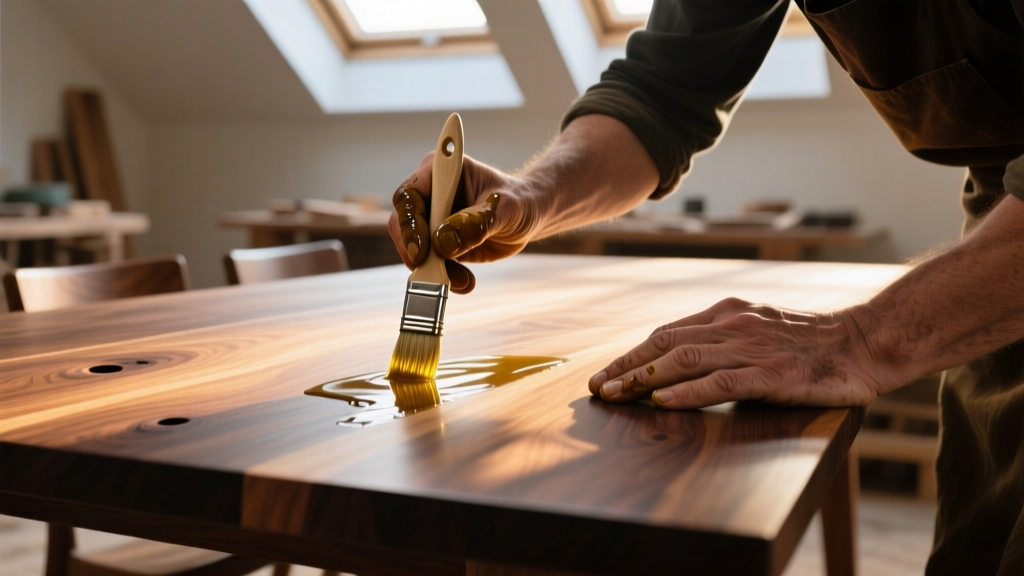
Species-Specific Preservation Matrix
Not all dark brown woods share the same preservation vulnerabilities. The matrix below outlines the mechanical and chemical properties of popular dark species and their required treatment protocols.
| Wood Species | Janka Hardness | Chemical Profile | Primary Preservation Threat | Recommended Finish System |
|---|---|---|---|---|
| Black Walnut | 1,010 lbf | Moderate Tannins, Juglone | UV Color Shift (Fading to Honey) | UV-inhibiting Hardwax Oil (e.g., Rubio Monocoat) or HALS Varnish |
| Honduran Mahogany | 900 lbf | Low Resins, Interlocking Grain | Moisture Intrusion, Tear-out | Penetrating Epoxy Sealer + Marine Spar Varnish |
| Wenge | 1,930 lbf | Low Oil, Extreme Porosity | Splintering, Pore Sinkage, Trapped Moisture | Solvent-based Grain Filler + 2K Polyurethane |
| East Indian Rosewood | 2,440 lbf | High Natural Oils, Resins | Curing Inhibition, Finish Delamination | Solvent Wipe + Dewaxed Shellac Barrier + Lacquer |
Step-by-Step Protocol: Sealing High-Oil Dark Woods
Species like Rosewood, Cocobolo, and African Blackwood contain high levels of natural oils that act as plasticizers, preventing polyurethanes and epoxies from cross-linking. If you apply a standard film finish directly to these woods, it will peel off in sheets within months. Follow this strict chemical preparation protocol to ensure adhesion.
Step 1: The Solvent Wipe
Do not use mineral spirits; it is too mild and will simply smear the oils across the surface. Use VM&P Naphtha or pure acetone. Wipe the raw wood down with lint-free shop towels soaked in the solvent. Change towels frequently. Allow 30 minutes for the solvent to flash off completely.
Step 2: The Barrier Coat
Apply a 1-pound cut of dewaxed shellac. Zinsser SealCoat is the industry standard for this application (approx. $28 per quart). Shellac is unique because it cures via solvent evaporation rather than oxidation, meaning the natural wood oils cannot inhibit its drying. Apply one thin coat with a natural bristle brush or a French polish pad.
Step 3: The Topcoat
Once the shellac barrier is dry (typically 45 minutes), you can safely apply your desired topcoat, such as a pre-catalyzed lacquer or a waterborne polyurethane like General Finishes High Performance. The shellac acts as a universal tie-coat, bridging the oily substrate and the modern film finish.
Combating the "Walnut Fade": UV Preservation Strategies
Black walnut is highly photosensitive. When exposed to ultraviolet light, the juglone and tannins in the wood undergo photo-oxidation, shifting the wood's color from a deep, rich chocolate brown to a pale, translucent honey-orange. Once this chemical shift occurs, it cannot be reversed without aggressive sanding.
Many woodworkers assume that applying a clear oil will permanently preserve walnut's dark color because the wood looks dark and rich while wet. Standard tung or linseed oils offer zero UV protection. Once the oil cures and the UV exposure begins, the walnut will still fade beneath the oil film.
To preserve the dark brown hue of walnut, you must use finishes formulated with Hindered Amine Light Stabilizers (HALS) and UV absorbers. For interior architectural millwork and furniture, Rubio Monocoat Oil Plus 2C (approx. $135 per liter) provides excellent color retention while maintaining a matte, natural feel. For exterior applications or sun-drenched interiors, a marine-grade varnish like Epifanes WoodFinish Matte (approx. $45 per quart) contains robust UV filters that physically block the radiation responsible for tannin degradation.
Troubleshooting Common Preservation Failures
When treating dense, dark brown timbers, environmental factors and improper material selection lead to specific failure modes. Use this diagnostic guide to identify and correct issues in the field.
Failure: White Haze in Wenge Pores
- Cause: Wenge features massive, open pores. If a fast-drying lacquer or waterborne finish is applied, the surface skins over while solvents remain trapped in the deep pores. As the trapped solvents eventually try to escape, they create a micro-fracture in the finish, appearing as a white haze.
- Fix: Never apply film finishes directly to raw wenge. First, fill the pores using a dark-tinted, solvent-based grain filler like Timber Mate or Aqua Coat (tinted with TransTint dyes). Sand back to bare wood, leaving filler only in the pores, before applying your topcoat.
Failure: Blotchy, Uneven Stain Absorption on Mahogany
- Cause: Honduran mahogany has an interlocking grain structure. When machined, some areas expose end-grain-like porosity while others are dense quarter-sawn surfaces. Applying a pigmented dark stain directly results in severe blotching.
- Fix: Avoid pigmented stains entirely. Mahogany's natural dark brown color should be enhanced, not masked. Use a clear penetrating epoxy sealer (like CPES from Smith & Co.) diluted 1:1 with acetone to stabilize the varying densities, followed by a clear dye stain if a darker tone is strictly required.
Long-Term Maintenance and Re-treatment Schedules
Preservation is not a one-time event. The maintenance schedule for dark brown woods depends entirely on the finish chemistry used during the initial treatment.
| Finish Type | Maintenance Interval | Re-treatment Protocol | Best For |
|---|---|---|---|
| Hardwax Oils (e.g., Osmo, Rubio) | 12 - 24 Months | Clean with pH-neutral soap, apply maintenance oil, buff. No sanding required. | Interior walnut floors, dining tables, high-use cabinetry. |
| Marine Spar Varnish (e.g., Epifanes) | 2 - 3 Years (Exterior) | Light scuff sand with 320-grit, wipe with tack cloth, apply 2 fresh coats. | Exterior mahogany doors, marine brightwork, sunroom trim. |
| 2K Polyurethane | 7 - 10+ Years | Complete strip and respray required if compromised. Cannot be spot-repaired. | Commercial wenge flooring, high-traffic dark wood stair treads. |
For comprehensive data on wood movement and moisture management in dense tropical species, refer to the Building and Construction Technology program at UMass Amherst. Understanding the equilibrium moisture content (EMC) of your specific dark wood species is critical; applying a rigid 2K polyurethane to mahogany that has not fully acclimated to the interior environment will result in cross-grain cracking as the wood inevitably expands and contracts with seasonal humidity shifts.
Written by
Marcus ChenMarcus Chen is a licensed structural engineer (PE) and building materials analyst with over 12 years of experience across residential, commercial, and industrial construction. He holds a Master of Science in Civil Engineering from UC Berkeley and spent six years at Thornton Tomasetti before transitioning to independent consulting and technical writing. Marcus specializes in material selection for seismic-prone regions, concrete reinforcement strategies, and lifecycle cost analysis. His work has been cited by the American Concrete Institute (ACI) and the Structural Engineers Association of California (SEAOC). When he is not on a job site or at his desk, you will find him hiking the Sierra Nevada or restoring a 1920s craftsman bungalow in Oakland, CA.
More from Marcus Chen
View all
Construction Cost
How Much Did the Eiffel Tower Cost to Build?
How much did the Eiffel Tower cost to build in 1889? We adjust for inflation and compare its budget to modern skyscraper construction.
Aug 4, 2026

Fire Resistance
What Is a Fire Resistant Material? Testing & Certification Guide
Discover what is a fire resistant material through ASTM and UL testing. Learn how fire ratings, certifications, and assemblies work in construction.
Aug 4, 2026

Construction Cost
How Much Did the Burj Khalifa Cost to Build?
How much did the Burj Khalifa cost to build? We break down the $1.5B project and extract 5 money-saving strategies for your next build.
Jul 30, 2026